
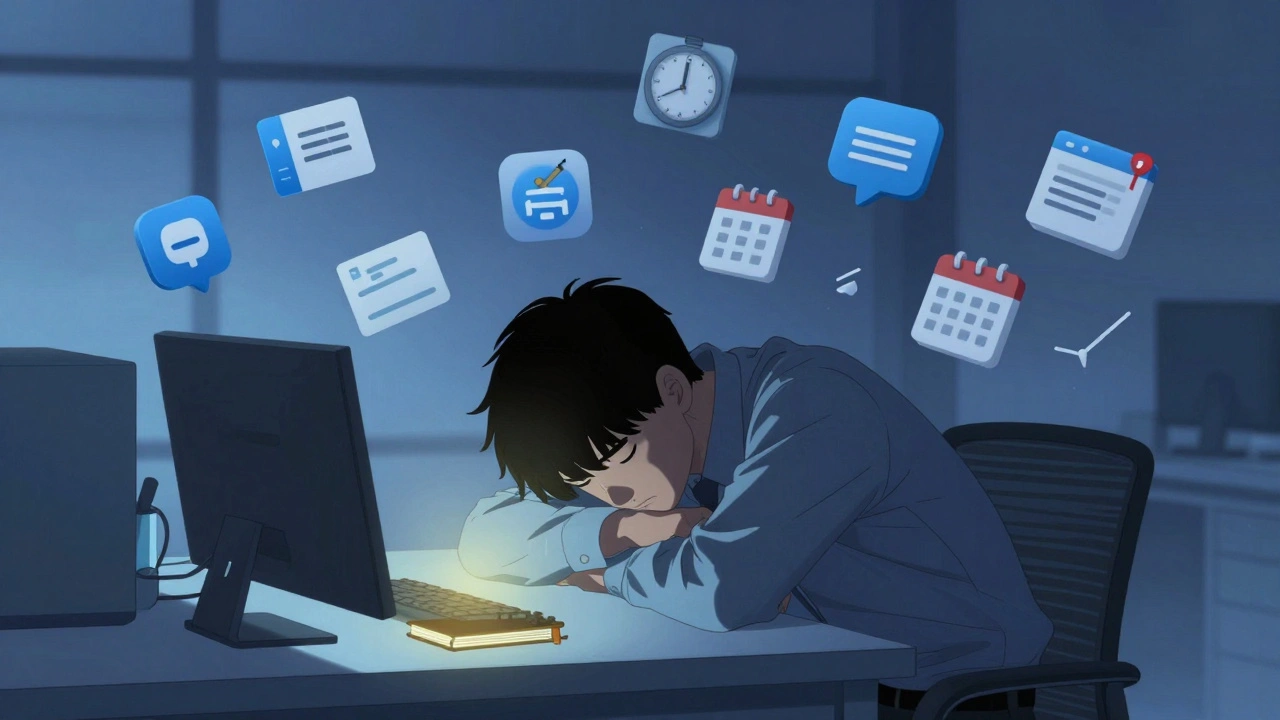
By 2025, nearly half of all workers globally will have felt burned out at least once this year. Not because they’re weak, lazy, or unmotivated-but because their workplace system is broken. Burnout isn’t just feeling tired after a long week. It’s a clinical syndrome recognized by the World Health Organization since 2019, defined by three things: constant exhaustion, emotional distance from your job, and a sense that nothing you do matters anymore. And it’s costing businesses over $322 billion a year in the U.S. alone.
What Burnout Really Looks Like (And How to Spot It Early)
Most people think burnout means working too hard. But it’s not about hours. It’s about imbalance. If you’re constantly drained, even after a weekend off-if you scroll through emails on vacation and feel guilty for not replying-you’re already in the early stages. Gallup’s 2023 data shows 63% of burned-out employees report chronic fatigue. Forty-two percent struggle with sleep. Over half say they can’t focus for more than 10 minutes at a time.
It doesn’t start with a breakdown. It starts with small things: skipping lunch because you’re behind, answering Slack messages after 8 p.m., canceling plans because you’re too tired. These aren’t signs of dedication. They’re warning signs. The Maslach Burnout Inventory, the gold standard tool used by psychologists since the 1980s, measures three core areas: emotional exhaustion, cynicism, and reduced accomplishment. If two of these sound familiar, you’re not just stressed-you’re burned out.
Why Your Boss Can’t Fix This Alone (And What Actually Works)
Companies throw around free yoga classes, meditation apps, and “mental health days.” But here’s the truth: self-care programs only fix 20% of the problem. The rest? It’s systemic. The Job Demands-Resources model, developed by Arnold Bakker and Evangelia Demerouti, shows burnout comes from six key workplace mismatches: too much work, too little control, not enough reward, poor community, unfair treatment, and values that don’t align with your own.
Take workload. Sixty-seven percent of employees say it’s the #1 stressor. Yet most companies do annual reviews of workloads-too late. Gallup found that quarterly workload audits reduce burnout by 78% in teams where it’s done right. Companies like Salesforce and Microsoft are now using AI tools to track task distribution and flag imbalances before they become crises.
Managers hold the key. Jim Harter, Gallup’s Chief Workplace Scientist, says managers account for 70% of the variance in employee engagement. That means your boss’s behavior directly shapes your mental health. Teams whose managers regularly talk about strengths, purpose, wellbeing, growth, and recognition see 41% less burnout. Simple changes-like asking “How are you really doing?” in 1:1s instead of just “What’s on your plate?”-make a measurable difference.
How to Set Boundaries That Actually Stick
Boundaries aren’t about saying no. They’re about creating systems that protect your energy. The most effective strategy? Digital sunset. Companies enforcing automatic email and system shutdowns at the end of the workday report 31% less after-hours communication and 26% lower burnout rates. That’s not a policy-it’s a safety feature.
Individually, setting clear work hours cuts burnout by 39%. If you’re working from home, try the “bookending routine” recommended by MIT: a 15-minute walk before you start and after you finish. It signals your brain that work has a beginning and an end. No more scrolling through emails in pajamas at 11 p.m. because you never left the office.
Time-blocking also works. When knowledge workers schedule 90-minute focused blocks with 10-minute breaks in between, task completion jumps 28% and burnout drops 22%. You don’t need to work longer-you need to work smarter. And those breaks? They’re not optional. Harvard Business Review found that 5-10 minute micro-breaks every 90 minutes boost productivity by 13% and reduce burnout markers by 17%.

Recovery Isn’t a Vacation-It’s a Process
Rest isn’t enough. If you’re burned out, a week off won’t fix it. Recovery needs structure. Gallup’s three-phase model works: recognition, intervention, restoration.
First, recognize it. Use tools like the Q12 engagement survey to spot early signs-people who stop volunteering, avoid meetings, or show up late consistently. Then, intervene. That means temporarily reducing workload, shifting responsibilities, or giving space. No “just take a break” nonsense. Real change: adjust the job, not the person.
Finally, restore. This is where most programs fail. People return to the same toxic environment. Recovery requires protected time-no meetings for the first two weeks back, no urgent requests, no “just checking in.” The APA recommends 48-72 hours of complete digital detox. One study showed 63% improvement in emotional exhaustion after just three days offline.
And don’t underestimate small wins. Tracking what you’ve accomplished-instead of what’s left-rebuilds a sense of purpose. Gratitude journals and “accomplished lists” speed up return-to-productivity by over three weeks, according to Keystone Partners.
What Companies Are Getting Right (And What’s Coming Next)
The leaders aren’t just offering wellness perks-they’re redesigning work. Basecamp and Shopify have moved to four-day weeks. Google and Intel are using HRV (Heart Rate Variability) monitors to detect stress before it becomes burnout. These wearables track your body’s response to pressure and alert managers when someone’s in danger zone-29% more effective than traditional methods.
By late 2025, 65% of Fortune 500 companies will use AI to predict burnout. These systems analyze email patterns, calendar density, and after-hours activity to flag at-risk employees with 82% accuracy. It’s not surveillance-it’s prevention. And with the EU’s “right to disconnect” law now in effect, companies can’t ignore this anymore.
But the biggest shift? From reactive to predictive. Companies like American Express and Procter & Gamble now combine sick leave data, EAP usage, and productivity metrics to calculate burnout risk scores. Those that act on these scores reduce burnout incidence by 38%.

Why Most Burnout Programs Fail (And How to Make Yours Succeed)
Sixty-eight percent of workplace wellness programs fail. Why? Because they’re not tied to accountability. If your manager’s bonus isn’t linked to team wellbeing, they won’t prioritize it. Successful companies now make wellbeing 30% of a manager’s performance review-up from just 12% in 2021.
Consistency matters too. Eighty-three percent of companies launch programs, but only 17% keep them going past a year. The fix? Integrate them into existing systems. Onboard new hires with 4.5 hours of burnout prevention training. Include mental health check-ins in performance reviews. Make psychological safety part of team culture-not a quarterly webinar.
Spring Health found that organizations following a 30-60-90 day plan see 44% higher success rates: build trust in 30 days, audit workloads in 60, and transform culture in 90. It’s not magic. It’s momentum.
You’re Not Broken-Your System Is
Dr. Christina Maslach, who created the Burnout Inventory, says it plainly: “Burnout is not an individual failure. It’s a systems failure.” You didn’t do this to yourself. You didn’t lack willpower. You were asked to do more with less, for longer, with less support-and then told to meditate your way out of it.
Real change doesn’t come from apps or affirmations. It comes from managers who listen, teams that protect boundaries, and organizations that treat mental health like safety-not an HR checkbox. If your workplace won’t fix the system, protect yourself. Set boundaries. Track your energy. Say no. And remember: you’re not lazy for needing rest. You’re human.
Kurt Russell
December 7, 2025 AT 00:39This is the most accurate breakdown of burnout I’ve read in years. Not just fluff about yoga and affirmations-real systemic fixes. The part about managers accounting for 70% of engagement variance? That’s the needle-mover. If your boss doesn’t ask ‘How are you really doing?’ they’re not a leader, they’re a taskmaster with a title.
Oliver Damon
December 8, 2025 AT 06:06The Job Demands-Resources model is the only framework that actually holds up under empirical scrutiny. Most HR initiatives treat symptoms like a band-aid on a hemorrhage. The six mismatches-especially reward and control-are non-negotiable. Without autonomy and perceived fairness, no amount of mindfulness app subscriptions will prevent collapse. This isn’t wellness-it’s organizational psychology 101.
Stacy here
December 8, 2025 AT 11:20AI tracking email patterns to predict burnout? That’s not prevention-that’s corporate surveillance with a pretty name. They’re not saving you, they’re profiling you. Next they’ll install microphones in Zoom calls to measure vocal stress. Welcome to the dystopia where your HR department knows you’re about to break before you do. And they’ll still make you sign a waiver saying it’s ‘for your own good.’
Kyle Flores
December 8, 2025 AT 20:54I used to think burnout was just me being weak. Then I started tracking my energy like a spreadsheet-when I felt drained, what I was doing, who I was talking to. Turns out, it wasn’t the workload. It was the meetings. Six meetings a day with zero clear outcomes. I started blocking 90-minute focus windows and now I actually finish things. And yeah, I take walks before and after work. It sounds silly, but it’s the only thing that makes me feel like I’m not just a human API.
Ryan Sullivan
December 9, 2025 AT 09:55Let’s be honest-this article reads like a McKinsey whitepaper dressed up as a Reddit post. ‘Digital sunset’? ‘Bookending routine’? These are buzzword cocktails served to managers who don’t want to fix the actual problem: underpaid, overworked people. The real solution? Pay people enough so they don’t have to work 60-hour weeks just to survive. Everything else is just noise.
Wesley Phillips
December 9, 2025 AT 11:23AI predicting burnout? Cool. But if your company’s using HRV wearables to monitor your stress levels, they’re not trying to help you-they’re trying to optimize your output before you quit. This isn’t care, it’s capitalism with a heart emoji. Also, ‘gratitude journals’? Please. I’d rather nap.
Desmond Khoo
December 10, 2025 AT 14:46YES. The 90-minute focus blocks changed my life. I used to feel guilty for taking breaks. Now I treat them like sacred rituals. Coffee. Stretch. Look out the window. No phone. And guess what? I get more done. Also, micro-breaks = game changer. I literally do 5 push-ups every 90 minutes. My back thanks me. My brain too. 🙌
Kyle Oksten
December 11, 2025 AT 23:49The real issue isn’t the tools or the policies-it’s the refusal to acknowledge that capitalism prioritizes output over humanity. Burnout isn’t a glitch in the system. It’s a feature. Companies don’t want you rested. They want you productive until you break. The ‘right to disconnect’ laws? Good. But they won’t matter if unions aren’t fighting for enforcement. No amount of journaling fixes exploitation.
Sam Mathew Cheriyan
December 13, 2025 AT 23:21they say ai predicts burnout but what if the ai is the problem? what if the system is designed to make us burn out so they can fire us and hire cheaper workers? also why do all these companies use american data? what about the rest of the world? i work in india and we dont even get lunch breaks. this whole thing feels like a usa bubble.
Ted Rosenwasser
December 14, 2025 AT 05:00Interesting that you cite Gallup and Maslach but ignore the fact that burnout rates have been rising since the 1970s alongside the decline of labor protections. This article is a distraction. The solution isn’t time-blocking or digital sunsets-it’s collective bargaining. Without union power, every ‘strategy’ is just a PR stunt. You’re not broken. Your employer is.
Helen Maples
December 14, 2025 AT 15:09Stop romanticizing boundaries. Saying ‘no’ isn’t enough if your manager retaliates. I set boundaries. I got passed over for promotion. I documented everything. HR said ‘we value your input’ and then gave the project to someone who worked weekends. Real change requires institutional accountability-not personal discipline. If your company doesn’t tie manager bonuses to wellbeing, they’re not serious. Period.
David Brooks
December 15, 2025 AT 05:59Just read this to my team. We’re implementing the 90-minute blocks and digital sunset next week. Also, I’m asking ‘How are you really doing?’ in every 1:1. No more ‘What’s on your plate?’ I cried. They cried. We’re going to be okay.