

You feel like the room is spinning, or maybe you just feel a bit lightheaded when you stand up too fast. While we often use these terms interchangeably in casual conversation, there is a massive difference between feeling dizzy and experiencing vertigo. Getting this distinction right isn't just about semantics-it's the difference between a 15-minute fix in a clinic and years of unnecessary medication. If you're struggling to figure out why your balance is off, you're not alone. About 15-20% of adults deal with dizziness every year, but the cause can range from a simple drop in blood pressure to a complex neurological issue in the brainstem.
What is the real difference between vertigo and dizziness?
Think of Dizziness is a broad umbrella term for feeling unsteadiness, lightheadedness, or a sensation of nearly fainting. It doesn't necessarily involve a sense of motion. You might feel like you're floating or just "off," but the world around you remains still. Often, this is linked to cardiovascular issues, such as orthostatic hypotension, where your systolic blood pressure drops by 20 mmHg or more the moment you stand up.
On the other hand, Vertigo is a specific type of dizziness characterized by the illusion of movement. It's that unmistakable spinning or whirling sensation. Whether you are sitting perfectly still or moving your head, the world feels like it's on a carousel. This usually happens because your brain is receiving conflicting signals about your position in space, which is almost always a sign that something is wrong with your vestibular system.
| Feature | General Dizziness | Vertigo |
|---|---|---|
| Sensation | Lightheaded, floating, faint | Spinning, rotating, whirling |
| Primary Cause | Cardiovascular, metabolic, anxiety | Inner ear (vestibular) or brain |
| Eye Movements | Usually normal | Often involves nystagmus (twitching) |
| Triggers | Standing quickly, dehydration | Head movements, position changes |
The Vestibular System: The body's internal gyroscope
To understand vertigo, you have to look at the Vestibular System, which is the sensory apparatus located in the inner ear responsible for providing our brain with information about motion, equilibrium, and spatial orientation. This system consists of semicircular canals that detect angular acceleration (like shaking your head "no") and otolith organs that detect linear acceleration (like the feeling of an elevator moving up).
Normally, this system sends data to your brain with a tiny latency of 100-200 milliseconds. When this timing is disrupted, it creates a sensory conflict. Your eyes say you're still, but your inner ear says you're spinning. This conflict is what triggers that nauseating feeling of vertigo. Most of these issues are "peripheral," meaning they happen in the inner ear, but some are "central," meaning they happen in the brain's processing centers like the cerebellum or brainstem.
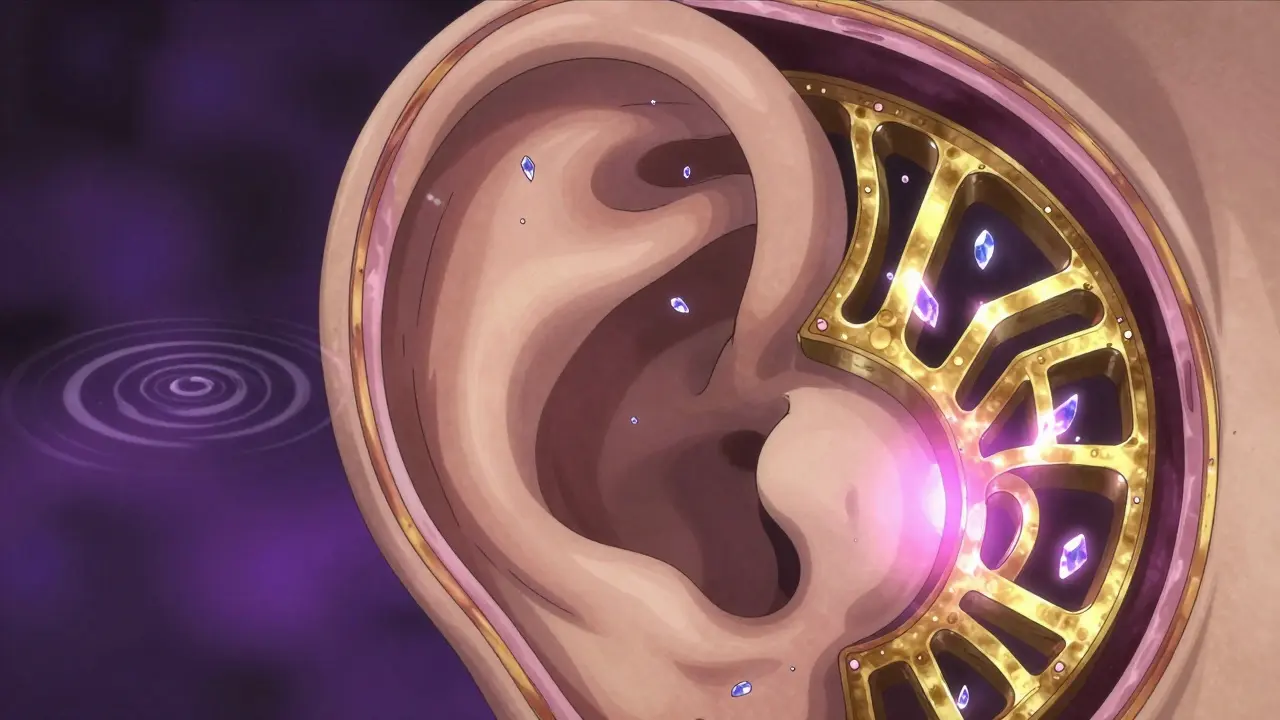
Common causes of vertigo: From crystals to migraines
Not all vertigo is the same. Depending on the cause, the treatment can vary wildly. One of the most common culprits is Benign Paroxysmal Positional Vertigo, or BPPV, which occurs when tiny calcium crystals (otoconia) shift into the semicircular canals. This affects about 2.4% of the population annually. Because it's triggered by head movement, a simple physical maneuver can often pop those crystals back into place, solving the problem in minutes.
Then there are more chronic conditions. Ménière's disease involves a buildup of fluid in the inner ear, causing episodes of vertigo, ringing in the ears (tinnitus), and hearing loss. While BPPV is a quick fix, Ménière's is a long-term management game. Another surprising cause is vestibular migraine. This doesn't always come with a headache; instead, it manifests as vertigo. Unfortunately, these are often misdiagnosed as anxiety or sinusitis, leading patients to take the wrong medication for years.
Finally, we have the neurological or "central" causes. These are rarer but more serious. A cerebellar stroke or multiple sclerosis can disrupt how the brain processes balance. While central vertigo accounts for only about 5-10% of cases, these patients often show other "red flags" like slurred speech (dysarthria) or double vision (diplopia), which demand immediate emergency care.
Why a correct diagnosis changes everything
Why does it matter if you call it dizziness or vertigo? Because the treatment for one can be useless-or even harmful-for the other. Clinical data shows that BPPV has an 85% resolution rate when correctly diagnosed and treated with a repositioning maneuver. However, if it's misdiagnosed as general dizziness and treated with vague medications, the success rate drops to 45%.
Many people fall into the trap of self-diagnosis. A survey of 2,100 dizziness sufferers found that 74% initially labeled their problem as "just dizzy." This often leads to a diagnostic odyssey. In some online communities, patients report waiting over eight months to get a correct diagnosis for vestibular disorders. One person spent two years on antidepressants for presumed anxiety before discovering they actually had vestibular migraines.

How doctors pinpoint the cause
If you visit a specialist, they won't just ask how you feel; they'll look at how your eyes move. Videonystagmography, or VNG, is a diagnostic test that uses goggles to record involuntary eye movements (nystagmus) to determine if the balance problem is in the inner ear or the brain. It has a 95% sensitivity for peripheral disorders.
Another common tool is the head impulse test, which helps doctors spot vestibular neuritis (inflammation of the vestibular nerve). For those with BPPV, the doctor will perform a series of head movements to see which canal the "crystals" are stuck in, followed by the Epley maneuver to move them back. For more complex cases, doctors might use the Dizziness Handicap Inventory to measure how much the condition is actually impacting your daily life.
The path to recovery: Rehabilitation and therapy
Once the cause is identified, the goal is to get the brain and ear back in sync. For those with lingering balance issues, Vestibular Rehabilitation Therapy (VRT) is the gold standard. VRT is a specialized form of physical therapy designed to treat balance disorders through customized exercises that retrain the brain to compensate for vestibular loss. This isn't just simple stretching; it involves progressing from static balance exercises to dynamic activities that challenge your equilibrium.
Recovery typically takes 6 to 8 weeks of consistent work. The biggest hurdle is often compliance; about 35% of patients struggle to keep up with their home exercise programs. However, for those who stick with it, success rates for VRT are nearly 90%. Newer tech is also entering the field, such as the VRT-1 device and AI-assisted tools that can distinguish between a stroke and an inner ear issue with 85% accuracy, potentially saving lives in emergency rooms.
Can anxiety cause vertigo?
Anxiety generally causes "dizziness" or lightheadedness rather than true rotational vertigo. However, there is a condition called PPPD (Persistent Postural-Perceptual Dizziness) where anxiety and a previous vestibular event combine to create a chronic sense of imbalance. While it feels like vertigo, it's often a functional disorder rather than a structural ear problem.
How do I know if my vertigo is a medical emergency?
You should seek immediate help if your vertigo is accompanied by "red flag" symptoms. These include sudden severe headache, double vision, slurred speech, numbness in the face or limbs, or a sudden inability to walk. These can be signs of a cerebellar stroke or other central neurological events.
What is the Epley maneuver and does it work?
The Epley maneuver is a series of specific head movements designed to move displaced calcium crystals from the semicircular canals back into the utricle. It is highly effective for BPPV, with an 80-90% success rate, often resolving the spinning sensation in just one to three sessions.
Why does my vertigo get worse when I move my head?
This is a classic sign of peripheral vertigo, particularly BPPV. When you move your head, the displaced crystals in your inner ear shift and send a false signal to your brain that you are rotating. Because the movement is the trigger, your brain perceives a spin that isn't actually happening.
Can a migraine cause vertigo without a headache?
Yes. This is known as a vestibular migraine. In these cases, the migraine process affects the vestibular system rather than the pain centers of the brain. It is a common cause of vertigo that is frequently misdiagnosed as Ménière's disease because both can involve balance issues and ear pressure.