
Side Effect Timing Calculator
Ever started a new medication and wondered if that headache, muscle ache, or weird dizziness is the drug-or just bad luck? You’re not alone. Many people assume side effects show up right away, but that’s not always true. Some hit within hours. Others creep in weeks or even months later. Knowing when side effects typically appear for different drugs can help you spot them early, avoid unnecessary panic, and talk smarter with your doctor.
Why Timing Matters More Than You Think
It’s not enough to know that a drug can cause dizziness or liver damage. You need to know when it’s likely to happen. That’s where time-to-onset (TTO) patterns come in. These aren’t guesses-they’re backed by data from millions of patient records and controlled studies. If your symptoms show up outside the expected window, your doctor might miss the connection. And if they show up right in the window? That’s a strong clue the drug is the culprit. Take ACE inhibitors, for example. If you develop swelling in your lips or throat after taking lisinopril, your doctor might blame allergies or a cold. But if that swelling hits three months after you started the pill? That’s not rare. It’s a known delayed reaction. Without knowing the timing pattern, you could be misdiagnosed for months.Fast-Acting Side Effects: Hours to Days
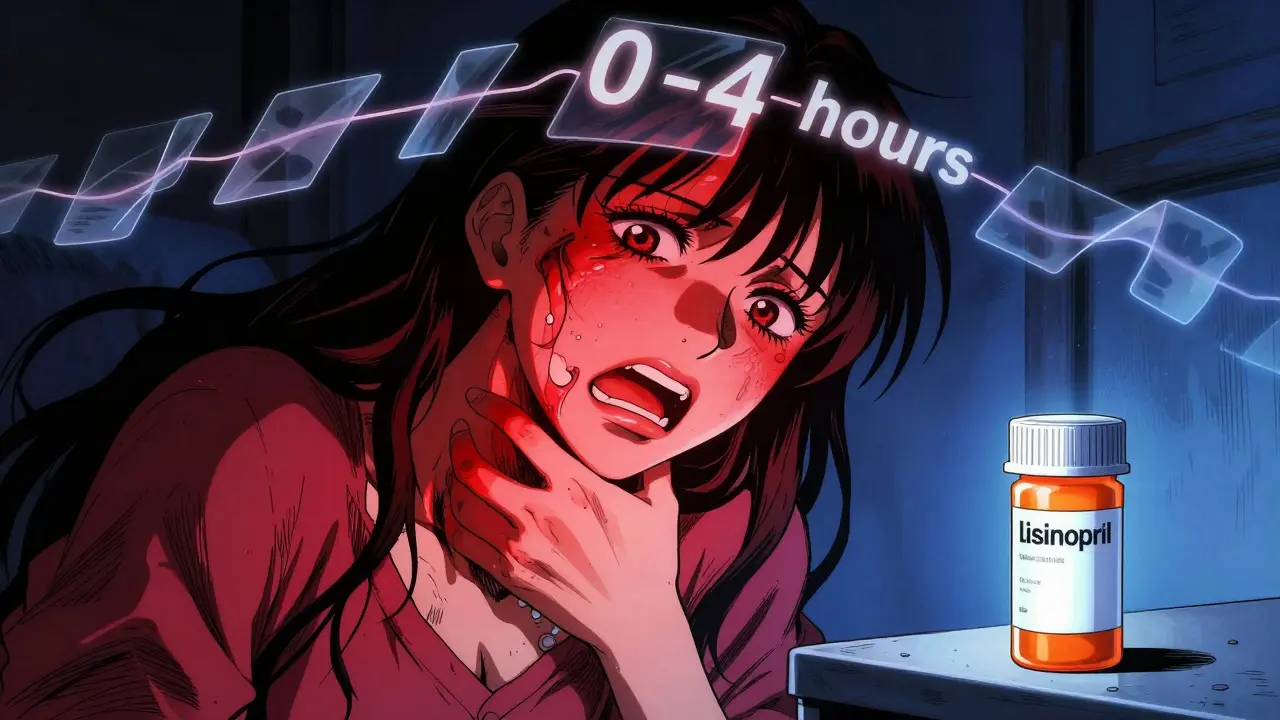
Some reactions are immediate. They happen fast because the drug triggers a direct biological response. These are the ones you notice before you even leave the pharmacy. Angioedema from ACE inhibitors: While some cases show up after months, the histamine-driven kind hits fast-within minutes to hours. Think swelling of the face, tongue, or throat. This is an emergency. If you’ve never had it before, don’t wait. Call 911. Antibiotics like ciprofloxacin: This common fluoroquinolone can cause nerve damage (peripheral neuropathy). Research shows the median time to onset is exactly 2 days. In women, it’s even faster-often within 24 hours. If you start feeling tingling, burning, or weakness in your hands or feet after just a day or two on cipro, don’t assume it’s a pinched nerve. Talk to your doctor immediately. Acetaminophen overdose: Unlike most drugs, this one doesn’t wait. Liver damage can begin within 24 hours. That’s why taking too many Tylenol tablets-even just a few extra-is so dangerous. The body doesn’t have time to recover.Mid-Term Reactions: Days to Weeks
This is where most people get confused. Symptoms appear after a week or two, and they assume the drug isn’t the problem because they’ve been taking it “fine” so far. Statins (atorvastatin, simvastatin): Many patients blame statins for muscle pain. But here’s the twist: a major 2021 study found that when people who thought they were intolerant to statins were given a placebo instead, 55% still felt better within 3 days. That’s the nocebo effect-your brain expecting side effects makes you feel them. But real statin myopathy does happen. It usually shows up between 1 and 4 weeks. If your muscles ache, feel weak, or you’re unusually tired after 10 days on a statin, get your CK levels checked. Pregabalin and gabapentin: These nerve pain drugs often cause dizziness, fatigue, or brain fog. Patient reviews and clinical data agree: over half of users report these symptoms within the first week. The median time to onset is 19 days for pregabalin and 31 days for gabapentin. If you’re starting one and feel off after day 7, it’s probably the drug-not your stress levels.
Delayed Reactions: Weeks to Months
These are the sneaky ones. They’re rare, but they’re real-and they’re often missed. Interferon beta-1a (for multiple sclerosis): This drug can cause peripheral neuropathy too. But unlike ciprofloxacin, it takes months. The median time? Over 526 days-nearly 18 months. If you’ve been on it for a year and suddenly get numb toes, your neurologist might not connect the dots. But they should. The pattern is well-documented. Natalizumab (for MS and Crohn’s): This immune-modulating drug carries a risk of a rare brain infection called PML. Symptoms can start as early as 3 months, but the median time is 141.5 days-about 4.5 months. If you develop trouble walking, blurred vision, or weakness after being on it for 4 months, don’t brush it off as “just getting worse.” Drug-induced hepatitis: Most liver damage from medications like antibiotics or anti-seizure drugs shows up around 6 weeks after starting. The median is 42 days, with a range of 20 to 117 days. If you’ve been on amoxicillin for 5 weeks and now your skin is yellow or your urine is dark, get your liver enzymes checked. It’s not “just a virus.”Sex, Age, and Genetics: Why Timing Varies
Not everyone reacts the same way. Women are more likely to get side effects-and often faster. In the 2025 study on ciprofloxacin, women developed nerve symptoms in 2 days. Men took 4 days. That’s not a small difference. It’s statistically significant. Older adults metabolize drugs slower. That means side effects can build up over time-even if they didn’t happen at first. And genetics play a role. Some people have gene variants that make them slow metabolizers of certain drugs. That can turn a safe dose into a toxic one, shifting the onset window from 2 weeks to 2 days.How Doctors Use This Info
Hospitals and clinics aren’t just reading this data-they’re building it into their systems. Mayo Clinic added TTO alerts to their electronic health records in 2022. Now, if a patient reports dizziness 3 days after starting a new drug, the system flags it as “high probability of drug-related.” That means faster testing, fewer misdiagnoses. The FDA and European Medicines Agency now require drug manufacturers to include time-to-onset data in safety reports. That’s why newer drug labels are starting to say things like: “Peripheral neuropathy may occur within days to weeks of initiation.” That wasn’t common 10 years ago.
What You Should Do
You don’t need to memorize every TTO pattern. But you can use this knowledge to be a smarter patient.- When you start a new drug, ask: “What side effects should I watch for, and when might they show up?”
- Keep a simple log: date you started, symptoms, when they began, and how bad they are.
- If something new pops up after 2 weeks, don’t assume it’s unrelated. Write it down and bring it up at your next visit.
- Don’t stop a drug on your own-especially if you’re on something like blood pressure meds or antidepressants. Talk to your doctor first.
- If you’ve had a side effect before, tell your doctor. Even if it was years ago. Patterns repeat.
When to Worry (and When Not To)
Not every new symptom means the drug is to blame. A cold, stress, lack of sleep, or even a change in your diet can cause similar symptoms. Here’s a quick rule of thumb:- Worry if: The symptom started within the known TTO window for the drug, it’s new, it’s getting worse, and it’s not explained by anything else.
- Probably not the drug if: The symptom started before you took the medication, it’s mild and fading, or it matches a common illness you’re likely to have (like seasonal allergies or a stomach bug).
What’s Next for Side Effect Timing
The future is personal. Researchers are starting to build TTO models that include your genes, your age, your sex, and even your gut microbiome. The NIH’s All of Us program is collecting this data right now, with plans to launch personalized side effect predictions by mid-2025. Wearables are also getting involved. Johnson & Johnson is testing smartwatches that track subtle changes in heart rate and movement to detect early signs of drug reactions-before you even feel them. For now, the best tool you have is awareness. Know that side effects don’t always come fast. And know that timing isn’t just a detail-it’s a clue.How soon after starting a drug do side effects usually appear?
It depends on the drug. Some side effects start within hours-like angioedema from ACE inhibitors. Others take days, like nerve damage from ciprofloxacin (median: 2 days). Many appear over weeks, such as muscle pain from statins (1-4 weeks) or dizziness from gabapentin (up to 31 days). Some, like liver damage or certain nerve issues, can take months-even over a year-to show up. There’s no single answer, but each drug class has a typical window.
Can a side effect appear after I’ve been taking a drug for months?
Yes. Many side effects are delayed. For example, interferon beta-1a can cause nerve damage after nearly 18 months. Natalizumab can trigger a rare brain infection after 4-6 months. ACE inhibitors can cause angioedema up to 6 months after starting. Even if you’ve taken a drug for a year without issues, new side effects can still emerge. That’s why it’s important to report any new symptom to your doctor, no matter how long you’ve been on the medication.
Do women experience side effects faster than men?
Yes, in many cases. Research shows women often develop side effects sooner than men. For example, ciprofloxacin-induced peripheral neuropathy occurs in women at a median of 2 days, compared to 4 days in men. This is likely due to differences in metabolism, body weight, and hormone levels. Women are also more likely to report side effects overall, which helps researchers identify these patterns faster.
Is muscle pain from statins always caused by the drug?
Not always. A major 2021 study found that 55% of people who thought they couldn’t tolerate statins due to muscle pain felt better within 3 days of switching to a placebo. This is called the nocebo effect-expecting side effects makes you feel them. But real statin-related muscle damage does happen, usually between 1 and 4 weeks. The key is to get tested: if your muscle enzyme (CK) levels are high, it’s likely the drug. If they’re normal, it may be psychological or another cause.
How can I tell if a new symptom is from my medication or something else?
Ask yourself three things: Did the symptom start after I began the new drug? Is it something I’ve never had before? Does it match the known timing pattern for that drug? If yes to all three, it’s likely related. But don’t assume-talk to your doctor. They can check for other causes, like infections or thyroid issues, and may order blood tests to confirm. Never stop a medication without medical advice.
Are there tools that help doctors spot drug side effects faster?
Yes. Hospitals like Mayo Clinic have added time-to-onset algorithms to their electronic health records. These systems flag symptoms that appear within the known risk window for a specific drug. For example, if a patient reports dizziness 3 days after starting gabapentin, the system alerts the doctor. Since 2022, Mayo reports a 22% increase in accurate side effect detection thanks to these tools. Regulatory agencies also now require drug makers to include timing data in safety reports.
Becky Baker
December 25, 2025 AT 21:16Wow, this is the most useful thing I’ve read all year. I thought my muscle pain from simvastatin was just aging-turns out it was the drug. I got my CK checked and yep, elevated. Doctor was shocked I didn’t quit sooner. Thanks for saving me from years of unnecessary suffering.
Sophia Daniels
December 27, 2025 AT 00:30Oh sweet baby Jesus, I’ve been on gabapentin for 6 weeks and now my brain feels like wet cotton. I thought I was just stressed from work. Turns out I’m not ‘overthinking’-I’m neurotoxic. 😭 This post just gave me permission to stop blaming myself. I’m calling my doc tomorrow. #DrugAwareness #NoMoreGaslighting
Sandeep Jain
December 28, 2025 AT 11:47bro i took cipro for a UTI and my feet went numb after 36 hours. doc said it was ‘just anxiety.’ i almost lost my job cause i couldn’t type. now i know it wasn’t in my head. thanks for validating.
Erwin Asilom
December 29, 2025 AT 15:52Excellent breakdown. The distinction between nocebo and true myopathy is critical. Many patients are dismissed as hypochondriacs when they’re simply experiencing delayed pharmacological toxicity. Documenting onset timelines empowers both clinicians and patients.
sakshi nagpal
December 30, 2025 AT 16:57This is life-changing information for patients in developing countries where doctors don’t have time to explain drug timelines. I’m sharing this with my community health group in Mumbai. Knowledge is the only medicine we can’t afford to miss.
Amy Lesleighter (Wales)
December 31, 2025 AT 13:15i had liver issues after amoxicillin. thought it was food poisoning. turned out my liver was screaming for 3 weeks before i noticed. now i log every new pill. simple. free. life-saving.
Nikki Brown
January 1, 2026 AT 19:36It’s irresponsible that pharmaceutical companies aren’t required to put this in bold on every label. People die because they’re told ‘side effects happen right away’-then they ignore symptoms that appear later. This isn’t just education-it’s a public health crisis being ignored.
roger dalomba
January 2, 2026 AT 13:03Wow. A post with actual data. Who knew? I thought this was just another ‘take your vitamins’ blog. Turns out I’ve been an idiot for 8 years. Thanks, I guess.
Fabio Raphael
January 3, 2026 AT 11:03Has anyone here had a delayed reaction to metformin? I started it 10 months ago and only now I get this weird tingling in my fingers. I didn’t think to connect it until I read this. Feels like I’m finally seeing the pattern.
Natasha Sandra
January 4, 2026 AT 23:34OMG I’m crying rn 😭 I’ve been on interferon for 16 months and my toes went numb last week. My neurologist said ‘it’s probably just cold.’ NOW I KNOW IT’S THE DRUG. THANK YOU. 🙏
Steven Destiny
January 6, 2026 AT 10:11This is why I hate lazy medicine. If your doctor doesn’t ask about timing, they’re not listening. They’re just prescribing and praying. I’m not a patient-I’m a detective. And I’m winning.
Sumler Luu
January 6, 2026 AT 15:25I appreciate this so much. I’ve been hesitant to speak up about side effects because I didn’t want to seem ‘difficult.’ But this shows it’s not about being difficult-it’s about being informed. I’m printing this and taking it to my next appointment.
Brittany Fuhs
January 8, 2026 AT 13:09Typical. Another article written by someone who’s never had to wait 3 months for a specialist appointment. While you’re busy tracking onset windows, I’m still on hold with my insurance trying to get a lab order approved. Real talk: awareness doesn’t fix access.
Peter sullen
January 9, 2026 AT 15:26It is imperative to underscore the significance of pharmacokinetic variability across demographic cohorts, particularly with respect to CYP450 enzyme polymorphisms and their influence on the temporal manifestation of adverse drug reactions. The integration of pharmacogenomic data into clinical decision-making frameworks represents a paradigm shift in personalized therapeutics.
Rajni Jain
January 10, 2026 AT 22:42my mom took statins for 2 years, said her legs hurt but the doc said ‘you’re just getting older.’ she stopped cold turkey and felt better in 2 days. i’m telling everyone i know to ask about timing. you don’t have to suffer.