
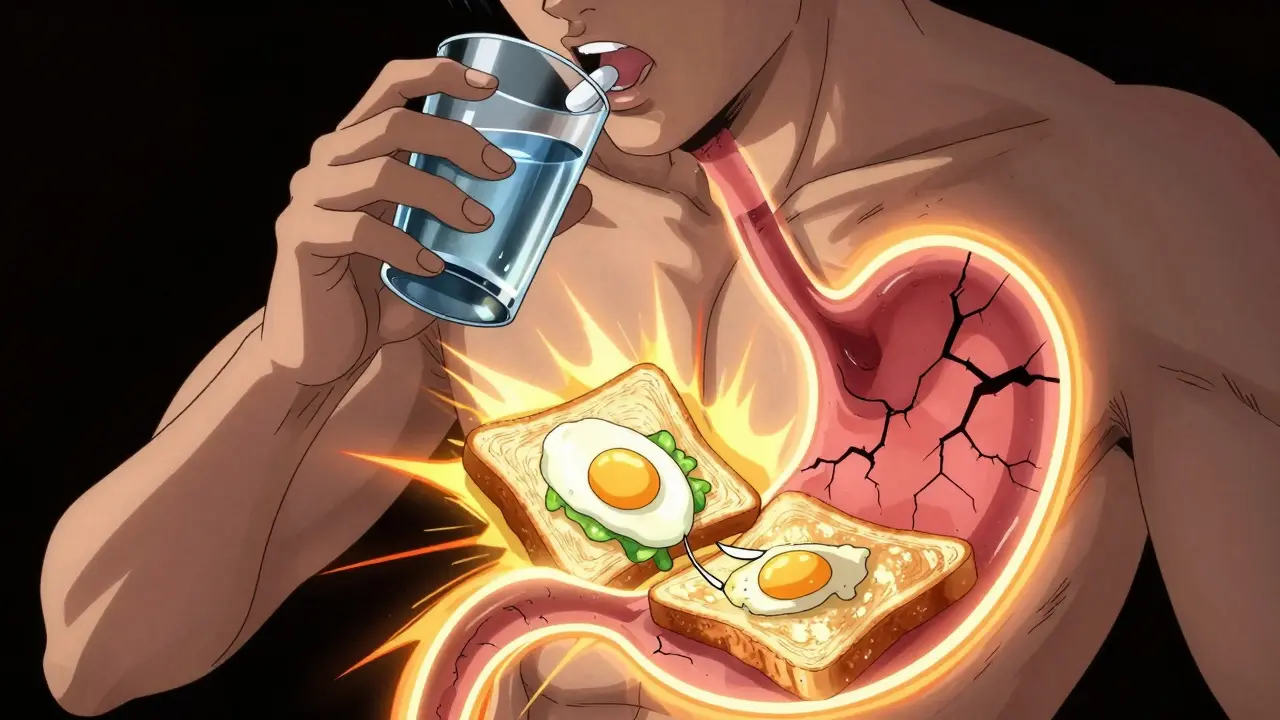
When you swallow a pill, you might think it’s just about the medicine itself. But what you eat - or don’t eat - at the same time can make a huge difference. For many people, taking medication with food isn’t just a suggestion. It’s a safety rule. And skipping it can mean more nausea, stomach ulcers, or even dangerous spikes in drug levels. The truth is, food isn’t just fuel. It’s a powerful player in how your body handles medicine.
Why Food Changes How Medicine Works
Your stomach and intestines aren’t just passive tubes. They’re active environments. When you eat, your body shifts gears. Blood flow changes. Stomach acid levels drop. Digestive enzymes kick in. And all of this affects how drugs get absorbed. Take NSAIDs like ibuprofen. These are common painkillers, but they’re tough on the stomach lining. Studies show that when taken on an empty stomach, up to 38% of users develop microscopic bleeding in the gut. That number drops to 12% when taken with food. Why? Food acts like a buffer. It dilutes the drug, slows its release, and reduces direct contact with sensitive stomach tissue. But it’s not just about protection. Food can also help your body absorb more of the drug. For example, the antifungal griseofulvin needs fat to be absorbed properly. A high-fat meal can boost its absorption by 15-30%. Without it, the drug just passes through - and your infection doesn’t get treated. Even your stomach’s pH matters. Some drugs need acid to dissolve. Others need a neutral environment. Eating changes the acid level. That’s why proton pump inhibitors like omeprazole must be taken 30 minutes before food - so they can work before the stomach gets busy digesting.When Food Makes Things Worse
It’s not always about helping. Sometimes, food blocks medicine from working at all. Take antibiotics. Tetracycline, doxycycline - these drugs bind tightly to calcium. That means if you take them with milk, yogurt, or even calcium-fortified orange juice, up to 50% of the drug gets trapped in your gut and never enters your bloodstream. Same goes for fluoroquinolones like ciprofloxacin. A single glass of milk can cut effectiveness in half. Then there’s grapefruit juice. It’s healthy, right? Wrong - for some meds. Grapefruit blocks an enzyme in your gut called CYP3A4. This enzyme normally breaks down drugs so they don’t build up. When it’s blocked, drug levels can skyrocket. Cyclosporine (used after transplants) can see blood levels jump 300-500%. Simvastatin - a common cholesterol drug - can hit 9 to 15 times higher than normal. That’s not just side effects. That’s risk of muscle damage, kidney failure, even death. Even something as simple as leafy greens can interfere. Warfarin, a blood thinner, works by blocking vitamin K. If you eat a salad one day and skip it the next, your INR (blood clotting level) swings wildly. A study in the New England Journal of Medicine found that inconsistent veggie intake caused 20-30% drops in warfarin’s effect. That’s why doctors tell patients to keep their veggie intake steady - not to avoid it, but to keep it consistent.Medications That Must Be Taken on an Empty Stomach
Some drugs are so sensitive that even a cracker can ruin them. Levothyroxine, used for hypothyroidism, is one. It’s designed to be absorbed in the upper small intestine. Food - especially calcium, iron, or soy - blocks that absorption. Studies show that taking it with breakfast can cut effectiveness by 30-55%. That means you’re not getting the full dose. Over time, your thyroid levels stay low, fatigue and weight gain creep back in, and your doctor keeps increasing your dose - not because the drug isn’t working, but because you’re not taking it right. Other drugs in this category include:- Alendronate (Fosamax) - for osteoporosis. Must be taken with plain water, 30 minutes before food. Otherwise, it doesn’t absorb, and it can burn your esophagus.
- Levothyroxine - as above. Always take on an empty stomach.
- Some HIV meds (like atazanavir) - food can make them less effective.
- Temazepam - a sleep aid. Food delays absorption, making it less reliable.

Medications That Need Food to Work Right
On the flip side, some drugs simply don’t work unless you eat with them. Metformin, the go-to drug for type 2 diabetes, is a classic example. Without food, it causes severe nausea, vomiting, and diarrhea in over 60% of users. With food? Those side effects drop to under 20%. That’s why most prescriptions say “take with meals.” Other drugs that need food:- NSAIDs (ibuprofen, naproxen) - reduce stomach irritation by 60-70%.
- Antifungals (griseofulvin) - require fat for absorption.
- Some antivirals (like ritonavir) - food boosts absorption by 20-40%.
- Antipsychotics (clozapine, olanzapine) - high-fat meals increase blood levels by 40-60%, which helps with symptom control - but also raises sedation risk.
The Hidden Cost of Getting It Wrong
Most people don’t realize how often this goes wrong. A 2023 study from the American Pharmacists Association found that 68% of medication-related hospitalizations were linked to improper food-drug timing. That’s not rare. That’s routine. And it costs the U.S. healthcare system $177 billion a year. Older adults are especially at risk. A Mayo Clinic study found that 68% of patients over 65 had no idea their meds needed food - and only 22% were ever told by their doctor. Many take levothyroxine with their morning coffee and cereal. Others take warfarin with a spinach smoothie one day and none the next. These aren’t mistakes. They’re predictable outcomes of poor education. Even younger people get it wrong. On Reddit, over 1,200 people shared stories about methotrexate - a drug for arthritis and autoimmune diseases. Seventy-eight percent said nausea vanished when they took it with food. But 22% noticed their symptoms came back - because food also reduced absorption. They didn’t know they had to balance safety with effectiveness.
How to Get It Right
Here’s how to avoid the traps:- Read the label. “Take with food” or “take on empty stomach” isn’t optional. It’s science.
- Ask your pharmacist. They’re trained in these interactions. Ask: “Does this need food? What kind? What should I avoid?”
- Use a timing app. Apps like Medisafe send reminders not just to take your pill - but when to eat before or after.
- Keep a food log. If you’re on warfarin or thyroid meds, write down what you ate each day. That helps your doctor spot patterns.
- Don’t assume. Just because one statin is safe with grapefruit doesn’t mean all are. Pravastatin? Fine. Simvastatin? Dangerous.
- Be consistent. If you take your pill with food, always use the same type. A burger one day, a salad the next - that’s a problem for drugs like warfarin.
What’s Changing in 2026
The field is evolving fast. In March 2024, the FDA approved the first “smart pill” - Abilify MyCite - that tracks when you take your medicine and whether you ate around it. Early data shows a 32% drop in food-related side effects. Pharmacies are catching up too. CVS now includes food interaction alerts on every prescription label. Walgreens’s app gives personalized timing tips based on your meds. And research is moving toward DNA-based advice: companies like Vitagene now offer $149 tests that tell you how your genes affect drug absorption with food. But here’s the catch: as processed foods get more complex - with hidden calcium, soy, or additives - predicting interactions gets harder. Without better education, the number of side effects could rise by 15-20% over the next decade. The bottom line? Your medicine doesn’t live in a vacuum. It lives in your body - and your body reacts to what you eat. Ignoring food-drug timing isn’t just careless. It’s risky. And for many, it’s the difference between feeling better - and feeling worse.Can I take my medication with water if it says "with food"?
No. Water alone doesn’t count as food. "With food" means eating at least 250-500 calories - like a sandwich, oatmeal, or eggs. Water won’t buffer stomach irritation or help absorption for drugs that need fat or other nutrients. Taking it with just water may reduce effectiveness or increase side effects.
Is it okay to take medication with coffee or juice?
Sometimes, but often not. Coffee can delay absorption of some drugs. Orange juice and grapefruit juice are especially risky - grapefruit can cause dangerous drug spikes. Calcium-fortified juices block antibiotics like tetracycline. Always check with your pharmacist. If in doubt, stick to plain water.
Why does my doctor say to take levothyroxine on an empty stomach?
Levothyroxine is absorbed in the upper small intestine. Calcium, iron, soy, and even fiber from food can bind to it and prevent absorption. Studies show that taking it with breakfast can reduce its effectiveness by 30-55%. That means your thyroid levels stay low, and you’ll keep feeling tired or gaining weight - even if you’re taking the right dose.
Can I eat grapefruit if I’m on a statin?
It depends on the statin. Simvastatin and atorvastatin can have dangerous interactions with grapefruit - increasing blood levels by 9-15 times. That raises the risk of muscle damage. Pravastatin, rosuvastatin, and fluvastatin don’t have this problem. Always check your specific drug. If you love grapefruit, ask your pharmacist which statins are safe.
What if I forget to take my pill with food? Should I take it later?
If you usually take it with food and forgot, don’t take it on an empty stomach later. Wait until your next meal. Taking it without food might increase side effects or reduce effectiveness. If you’re on a drug that requires an empty stomach, don’t eat anything for an hour after. Consistency matters more than timing - but always follow the label.
Dylan Patrick
March 13, 2026 AT 21:16Food isn't just a buffer-it's a co-pilot. I used to take my metformin on an empty stomach because I thought 'empty stomach' meant no snacks. Turns out, I was just training my gut to revolt. Took it with a peanut butter sandwich one day and suddenly I wasn't running to the bathroom every 20 minutes. Game changer.
Now I treat my meds like a dance partner-timing matters, rhythm matters, and sometimes you gotta move slow.
Elsa Rodriguez
March 15, 2026 AT 12:47They say grapefruit is healthy. Then they say it’ll kill you if you’re on statins. And we wonder why people just stop taking meds. This isn’t medicine. This is a goddamn obstacle course with a side of confusion.
My aunt took her simvastatin with OJ for years. She didn’t know until she ended up in the ER with rhabdo. No one told her. No one. Not the pharmacist, not the doctor. Just a tiny footnote on a 12-page pamphlet.
Leah Dobbin
March 15, 2026 AT 21:42It's fascinating how pharmaceutical companies have optimized drug delivery systems while simultaneously neglecting to communicate the most basic pharmacokinetic principles to patients. The disconnect between clinical science and patient education is not merely a gap-it's a chasm, and one that is actively widening as polypharmacy becomes the norm rather than the exception.
Furthermore, the commodification of health literacy through apps like Medisafe is a form of neoliberal triage: the burden of compliance is outsourced to the individual, while systemic failures in provider education remain unaddressed.
Aaron Leib
March 16, 2026 AT 02:34Just a quick heads-up: if your pill says "take with food" and you're not sure what that means-go for a sandwich. Not a banana. Not a handful of almonds. A real sandwich. Two slices of bread, some protein, maybe a little cheese.
That’s the gold standard. Your body doesn’t need fancy meals. It just needs enough to slow things down and not turn your stomach into a warzone.
Amisha Patel
March 16, 2026 AT 12:51Interesting. I take levothyroxine and always wondered why my TSH kept creeping up even though I took it at the same time every day. Turns out I was having oatmeal with soy milk. Never realized soy blocked absorption.
Switched to water and toast. TSH dropped back to normal in 3 weeks. Simple fix. Why isn’t this taught in basic health classes?
Rosemary Chude-Sokei
March 17, 2026 AT 21:44As someone who manages multiple chronic conditions, I appreciate the depth of this post. There’s a quiet dignity in respecting the science behind these interactions-not as a burden, but as a form of self-care.
I keep a small notebook: date, time, medication, what I ate, how I felt. It’s tedious, yes. But when my doctor says, "Your levels are off," I can show her exactly what changed. That’s power. Not just compliance. Agency.
Noluthando Devour Mamabolo
March 18, 2026 AT 06:36Yo, the CYP3A4 enzyme inhibition by furanocoumarins in grapefruit is a classic pharmacokinetic interaction-phase I metabolism blockade leading to elevated AUC and Cmax. But let’s be real: most patients don’t care about AUC. They care about not puking or dying.
Pharmacies need to stop burying this in fine print. Put a neon warning on the bottle. A skull. A grapefruit. A scream emoji. 🚨🍇💀
Ali Hughey
March 20, 2026 AT 04:44They say food-drug interactions are "common"... but have you ever wondered who BENEFITS from this confusion?
Big Pharma knows 70% of patients mess up their timing. That means more refills. More ER visits. More doctor visits. More prescriptions. And guess who gets paid?
And now they’re selling "smart pills" that track your food intake? That’s not innovation. That’s surveillance with a prescription label.
They want you to be afraid of your breakfast. They want you to pay for an app. They want you to think you’re powerless.
But you’re not. You’re just being manipulated.
Read the label. Ask questions. Trust your gut. Not the algorithm.