
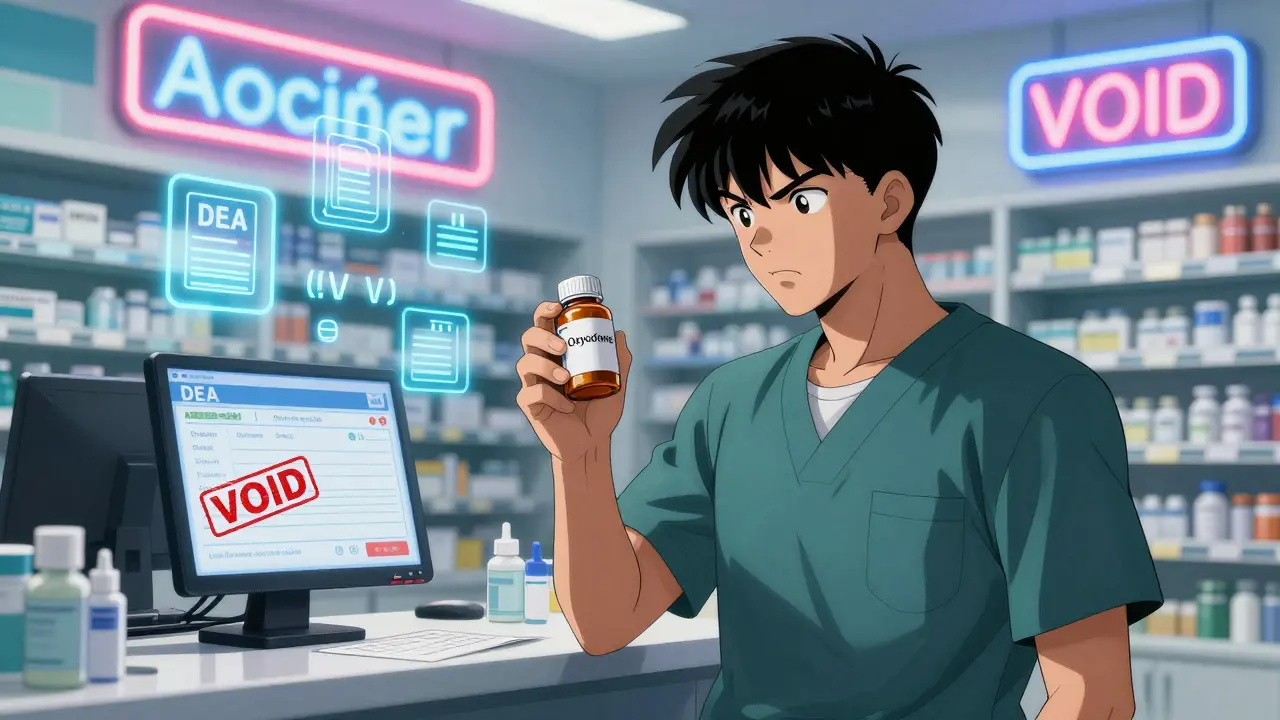
Switching pharmacies sounds simple-just walk in, hand over your pill bottle, and walk out with your meds. But if you’re taking controlled substances, it’s not that easy. Federal rules changed in August 2023, and now the process for transferring prescriptions depends heavily on what kind of medication you’re taking. Get it wrong, and your refill could be delayed for days-or denied entirely.
What You Need to Give the New Pharmacy
No matter what medication you’re transferring, you’ll always need to give the new pharmacy your full legal name, date of birth, and current address. These are non-negotiable. Pharmacies use this info to match your profile across systems and avoid dangerous mix-ups. For non-controlled medications-like blood pressure pills, cholesterol drugs, or antibiotics-you’ll also need the name of the medication, the dosage, how often you take it, and the name of your prescriber. That’s it. Most pharmacies can pull the rest from your old pharmacy’s system if you give them the name and location of your previous pharmacy. But if you’re on a Schedule III, IV, or V controlled substance-think oxycodone, Adderall, Xanax, or tramadol-the rules get strict. You must tell the new pharmacy that you’re transferring a controlled prescription. They’ll need the original prescription number, the date it was written, how many refills were originally authorized, and how many are left. They also need the prescriber’s DEA number and the old pharmacy’s DEA number. Missing any of these? The transfer won’t go through.Controlled Substances: One-Time Only
Here’s the biggest change since August 2023: you can only transfer a controlled substance prescription once. That’s it. Once it’s moved to your new pharmacy, you can’t move it again-even if you move again next year. This rule applies per prescription, not per person. So if you’re on three different controlled medications, you can transfer all three, but each one only once. After that, you’ll need a new prescription from your doctor. Schedule II drugs-like oxycodone tablets, fentanyl patches, or Adderall XR-are completely off-limits for transfer. No exceptions. If you’re switching pharmacies and you take one of these, you must call your doctor and ask for a new prescription. No pharmacy can legally transfer it, even if it’s still refillable. The DEA made this change to stop people from “pharmacy shopping” to get extra pills. Before, someone could transfer a prescription back and forth between pharmacies to stretch refills. Now, the system locks it down after one move.How the Transfer Actually Happens
You don’t need to go to your old pharmacy. You don’t need to call your doctor. Just give your new pharmacy the details. They’ll contact your old pharmacy directly. The transfer must happen electronically between two licensed pharmacists. No faxes, no screenshots, no photos of your prescription bottle. The original electronic record must be sent as-is, with no edits. Your old pharmacy then marks the original prescription as “VOID” in their system. Your new pharmacy adds “TRANSFER” to the record and logs the date, the old pharmacy’s name, and the name of the pharmacist who sent it. Both pharmacies must keep a copy of this transfer for two years. If there’s ever an audit, they need to prove the transfer was legal.
Why Transfers Get Stuck
Most transfers take 24 to 48 hours. But delays happen. Here’s why:- Your old pharmacy didn’t mark the prescription as “VOID.”
- The new pharmacy didn’t get the DEA number right.
- You’re transferring a Schedule II drug-no transfer allowed.
- Your prescription has no refills left.
- You’re moving between states, and your new state has stricter rules.
State Laws Can Block You
Federal law sets the floor, not the ceiling. Some states have tighter rules. For example:- California requires a written patient consent form for any controlled substance transfer.
- New York mandates that the transferring pharmacist call the receiving pharmacist directly-not just send an electronic file.
- Florida requires that the transfer be completed within 72 hours, or the prescription is voided.
What to Do If Your Transfer Is Denied
If your new pharmacy says no, here’s what to do:- Double-check the medication’s schedule. Is it Schedule II? If yes, you need a new prescription.
- Confirm the prescription still has refills. If not, call your doctor.
- Ask if the old pharmacy used an electronic system. If not, you’ll need a paper script.
- Ask if your state has special rules. Call your state pharmacy board if you’re unsure.
- If all else fails, get a new prescription from your doctor. It’s faster than fighting the system.
Ayodeji Williams
January 8, 2026 AT 09:27bro i just tried to transfer my Adderall and got told "sorry, can't do it" like i was trying to smuggle cocaine 🤦♂️
Adam Gainski
January 9, 2026 AT 08:32Actually, this is super important info. I used to work in a pharmacy before I switched careers, and I saw so many people get stuck because they didn't know Schedule II drugs can't be transferred at all. Even the pharmacists sometimes forget unless they're trained on the 2023 updates. Always double-check the DEA schedule first. You don't want to show up empty-handed on a Friday afternoon.
Christine Joy Chicano
January 11, 2026 AT 06:58The 2023 DEA change is actually a net positive for patient safety, even if it's inconvenient. Before, people would transfer prescriptions back and forth between pharmacies to stretch refills-sometimes even across state lines. I once saw a guy transfer the same oxycodone script between three different pharmacies in a month. That’s not just abuse, that’s a public health risk. The system wasn’t designed for that kind of loop.
Now, yes, it’s harder if you move frequently, but it forces you to engage with your prescriber. That’s not a bug, it’s a feature. Doctors need to know if you’re relocating, changing insurance, or having access issues. It’s not just about preventing diversion-it’s about continuity of care.
Also, small pharmacies lagging behind on tech? That’s a systemic issue, not a personal failure. Many rural pharmacies operate on shoestring budgets. The real fix isn’t blaming them-it’s pushing for federal funding to upgrade legacy systems. The DEA should subsidize that, not just punish the patients.
And yes, state laws vary wildly. I’m in California, and we require signed consent forms for any controlled transfer. It feels bureaucratic, but it’s a paper trail that protects everyone-patients, pharmacists, and doctors. Don’t assume your new pharmacy knows your state’s rules. Always ask.
If your transfer fails, don’t panic. Get the denial in writing. Then call your state pharmacy board. They’re required to explain the regulation. Most of the time, it’s just a clerical error-wrong DEA number, missed refill count, or outdated software. But if they say "we don’t do that," they’re either lying or untrained. Either way, escalate.
And if you’re on Schedule II? Start the new prescription process at least 7 days before you run out. Don’t wait until your last pill. Your doctor might need to schedule a follow-up, especially if it’s for chronic pain or ADHD. And yes, it’s annoying. But it’s also the law. No one’s getting rich off this system-it’s just trying to stop people from dying.
Pro tip: Keep a printed copy of your prescription history, even if it’s just a screenshot from your portal. That way, if your old pharmacy’s system crashes, you can still prove what was prescribed. I’ve seen people lose weeks because they didn’t have documentation. Don’t be that person.
Jonathan Larson
January 11, 2026 AT 10:05The regulatory architecture surrounding controlled substance transfers reflects a fundamental tension in American healthcare: the imperative to safeguard public welfare versus the individual’s right to unimpeded access to necessary therapeutics. The one-time transfer rule, while ostensibly a deterrent to diversion, imposes a disproportionate burden on transient populations-military personnel, seasonal workers, and students-who relocate without forewarning. One might argue that the DEA’s intent was noble, yet the mechanism lacks nuance. A patient on a stable regimen of Schedule IV benzodiazepines for generalized anxiety disorder should not be penalized for relocating to a new city for employment. The system presumes malice where often there is merely logistical inevitability.
Furthermore, the reliance on electronic systems presumes universal technological infrastructure, which is demonstrably false in rural and underserved communities. To mandate an electronic transfer protocol without ensuring equitable access to compliant software is regulatory overreach cloaked in compliance. The burden of noncompliance is borne not by the pharmacy owner who cannot afford an upgrade, but by the patient who must endure a gap in care.
It is also worth noting that the distinction between Schedule II and III-V substances is clinically arbitrary. Oxycodone immediate-release and oxycodone extended-release are pharmacologically identical in effect, yet one is transferable and the other is not. This dichotomy lacks scientific justification and instead reflects historical scheduling decisions rooted in political, rather than pharmacological, considerations.
Perhaps the most concerning implication is the normalization of bureaucratic indifference. When a patient is told, "We can't transfer that," and the response is met with silence, it reinforces a healthcare culture that prioritizes compliance over compassion. The law must be followed, yes-but so must the Hippocratic oath. There must be pathways for exceptions, for humanitarian need, for the patient who is not a drug seeker but a person in distress.
Until the system is restructured to accommodate human variability rather than punish it, we are not protecting public health-we are merely enforcing administrative convenience.
Aparna karwande
January 12, 2026 AT 09:44How can Americans be so clueless? In India, we don’t have this nonsense. If you need medicine, you get it. No DEA numbers, no "one-time transfer" drama. You walk in, show your bottle, and they give you the same pills-even if it’s tramadol or Xanax. Our system works because we trust doctors and patients, not bureaucrats. This whole American red tape is a joke. You’re not in a spy movie, you’re just trying to get your anxiety meds. Why make it so hard? 🤦♀️
Emma Addison Thomas
January 14, 2026 AT 01:30I moved from New York to Oregon last year and had to transfer three controlled scripts. The process was smoother than I expected-once I had the right info. The key was calling my old pharmacy first and asking them to confirm their DEA number and the exact refill count. My new pharmacy in Portland had no issues once I gave them the full details. I think a lot of the problems come from people assuming the pharmacy will magically know everything. But they’re not mind readers. Give them the full picture: name, DOB, address, script number, refill count, prescriber’s DEA, old pharmacy’s DEA. Write it down. Keep a copy. It saves hours.
Also, if you’re on a Schedule II, don’t waste your time asking for a transfer. Just call your doctor. They’ll understand. Most do it the same day if you explain you’re relocating. No need to panic.
Jessie Ann Lambrecht
January 16, 2026 AT 00:04Y’all are making this way harder than it needs to be. Seriously. If you’re on a controlled med and you’re switching pharmacies, just treat it like a mini project. Write down everything on a sticky note: your name, DOB, address, the name of the drug, how many refills are left, the prescriber’s name, the old pharmacy’s name and phone number, and both DEA numbers if you can find them. Then walk into your new pharmacy and say, "I need to transfer these. Here’s everything you need." Boom. Done. No drama. No stress. Pharmacies are overwhelmed-they appreciate when you come prepared. And if they say no? Ask for the manager. Nine times out of ten, it’s just a staff member who hasn’t been trained. You’re not being difficult-you’re being smart.
Also, if you’re on Adderall or Xanax? Don’t wait until your last pill. Start the transfer 5 days before you run out. Pharmacies get backed up. I’ve seen people go without meds for a week because they waited too long. Don’t be that person. Plan ahead. You’ve got this.
LALITA KUDIYA
January 17, 2026 AT 20:57my doc gave me a 90 day script for my anxiety med and i just took it to the new pharmacy and they said no transfer allowed 😭
Sai Ganesh
January 18, 2026 AT 20:55India has a different approach-we don’t have DEA classifications. Controlled substances are still regulated, but the system is simpler: doctor prescribes, pharmacy dispenses, patient takes. No bureaucratic dance. If a patient needs a refill, they just come back. No transfer rules because the system assumes continuity of care. The U.S. model feels like it was designed to confuse rather than help. Maybe it’s time to look beyond borders for better solutions.
Andrew N
January 19, 2026 AT 04:01Let’s be real. The DEA didn’t make this rule to protect patients. They made it because they’re scared of lawsuits. If someone dies from a diverted prescription, the DEA gets blamed. So they made it harder for everyone-even the people who just moved apartments. It’s not about safety. It’s about liability. And now we’re all stuck paying the price.
Paul Mason
January 20, 2026 AT 17:16Oh wow, so now I can’t move my Xanax if I switch from CVS to Walgreens? That’s insane. I’ve done it twice before and never had an issue. This is just more government overreach. You’d think they’d want people to have their meds, not make it harder. My cousin in Florida got locked out of her meds for three weeks because the pharmacy didn’t have the right software. She had to drive 80 miles to get a new script. That’s not healthcare. That’s a nightmare.
Poppy Newman
January 22, 2026 AT 03:55Wait-so if I transfer my tramadol and then move again next year? I’m stuck? No way to move it again? 😱
Anastasia Novak
January 22, 2026 AT 23:38Let me guess-the person who wrote this is a pharmacist who thinks patients are criminals. "No transfers!" "DEA numbers!" "Void the original!" You sound like a robot who got stuck in a 2023 compliance training video. Do you have any idea how many people have to choose between their mental health and their dignity because of this? I had to beg my doctor for a new script because my pharmacy didn’t have the right software. My anxiety spiked. I cried. And then I had to explain to my boss why I was late for work because I was stuck in a pharmacy arguing about a DEA number. This isn’t regulation. It’s punishment dressed up as policy.
And don’t even get me started on the "one-time only" rule. So if I move for a job, then my partner gets transferred to another state? I’m out of meds? Brilliant. What a system. The DEA didn’t fix pharmacy shopping-they just made life hell for people who actually need help.
Also, why are we still using fax machines in 2024? No, seriously. I’ve seen pharmacies still fax prescriptions. That’s not secure. That’s not modern. That’s just lazy. Fix the tech. Don’t punish the patients.
Elen Pihlap
January 24, 2026 AT 09:11i just moved and my pharmacy said they can't transfer my adderall so i had to go without for 5 days and i had a panic attack and cried in the parking lot