

Every year, millions of workers are exposed to noise so loud it silently destroys their hearing-without pain, without warning, and without a chance to get it back. This isn’t just a problem for factory workers or construction crews. It’s happening in warehouses, farms, airports, and even some offices. The damage? Permanent. The good news? It’s 100% preventable. But only if we stop treating hearing protection as an afterthought and start treating noise like the hazard it is.
How Noise Destroys Your Hearing
Your inner ear is full of tiny hair cells that turn sound waves into electrical signals your brain understands. Once these cells are damaged by loud noise, they don’t grow back. That’s why noise-induced hearing loss (NIHL) is permanent. It doesn’t happen overnight. It builds up over years-like sunburn on your ears. You might not notice it until you’re struggling to hear conversations in noisy rooms, or until your coworkers ask if you’re okay because you keep asking them to repeat themselves. The science is clear: exposure to noise above 85 decibels (dBA) for more than eight hours a day starts to cause damage. For context:- A lawnmower: 90 dBA
- A power drill: 98 dBA
- A jackhammer: 110 dBA
- A rock concert: 115 dBA
Why Current Rules Don’t Go Far Enough
In the U.S., OSHA says it’s okay to expose workers to up to 90 dBA for 8 hours. That’s the legal limit. But NIOSH-the health agency that actually studies this stuff-says 85 dBA is the real threshold where damage begins. Why the difference? It’s not science. It’s politics. The 90 dBA limit means companies can legally let workers listen to noise that’s 16 times more powerful than what NIOSH says is safe. That’s like saying it’s okay to drive 80 mph in a 55 mph zone because the law hasn’t caught up. And it’s not just the U.S. The European Union already uses an 80 dBA limit. California passed new rules in 2023 requiring employers to fix the noise at the source before relying on earplugs. Dr. Thais Morata from NIOSH puts it bluntly: “Occupational noise exposure limits do not prevent NIHL, even if they are often wrongly cited as safe for the public.” The truth? There’s no safe level of loud noise at work. There’s only a level where damage happens slower.The Real Problem: Hearing Protection Isn’t Enough
Most companies think giving out foam earplugs solves the problem. It doesn’t. A 2017 Cochrane review found that workers often insert foam earplugs wrong-up to 75% of them. That cuts the protection from 30 dB down to just 15 dB. And even when inserted right, earplugs don’t block all noise. Workers remove them because they can’t hear alarms, coworkers, or machinery warnings. One construction worker on Reddit said: “Most guys take their earplugs out because they can’t hear equipment warnings.” NIOSH data shows only 38% of workers in high-noise jobs wear hearing protection consistently. Why? Because they’re uncomfortable, they feel isolated, or they don’t believe it’s necessary. And let’s be honest-if your boss gives you cheap, one-size-fits-all earplugs that hurt after two hours, you’re not going to wear them. Hearing protection is the last line of defense. It’s the weakest link. Relying on it is like using a Band-Aid on a broken leg.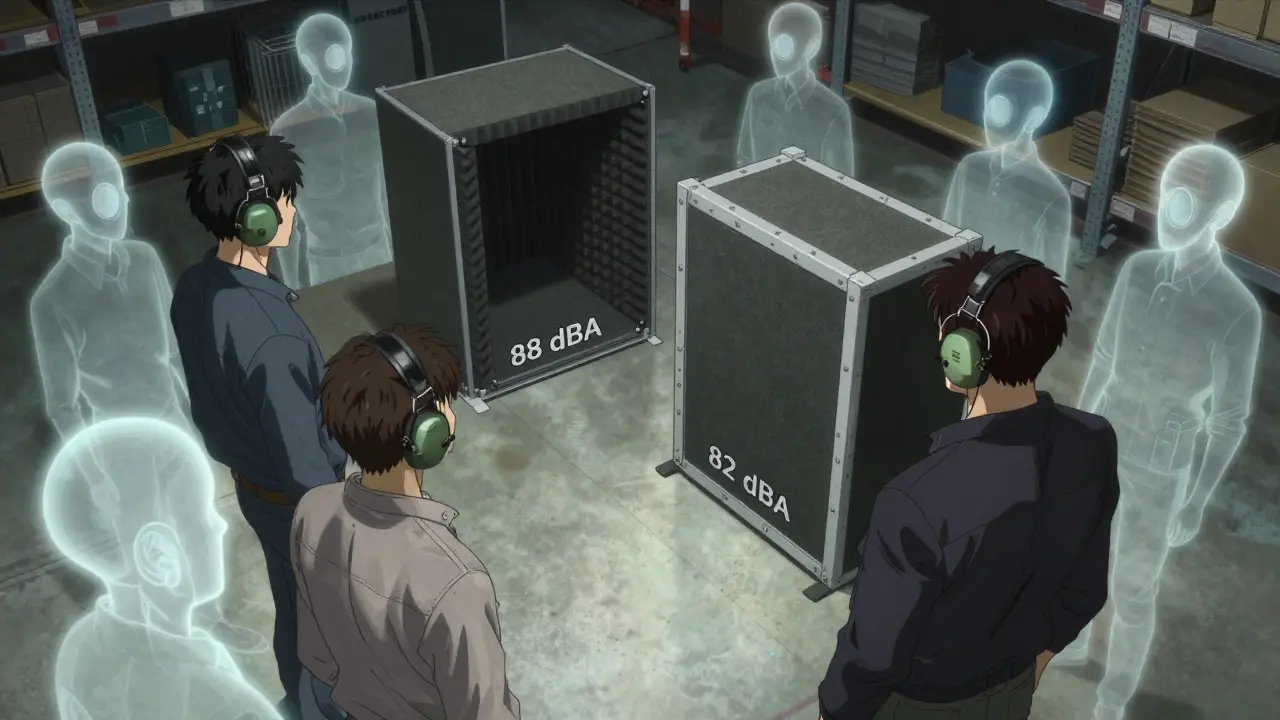
What Actually Works: The Hierarchy of Controls
The only way to truly prevent NIHL is to follow the hierarchy of controls-starting at the top:- Elimination: Can you remove the noisy machine? Maybe replace it with a quieter model.
- Substitution: Can you swap the loud tool for a quieter one? NIOSH’s “Buy-Quiet” initiative, launched in 2023, lists over 1,200 low-noise tools and machines-some 3 to 15 dB quieter than standard models.
- Engineering Controls: Install sound barriers, enclosures, or vibration dampeners. In mining, noise dropped from 98 dBA to 82 dBA after adding acoustic enclosures. Workers reported less fatigue and better focus.
- Administrative Controls: Rotate workers so no one is exposed for more than 4 hours. Limit time near noise sources. Schedule loud tasks for low-traffic hours.
- Hearing Protection Devices (HPDs): Only after the above steps. And even then, use custom-molded earplugs, not foam. They fit better, last longer, and deliver consistent 25-30 dB of protection.
What a Real Hearing Conservation Program Looks Like
A true program isn’t just handing out earplugs once a year. It’s a system:- Noise monitoring: Use calibrated sound level meters to map noise levels across the site. Don’t guess. Measure.
- Fit testing: Use Real Ear Attenuation at Threshold (REAT) to test how well each worker’s earplugs work. If they’re not blocking enough, give them better ones.
- Audiometric testing: Annual hearing tests at 500, 1000, 2000, 3000, 4000, and 6000 Hz. A “standard threshold shift”-a 10 dB drop at 2000, 3000, and 4000 Hz-is your early warning sign.
- Training: Don’t just hand out earplugs. Train workers how to insert them. Spend 10-15 minutes per person. The Cleveland Clinic found that after proper training, 75% of workers could insert foam earplugs correctly.
- Management accountability: If safety managers aren’t measured on hearing loss rates, they won’t fix the problem. Track it. Report it. Reward it.
Who’s Most at Risk
Some industries are worse than others:- Construction: 22% of workers exposed to noise above 85 dBA
- Manufacturing: 19%
- Mining: 17%
- Agriculture: 15%

The Future of Hearing Protection
New tools are emerging. 3M’s PELTOR TS3+ smart ear muffs record noise exposure and sync data to compliance systems. Researchers at the University of Southern California are testing blood biomarkers that could detect early hearing damage before it shows up on a hearing test. That could change everything. But the biggest shift is cultural. We’re starting to see that hearing loss isn’t just a “worker issue.” It’s a public health crisis. The Cochrane Review admitted there’s still “insufficient evidence for long-term effectiveness” of most prevention programs. That means we’re still failing. The good news? We know what works. We have the tools. We have the science. What we’re missing is the will.Frequently Asked Questions
Can noise-induced hearing loss be reversed?
No. Once the hair cells in your inner ear are damaged by noise, they don’t regenerate. That’s why NIHL is permanent. The only way to stop it is to prevent the damage from happening in the first place.
Is 85 dBA really dangerous? I’ve heard people say it’s safe.
85 dBA is the level where damage begins-not where it’s safe. OSHA allows up to 90 dBA, but that’s a legal limit, not a health one. NIOSH, the CDC, and the World Health Organization all say 85 dBA is the point where hearing loss starts. Think of it like a speed limit: just because you’re allowed to drive 70 mph doesn’t mean it’s safe to drive that fast on a winding road.
Are foam earplugs good enough?
Only if used perfectly-and they rarely are. In real-world use, foam earplugs often provide only 15-20 dB of protection, even if they’re rated for 30+ dB. Most people insert them wrong. Custom-molded earplugs offer better, more consistent protection and are more comfortable over long shifts.
Why don’t more companies fix the noise at the source?
It’s cheaper to buy earplugs than to replace machines or install sound barriers. But that’s a false economy. The CDC found companies save $5.50 for every $1 spent on proper hearing conservation. Plus, workers are more productive and less fatigued when noise is reduced. Fixing the source is smarter, safer, and more cost-effective in the long run.
What should I do if my workplace is too loud?
First, ask for a noise assessment. If your employer refuses, file a complaint with OSHA. You have the right to a safe workplace. Also, get your hearing tested annually. Early detection is key. If you’re struggling to hear conversations in noisy rooms, or if you have ringing in your ears after work, those are red flags. Don’t wait until it’s too late.
Is there a law that requires employers to protect hearing?
Yes. OSHA requires hearing conservation programs when noise exposure reaches 85 dBA over 8 hours. But many employers don’t follow the rules. Only 49% of manufacturing facilities comply, even though 30% of workers in that sector have hearing loss. California and the EU have stricter rules. If your employer isn’t measuring noise, providing proper protection, or testing hearing, they’re breaking the law.
Tommy Chapman
February 20, 2026 AT 10:45Let me get this straight - we’re still letting companies get away with this? In 2025? You think earplugs are the solution? Bro, that’s like giving someone a raincoat in a hurricane and calling it a day. OSHA’s 90 dBA limit is a corporate loophole dressed up as a safety rule. NIOSH said 85. The EU says 80. California just passed laws to fix noise at the source. But here in the good ol’ US of A, we’d rather keep our profits clean than our workers’ ears. Wake up. This isn’t ‘hazard mitigation.’ This is negligence with a paycheck.
Freddy King
February 21, 2026 AT 19:32From a systems perspective, the hierarchy of controls is textbook, but implementation is where the rubber meets the road. The real bottleneck isn’t tech - it’s cognitive dissonance in safety leadership. You’ve got a cost-benefit model that prioritizes CAPEX avoidance over OPEX savings, and that’s why HPDs become the de facto solution. The 38% consistent usage rate? That’s not user error - it’s systemic failure. And don’t get me started on the Cochrane review’s ‘insufficient evidence’ - that’s just academia politely saying ‘we’ve been lying to ourselves for decades.’
Laura B
February 22, 2026 AT 20:23I work in a warehouse and honestly, this article hit home. I didn’t realize how much I was straining to hear my coworkers until I started wearing better earplugs. The fit testing thing? That’s genius. My company just started doing it last month - I didn’t even know it was a thing. Now I actually feel heard (literally). Also, the part about rotation schedules? We do that for heavy lifting - why not for noise? It’s the same logic. Small changes, big impact.
Caleb Sciannella
February 24, 2026 AT 08:50It is of paramount importance to recognize that occupational noise exposure constitutes a chronic, insidious public health burden that has been systematically under-prioritized within regulatory frameworks. The divergence between OSHA and NIOSH thresholds is not merely a technical discrepancy, but rather a manifestation of institutional capture by industrial lobbying interests. Furthermore, the reliance upon hearing protection devices as a primary control mechanism represents a fundamental misapplication of the precautionary principle, as such devices are inherently fallible in real-world operational environments. The adoption of engineering controls - particularly through the integration of acoustically optimized machinery - yields not only superior health outcomes but also demonstrable economic returns, as evidenced by CDC cost-benefit analyses. A paradigm shift from reactive to proactive intervention is not merely advisable - it is ethically imperative.
Oana Iordachescu
February 24, 2026 AT 10:52Who funds NIOSH? Who writes the Buy-Quiet database? Who decides what’s ‘quieter’? There’s a reason the EU moved to 80 dBA - they’re not being altruistic. It’s because the noise industry is tied to the hearing aid industry. You think they want you to fix the noise? No. They want you to keep damaging your ears so you’ll buy their products. And those ‘smart muffs’? They’re tracking your data. They’re selling it. I’ve seen the patents. This isn’t safety. It’s surveillance with a decibel meter.
Chris Beeley
February 26, 2026 AT 01:11Let’s be real - this whole thing is a performance. You think companies care about your hearing? They care about liability. That’s why they give you foam plugs and call it a day. Meanwhile, the CEO’s office is soundproofed, the boardroom has acoustic panels, and the HR guy wears Bose noise-canceling headphones. But you? You get the $2 plastic plugs that fall out every 15 minutes. And if you complain? They say, ‘It’s your job to protect yourself.’ Yeah, right. That’s like saying, ‘It’s your job to not get cancer from asbestos.’ This isn’t about hearing loss. It’s about class. The rich protect their ears. The rest of us? We’re just collateral damage with a paycheck.
James Roberts
February 26, 2026 AT 23:00So… we’ve got a $280 million problem, and the solution is… *checks notes*… buying quieter machines? Installing barriers? Training people? That’s it? That’s the whole plan? No wonder we’re failing. We’ve turned prevention into a PowerPoint slide. ‘Here’s a graph. Now go fix it.’ Meanwhile, the guy on the floor is screaming because he can’t hear the forklift - and his manager says, ‘Just wear the plugs.’ Oh, and the plugs are ‘one-size-fits-all’? That’s like giving everyone the same pair of shoes. And you wonder why 75% of them are worn wrong? I mean, really - do we think people are dumb? Or do we just not care enough to try? 😅
Benjamin Fox
February 28, 2026 AT 02:45Why are we even talking about this? Just wear the damn earplugs. If you can’t handle a little noise, maybe you’re in the wrong job. I’ve worked construction for 15 years. I’ve got tinnitus. So what? You think I’m gonna cry about it? No. I’m gonna keep working. You want quiet? Go work in an office. This isn’t a spa. It’s a job. Stop whining. 🇺🇸
Irish Council
February 28, 2026 AT 16:11They’re coming for your ears next. You think this is about noise? It’s about control. The ‘noise mapping’? The ‘fit testing’? The ‘compliance systems’? That’s surveillance. They’re tracking your exposure so they can adjust your wages. They’ll say ‘you’re too sensitive’ - then dock your pay. Or worse - label you ‘unfit for duty.’ And who gets to decide what’s ‘safe’? The same people who wrote the rules that let 90 dBA fly. This isn’t safety. It’s a slow rollout of the surveillance state. And they’ll call it ‘progress.’
Jayanta Boruah
March 1, 2026 AT 08:25It is imperative to acknowledge that the persistent under-enforcement of hearing conservation protocols stems not from technical inadequacy, but from a deeply entrenched epistemological failure within occupational safety paradigms. The prevailing paradigm of individualized risk mitigation - epitomized by the distribution of passive hearing protection devices - is predicated upon a flawed anthropological assumption: that human behavior can be reliably coerced into compliance through the provision of tools alone. This is a categorical error. The solution lies not in behavioral modification, but in structural re-engineering - specifically, the institutionalization of acoustic design as a core metric of industrial productivity. The economic return of $5.50 per $1 invested is not a recommendation - it is a moral imperative.