

When you’re struggling to breathe, the last thing you want is to waste time figuring out how to use your medication. Nebulizers and inhalers both deliver drugs straight to your lungs, but they’re not the same. One takes 15 minutes. The other takes 2. One’s bulky and noisy. The other fits in your pocket. And yet, most people still think the bigger machine works better. That’s not what the science says.
How Nebulizers Work - and Why People Still Use Them
A nebulizer looks like a small machine with a tube and a mask or mouthpiece. It turns liquid medicine - like albuterol or budesonide - into a fine mist you breathe in over 5 to 15 minutes. It’s been around since the 1950s. For decades, it was the go-to tool in hospitals and homes for asthma attacks and COPD flare-ups. The big selling point? You don’t need to coordinate anything. No timing your breath with a click. No holding your breath after inhaling. Just sit there, breathe normally, and the machine does the work. That’s why it’s still the top choice for babies, toddlers, elderly patients with shaky hands, or anyone with cognitive issues. If you can’t press a button and breathe in at the same time, a nebulizer is your only real option. But here’s the catch: most of the medicine doesn’t even reach your lungs. In a standard jet nebulizer, 60 to 70% of the dose is lost during exhalation or stuck in the tubing. That’s why doctors often prescribe higher doses - you’re literally wasting half your medication. Newer breath-assisted models cut that waste down to 30-40%, but they’re more expensive and not widely available.How Inhalers with Spacers Work - and Why They’re Actually Better
A metered-dose inhaler (MDI) is a small canister that sprays medicine when you press it. Alone, it’s terrible. Most people spray and breathe at the wrong time. Studies show 70 to 80% of adults use them wrong. That means up to 80% of the drug lands in your mouth or throat - not your lungs. That’s why you get hoarseness, thrush, or even a sore stomach. But add a spacer - a plastic tube with a chamber and a mask or mouthpiece - and everything changes. The spacer catches the spray, letting you inhale slowly and deeply. Suddenly, 70 to 80% of the dose gets where it needs to go. That’s better than most nebulizers. The American Thoracic Society says spacer use cuts oropharyngeal deposition from 80% to just 20-30%. Fewer side effects. Better results. And the treatment? Two to five minutes. You press the inhaler once, breathe in slowly through the spacer five times. Done. No waiting. No cords. No cleaning a cup every day. You can take it to work, on a plane, or to the park.What the Science Actually Shows
Let’s cut through the myths. In 2022, a study of nearly 700 patients, doctors, and nurses found that 60% of patients believed nebulizers worked better. But only 11% of doctors agreed. Nurses? Just 35% thought nebulizers were superior - even though they used them daily. Why the gap? Comfort. Visibility. Perception. If you can see the mist coming out of the machine, it feels like it’s working. That’s powerful. But feeling better isn’t the same as being better. The American Academy of Family Physicians ran a head-to-head trial in 2002. Patients using MDIs with spacers improved their breathing faster. They spent 50 minutes less in the ER. They needed less total albuterol - 8.4 mg versus 12.6 mg. Their blood oxygen levels improved more. And at two weeks, only 12% of them had another attack. With nebulizers? 28% did. The Global Initiative for Asthma (GINA) 2022 guidelines are blunt: MDIs with spacers are equally effective as nebulizers for most people - and should be the first choice. Why? Faster. Cheaper. Safer. Less waste. Fewer infections.
Cost, Maintenance, and Real-World Use
A basic nebulizer system costs $100 to $200. You need electricity. You need to clean the cup and tubing daily with soapy water. Weekly, you have to disinfect it with a vinegar solution to stop mold from growing. If you skip this, you risk breathing in mold spores - especially dangerous if you’re immunocompromised. An MDI with a spacer? Around $30 to $50. You prime it once when you get it. You rinse the spacer once a week. No electricity. No cleaning a cup. No waiting. You can buy it at any pharmacy, no prescription needed in many places. And here’s the kicker: the global market for respiratory devices is growing fast - $28.7 billion by 2028. But inhalers (including dry powder types) make up 65% of that market. Nebulizers? Only 25%. The shift isn’t just happening - it’s already over.Who Should Use What?
This isn’t about which device is “better.” It’s about which one works for you.- Use a nebulizer if: You’re under 5, have severe dementia, are in acute distress and can’t coordinate breathing, or your doctor specifically recommends it for a short-term flare-up.
- Use an MDI with a spacer if: You’re over 5, can follow simple instructions, want speed and portability, care about cost, or want to avoid side effects like thrush.
What About Smart Inhalers?
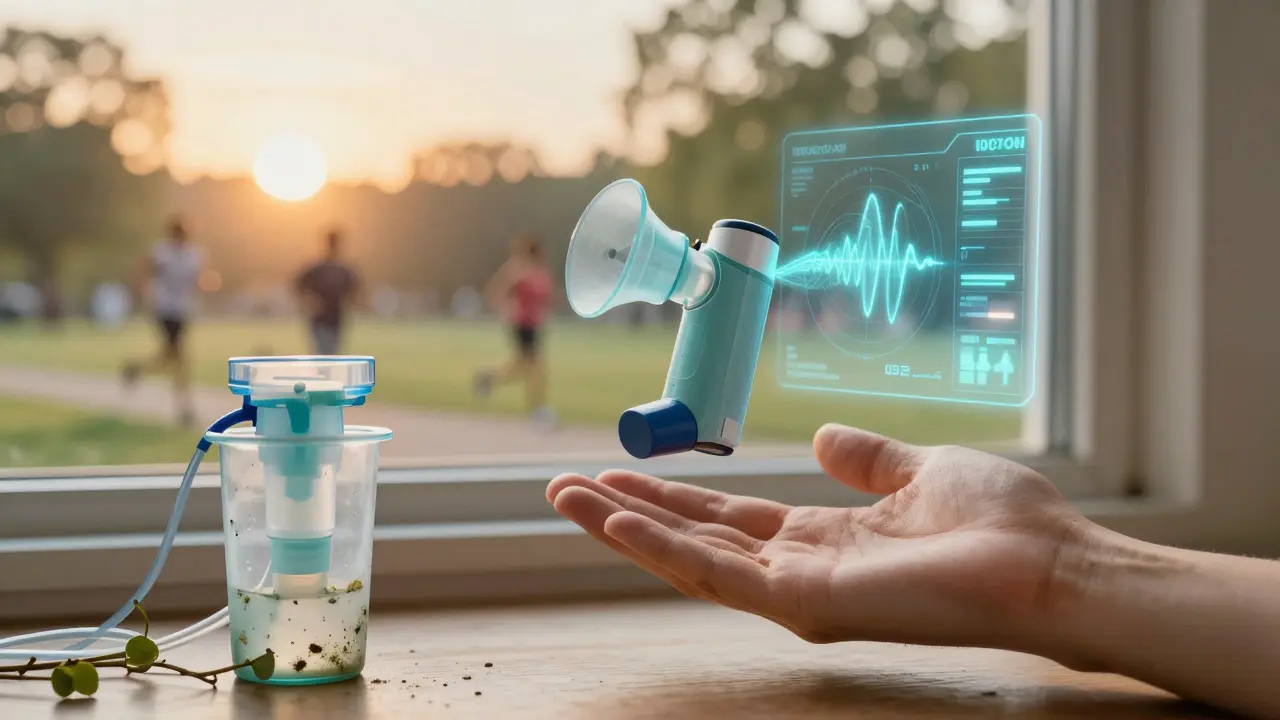
The future is here. Smart inhalers like Propeller Health track when and how often you use your medicine. They send reminders to your phone. A 2022 study in JAMA Internal Medicine showed users cut their rescue inhaler use by 58% just by getting feedback. No nebulizer can do that. These devices don’t replace spacers - they enhance them. And they’re becoming more affordable. If you’re serious about managing your asthma or COPD, a smart inhaler with a spacer is the smartest move you can make.The Bottom Line
Nebulizers aren’t useless. But they’re not better. For most people - adults and kids alike - an MDI with a spacer is faster, cheaper, more effective, and safer. The evidence has been clear for over 20 years. Yet, hospitals still use nebulizers because they’re familiar. Parents still use them because they feel more reassuring. But feeling better isn’t the same as being better. If you’re still using a nebulizer at home, ask yourself: Is it because it works better - or because you’ve never tried the alternative? Try a spacer. It takes one visit to the pharmacy. Five minutes to learn. And it could save you hours of wasted time, hundreds of dollars, and a lot of unnecessary side effects. You don’t need a machine to breathe better. You just need the right tool - and the right technique.Can I use a nebulizer instead of an inhaler for my daily asthma meds?
Not usually. Nebulizers are designed for short-term relief during flare-ups, not daily maintenance. Most maintenance medications like inhaled corticosteroids come in MDI or DPI form because they’re designed for precise, low-dose delivery. Using a nebulizer daily is inefficient, expensive, and increases your risk of side effects from overdosing. Stick to your prescribed inhaler for daily use.
Do I need a spacer if I’m using a dry powder inhaler (DPI)?
No. Dry powder inhalers don’t need a spacer because they don’t use a propellant. Instead, they rely on your own breath to pull the powder into your lungs. But you need to inhale quickly and deeply - which is why they’re not recommended for young children or people with very weak lung function. If you struggle with DPIs, switch back to an MDI with a spacer.
Why do hospitals still use nebulizers if inhalers are better?
Hospitals use nebulizers because they’re easier to administer in emergencies. A nurse can hand a mask to an unconscious or panicked patient and turn on the machine. With an inhaler, you need the patient to cooperate - which isn’t always possible during a severe attack. But even in hospitals, guidelines now push for MDIs with spacers whenever the patient can manage it. The shift is happening - just slowly.
Is it safe to share a spacer between family members?
No. Spacers should never be shared. Even with cleaning, they can harbor bacteria or mold. Each person needs their own spacer. It’s cheap - under $15 - and worth the investment. Sharing increases infection risk, especially for children or people with weakened immune systems.
How do I know if I’m using my inhaler correctly?
Watch yourself in a mirror. When you press the inhaler, you should see no mist coming out of your mouth or nose. If you taste the medicine or feel it in your throat, you’re doing it wrong. Try using a spacer. If you still have issues, ask your doctor for a demonstration or watch a video from the American Lung Association. Proper technique is non-negotiable - it’s the difference between relief and ongoing symptoms.
Can I travel with a nebulizer on a plane?
You can, but it’s a hassle. Nebulizers need power, take up space, and can’t be used during takeoff or landing. Most airlines allow them as medical devices, but you’ll need a doctor’s note. An MDI with a spacer? Fits in your pocket. No power needed. No restrictions. If you travel often, switch to the inhaler - your future self will thank you.
Marlon Mentolaroc
January 23, 2026 AT 14:31Okay but let’s be real - nebulizers are basically the asthma equivalent of a VCR. Everyone still has one in the closet because ‘it worked back then’ but nobody actually uses it anymore unless they’re stuck in 1998. Spacers are the iPhone 15 of inhalers. Simple. Fast. No cords. No drama.
Dolores Rider
January 23, 2026 AT 15:50lol i swear the medical industry is just pushing spacers because they make more money off them. my aunt got a nebulizer from the VA and now they won’t refill her meds unless she buys a ‘smart spacer’ that costs $200. conspiracy?? i think so 😏
Husain Atther
January 24, 2026 AT 13:47It's interesting how perception often outweighs evidence in healthcare. I've seen elderly patients in India cling to nebulizers not because they're more effective, but because the ritual of sitting still, watching the mist, gives them a sense of control. The science may favor spacers, but comfort matters too - especially when you've been using one device for decades.
venkatesh karumanchi
January 25, 2026 AT 20:15My grandfather used a nebulizer for 30 years. Last year I got him a spacer. He cried. Said he felt like he was ‘giving up.’ But now he goes to the park without dragging that big machine. He says he breathes better. Funny how the body knows before the mind accepts it.
Don Foster
January 27, 2026 AT 11:13Anyone who still uses a nebulizer at home is either delusional or lazy. The data is 20 years old and still 100% valid. If you can’t press a button and breathe in you probably shouldn’t be managing your own meds anyway. Get a caregiver or get a smart inhaler. Stop wasting oxygen and money
John McGuirk
January 27, 2026 AT 14:40you ever wonder why hospitals still use nebulizers? its not because they’re better. its because the nurses don’t want to explain how to use a spacer to a dying man who’s gasping. they just wanna turn the machine on and walk away. its about convenience for the staff not the patient. they know it’s inefficient but they don’t care
Kevin Waters
January 28, 2026 AT 03:25Just want to add - if you’re using a spacer, make sure you’re cleaning it weekly. I used to skip it and ended up with a fungal infection in my throat. Cheap device, big consequences if you don’t maintain it. Also - don’t share. Seriously. Even if it’s your sibling. Just buy two.
Viola Li
January 29, 2026 AT 05:33So let me get this straight - you’re saying the entire medical system has been lying to us for decades? That hospitals are just clinging to outdated tech because they’re lazy? And now you’re the hero who woke everyone up? Wow. What a revelation. I’m sure the 10,000 nurses who use nebulizers daily are just sitting around drinking coffee while patients choke.
Luke Davidson
January 30, 2026 AT 07:26Man I used to think nebulizers were the gold standard until my kid had her first asthma flare and we tried the spacer - holy hell it was like night and day. She didn’t cry, we were done in 3 minutes, and no more thrush. I went from ‘this looks too simple to work’ to ‘why didn’t anyone tell me this before’ in under an hour. The real tragedy isn’t the nebulizer - it’s that no one ever shows you how to use the spacer properly. They just hand you the inhaler like it’s a magic wand
And smart inhalers? Game changer. Mine buzzes if I skip a dose. My wife gets a text. We’re basically a team now. No more ‘did you take your meds?’ arguments. Just quiet, efficient breathing.
Jamie Hooper
January 31, 2026 AT 11:34spacers are great but what if you live in a place where the air is full of dust and pollen? my neighbor uses a nebulizer because he says the spacer just sucks in all the junk outside. i dont know if hes right but he swears by it. maybe we need better filters not better devices
Kat Peterson
February 1, 2026 AT 15:29Okay but the NEBULIZER has a MIST. A MIST. 🌫️✨ It feels like magic. The spacer? Just a plastic tube with a sad little puff. Where’s the drama? Where’s the ceremony? Where’s the TikTok moment? I’m not just treating asthma - I’m performing a ritual. The nebulizer is my wellness influencer. The spacer is a Walmart receipt.
Darren Links
February 2, 2026 AT 04:20So if spacers are so great why do insurance companies still cover nebulizers but not smart inhalers? Coincidence? I think not. Big Pharma doesn’t want you to know you can get 90% of the benefit for $30. They want you buying $150 devices with monthly subscriptions. The system is rigged. But hey - at least the mist looks cool.
Izzy Hadala
February 3, 2026 AT 02:15Based on the referenced 2002 AAFP trial and subsequent GINA guidelines, the equivalence of efficacy between metered-dose inhalers with spacers and nebulizers is well-documented in randomized controlled trials with primary endpoints of FEV1 improvement, hospitalization duration, and medication dosage reduction. The persistence of nebulizer use in clinical practice represents a cognitive bias toward visible intervention, not evidence-based superiority. The cost differential and reduced environmental impact further support the paradigm shift toward spacer-based delivery systems in non-emergent settings.