
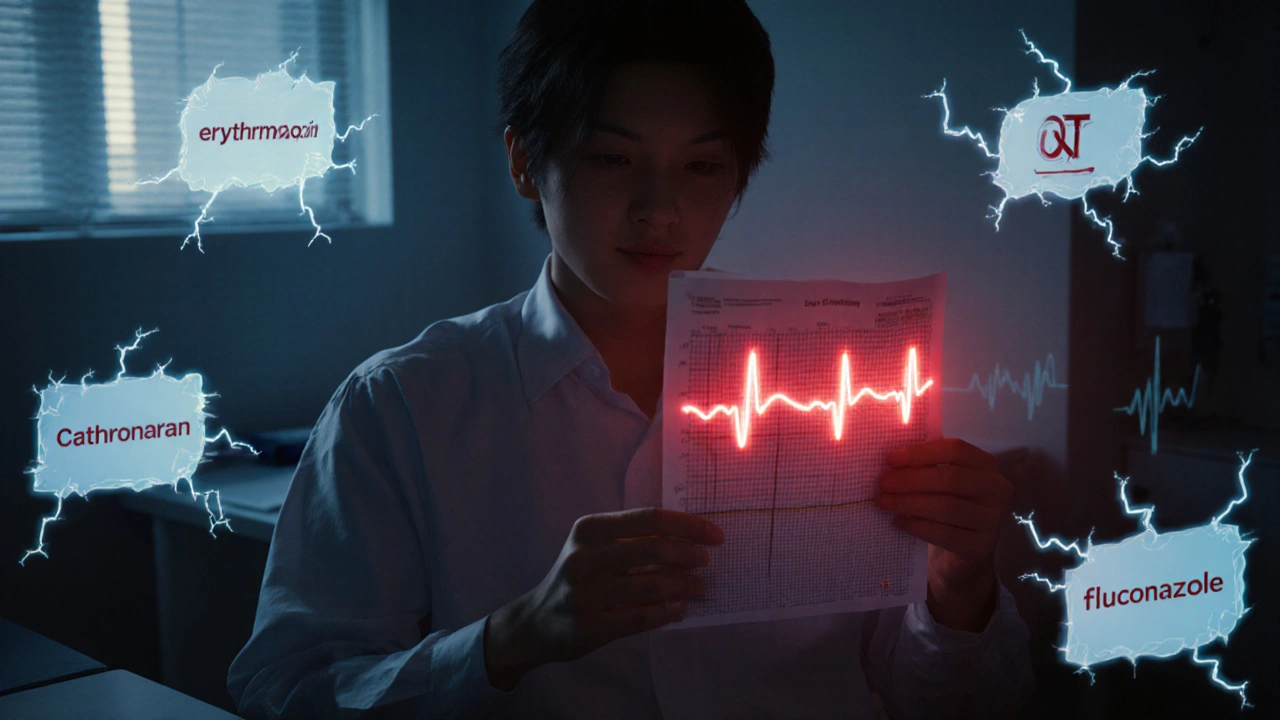
Methadone QTc Risk Calculator
Risk Assessment Tool
When someone starts methadone for opioid dependence or chronic pain, the focus is usually on managing cravings, reducing withdrawal, or controlling pain. But there’s a quiet, dangerous side effect that doesn’t always get talked about-methadone can mess with your heart’s electrical rhythm. And when it’s taken with other common medications, that risk doesn’t just add up-it multiplies.
How Methadone Affects Your Heart
Methadone isn’t just an opioid. It’s also a potent blocker of specific potassium channels in heart cells, especially the hERG channel and, as newer research shows, the IK1 channel too. These channels are responsible for letting potassium flow out of heart cells after each beat, which helps the heart reset for the next one. When methadone blocks them, that reset gets delayed. The result? A longer QT interval on an ECG.
A normal QTc (corrected QT interval) is 430 ms or less for men, and 450 ms or less for women. When it climbs above 500 ms, the risk of a dangerous irregular heartbeat called torsades de pointes (TdP) jumps sharply. TdP can turn into ventricular fibrillation-and suddenly, the heart stops pumping. This isn’t theoretical. Between 1.3% and 16% of people on methadone maintenance therapy reach QTc levels above 500 ms, especially at doses over 100 mg per day.
What’s scary is that methadone’s effect isn’t linear. It gets worse over time. Studies show QTc can keep increasing for up to 16 weeks after starting treatment. Even if you feel fine, your heart’s electrical system may be slowly destabilizing. And unlike other opioids like buprenorphine-which barely touches hERG channels-methadone’s blockade is about 100 times stronger. That’s why it’s uniquely risky.
Why Combining Drugs Makes It Worse
Methadone doesn’t work alone. Most people on long-term methadone are also taking other meds-for depression, anxiety, infections, or HIV. And many of those drugs also prolong the QT interval. When you stack them, the effect isn’t just added-it’s amplified.
Take antibiotics like erythromycin or clarithromycin. They block hERG too. Fluoroquinolones like moxifloxacin? Same thing. Antifungals like fluconazole? They do it as well. Even common antidepressants like citalopram, venlafaxine, or haloperidol (used for psychosis) can push QTc higher. In one documented case, a patient on methadone developed TdP after taking cocaine-a drug with a short half-life but strong QT-prolonging effects. It only took one dose to trigger it.
And then there are HIV drugs like ritonavir. These don’t just prolong QT-they slow down how fast your body breaks down methadone. That means methadone builds up in your blood, increasing both its pain relief and its heart risk. It’s a double hit: more methadone in your system, plus another drug doing the same thing to your heart.
It’s not just about the drugs themselves. Low potassium, low magnesium, heart failure, or a family history of long QT syndrome can turn a moderate QT prolongation into a life-threatening event. One New Zealand case involved a patient on 120 mg of methadone who had repeated episodes of TdP. When the dose was cut to 60 mg, the QT interval returned to normal. That’s how powerful the interaction is.
Who’s Most at Risk?
Not everyone on methadone will have problems. But certain people are walking into a storm with no umbrella:
- Those taking doses over 100 mg/day
- People already on other QT-prolonging medications
- Those with pre-existing heart conditions or bradycardia
- Patients with electrolyte imbalances (low potassium or magnesium)
- Individuals with a personal or family history of sudden cardiac death or long QT syndrome
- Women, who tend to have longer baseline QT intervals than men
Studies show that among women on methadone, over 70% reach QTc levels above 470 ms-the threshold that should trigger concern. For men, nearly 70% hit above 450 ms. These aren’t outliers. They’re the norm at higher doses.
What Doctors Should Do
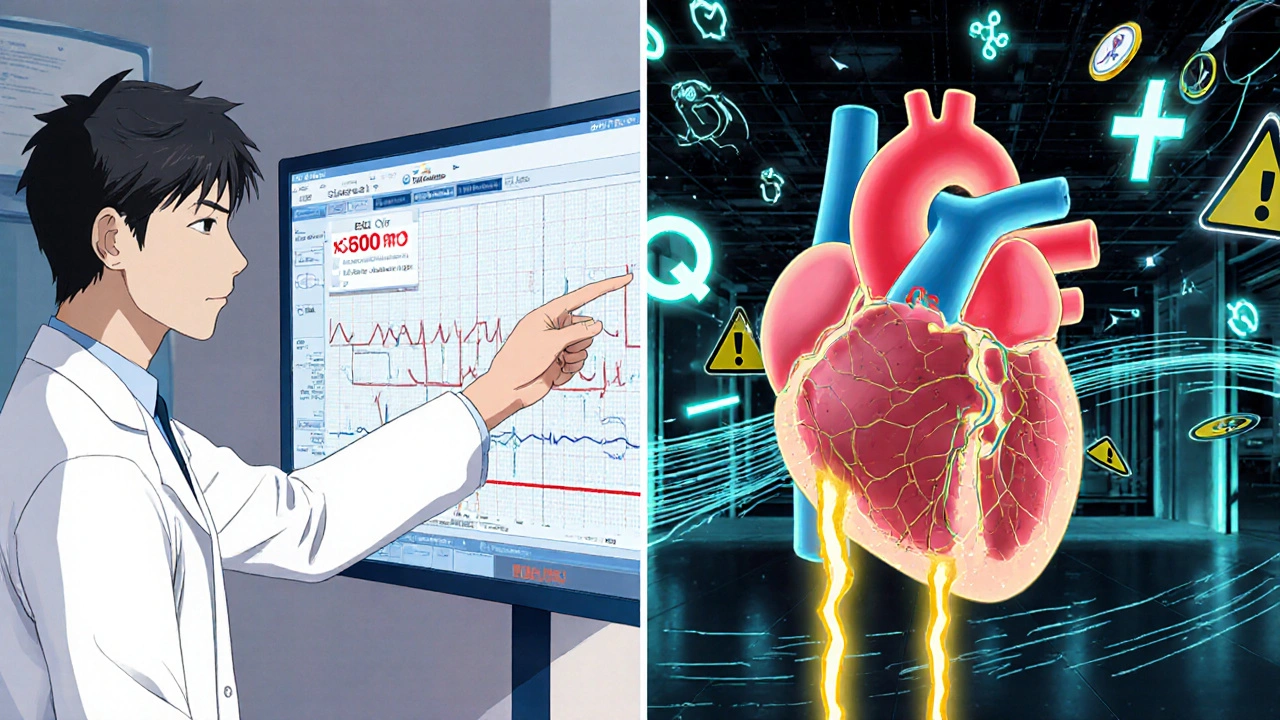
Guidelines are clear: you shouldn’t start methadone without an ECG. And you shouldn’t keep giving it without checking again.
Before starting methadone, get a baseline ECG. Repeat it after 2-4 weeks, then every 3-6 months if you’re stable. If you’re on more than 100 mg/day, or if you’re adding another QT-prolonging drug, check every 1-3 months. If your QTc goes above 500 ms, or increases by more than 60 ms from baseline, it’s time to act.
Options include:
- Reducing the methadone dose
- Switching to buprenorphine (which has far less cardiac risk)
- Correcting low potassium or magnesium
- Stopping or replacing any other QT-prolonging drugs if possible
Some patients can’t switch off methadone-it’s the only thing that keeps them stable. In those cases, the focus shifts to minimizing other risks. That means avoiding azole antifungals, macrolide antibiotics, and certain antidepressants unless absolutely necessary. If you need an antibiotic, azithromycin is a safer choice than erythromycin. For depression, sertraline or escitalopram (in low doses) are better than citalopram.
What Patients Should Ask
If you’re on methadone, don’t assume your doctor knows every pill you’re taking. Many people don’t mention over-the-counter meds, herbal supplements, or even occasional painkillers. But here’s what you need to ask:
- “Is this new medication safe to take with methadone?”
- “Could this affect my heart rhythm?”
- “Have I had an ECG recently?”
- “Should I get one now?”
Also, know the warning signs: dizziness, fainting, palpitations, or sudden fatigue. These aren’t just “feeling off.” They could be your heart trying to tell you something’s wrong. If you feel any of these, get checked immediately.

The Bigger Picture
Methadone saves lives. It reduces overdose deaths by 20-50%, cuts criminal activity, and helps people stay in treatment. That’s why it’s still a cornerstone of opioid addiction care. But that doesn’t mean we ignore the heart risk. The goal isn’t to stop methadone-it’s to use it safely.
The 2022 study in the Journal of the American Heart Association was a game-changer. It showed methadone doesn’t just block one channel-it blocks two. That’s why its effect is so strong, even at low concentrations. This isn’t just another drug interaction. It’s a unique, biologically grounded danger that demands attention.
Health systems need better tools. Right now, we rely on ECGs and guesswork. But future tests-like analyzing the U-wave on an ECG-could help predict who’s most vulnerable before anything bad happens. Until then, vigilance is the best defense.
For patients, the message is simple: methadone can be safe, but only if you’re monitored. For providers, it’s a reminder: never assume a patient is low-risk just because they feel fine. The heart doesn’t always show symptoms until it’s too late.
Can methadone cause sudden death even at low doses?
Yes, though it’s rare. Most cases of torsades de pointes linked to methadone happen at doses above 100 mg/day. But sudden death has been reported at lower doses-especially when combined with other QT-prolonging drugs, electrolyte imbalances, or pre-existing heart conditions. There’s no completely safe dose; the risk increases with dose, but even 40-60 mg can be dangerous in high-risk individuals.
Is buprenorphine safer than methadone for the heart?
Yes, significantly. Buprenorphine has about 100 times less effect on the hERG potassium channel than methadone. Studies show it causes minimal or no QT prolongation, even at high doses. For patients with a history of heart rhythm problems, or those on multiple QT-prolonging medications, buprenorphine is often the preferred alternative for opioid dependence treatment.
What medications should I avoid while on methadone?
Avoid these if possible: macrolide antibiotics (erythromycin, clarithromycin), fluoroquinolones (moxifloxacin), antifungals (fluconazole), certain antidepressants (citalopram, venlafaxine), antipsychotics (haloperidol, thioridazine), and HIV protease inhibitors (ritonavir). Always check with your pharmacist or doctor before starting any new medication, even over-the-counter ones like antihistamines or cough syrups containing diphenhydramine.
How often should I get an ECG on methadone?
Get a baseline ECG before starting. Then repeat at 2-4 weeks after starting or changing dose, and every 3-6 months if stable. If you’re on more than 100 mg/day, have other risk factors, or start a new QT-prolonging drug, get an ECG every 1-3 months. If your QTc exceeds 500 ms or increases by more than 60 ms from baseline, urgent evaluation is needed.
Can I take ibuprofen or acetaminophen with methadone?
Yes, both ibuprofen and acetaminophen are generally safe with methadone and do not prolong the QT interval. They’re preferred over NSAIDs like celecoxib or naproxen in patients with cardiac risk, since some NSAIDs have mild QT effects. But always avoid combination products with hidden antihistamines or decongestants, which can be risky.
What should I do if I feel dizzy or faint on methadone?
Don’t ignore it. Dizziness or fainting could be a sign of a dangerous heart rhythm. Stop what you’re doing, sit or lie down, and call your doctor immediately. If symptoms are severe or you lose consciousness, call emergency services. An ECG and blood tests for potassium and magnesium are needed right away. This isn’t something to wait out.
Final Thoughts
Methadone is a powerful tool-but it’s not harmless. Its cardiac risks are real, measurable, and often preventable. The key isn’t fear-it’s awareness. Know your dose. Know your meds. Know your ECG numbers. If you’re on methadone, your heart deserves as much attention as your addiction or pain. A simple ECG, a few questions, and a few swaps in your medication list can mean the difference between staying alive and becoming a statistic.
Cecil Mays
October 29, 2025 AT 10:00Yo this is wild but so important 🚨 I had no idea methadone could mess with your heart like this. My cousin’s on it for pain and just got prescribed clarithromycin for a sinus infection - no one warned him. This needs to be screaming from the rooftops.
Raj Modi
October 31, 2025 AT 03:37While the clinical implications of methadone-induced QT prolongation are well-documented in the literature, the magnitude of risk escalates exponentially when polypharmacy is introduced, particularly with concomitant hERG channel blockers such as macrolides and fluoroquinolones. The electrophysiological mechanism involves not merely potassium efflux inhibition but also a synergistic disruption of repolarization reserve, which is especially perilous in patients with subclinical cardiac structural abnormalities or electrolyte derangements. The 2022 JAMA Cardiology study further elucidates the dual-channel blockade of hERG and IK1, which explains the disproportionately high incidence of torsades de pointes compared to other opioids. Consequently, routine ECG monitoring is not merely advisable-it is a mandatory standard of care for all patients initiated on methadone regimens exceeding 60 mg daily, particularly in populations with heightened baseline QT intervals, such as females and the elderly.
Sarah Schmidt
November 1, 2025 AT 20:55It’s fascinating how we’ve built entire treatment paradigms around drugs that quietly kill people while we celebrate their "life-saving" properties. Methadone is a perfect example of medical hypocrisy: we praise it for reducing overdose deaths, yet ignore the fact that it’s replacing one slow death with another-just slower, quieter, and more insidious. The system doesn’t want you to know this because if people realized how many of their "stable" patients are walking time bombs, they’d have to rethink everything. But no, better to keep prescribing and calling it harm reduction while the ECGs silently scream.
Billy Gambino
November 3, 2025 AT 13:38The hERG blockade is merely the surface layer. Underneath lies a deeper neurocardiac axis disruption-methadone’s metabolites, particularly EDDP, exhibit prolonged half-lives and cumulative mitochondrial toxicity, which may induce subclinical cardiomyopathy over time. This is not merely a QT issue; it’s a systemic bioenergetic collapse masked as pharmacological stability. The clinical community’s reliance on ECGs as a proxy for safety is a gross reductionist fallacy. We need longitudinal biomarkers-troponin gradients, T-wave alternans, autonomic variability indices-not just a single snapshot of QTc. Until then, we’re flying blind with a loaded gun.
Karen Werling
November 4, 2025 AT 22:46I’m so glad this was posted. My mom’s been on methadone for 8 years and just had her first ECG last month-QTc was 498. She’s on sertraline and ibuprofen (which is fine!) but didn’t realize she needed regular checks. We’re switching her to buprenorphine next month. 💙 This stuff matters. You can feel fine and still be in danger. Please, if you’re on methadone, ask for an ECG. No shame. Just safety.
STEVEN SHELLEY
November 5, 2025 AT 01:48THIS IS A GOVERNMENT PLOT TO CONTROL ADDICTS!! THEY WANT YOU TO NEED HEART MONITORS SO YOU CAN’T MOVE FREELY!! THEY’RE USING "QT PROLONGATION" TO JUSTIFY SURVEILLANCE!! I KNOW A GUY WHO GOT A HEART ATTACK AFTER HIS DOCTOR CHANGED HIS MEDS-THEY’RE LYING ABOUT THE RISK BECAUSE THEY’RE MAKING MONEY OFF THE HOSPITALS!!
Emil Tompkins
November 5, 2025 AT 16:39So what you're saying is… we're supposed to be scared of a drug that's literally keeping people alive? Like maybe the real danger is not taking it? Maybe the real problem is that people are on too many pills in the first place? But no, let's just panic about the one that works. Classic.
Kevin Stone
November 6, 2025 AT 20:38It’s not that methadone is dangerous-it’s that people don’t follow the guidelines. If you’re taking it with other QT-prolonging meds, you’re being reckless. If you’re not getting ECGs, you’re asking for trouble. This isn’t a flaw in the drug. It’s a flaw in the patient’s responsibility.
Natalie Eippert
November 7, 2025 AT 02:40Why are we giving this to people who can’t even take care of themselves? This isn’t medicine-it’s social engineering. If you’re on methadone, you should be monitored daily. Not every 3 months. And if you’re on antidepressants too? You shouldn’t be allowed to leave the house unsupervised.
kendall miles
November 8, 2025 AT 09:20My cousin in Christchurch got TdP on 80mg. They said it was "rare". But he was on fluconazole and had low magnesium. They didn’t test him until after he coded. Now he’s got a pacemaker. The system failed him. Don’t wait for the collapse.
Gary Fitsimmons
November 9, 2025 AT 01:28I’ve been on methadone for 5 years. Never had an ECG until last year. QTc was 480. I didn’t even know what that meant. My doctor just said "keep going". I’m switching to buprenorphine now. This post saved me. Thank you.
Bob Martin
November 9, 2025 AT 11:55Wow. So after all this, the takeaway is… don’t take antibiotics? Cool. I guess we’ll just let people die of pneumonia then. Real thoughtful.
Sage Druce
November 9, 2025 AT 21:36You’re not alone. This is terrifying but you’re not alone. If you’re reading this, you’re already doing better than most. Ask the questions. Get the ECG. Switch if you can. Your heart is worth fighting for.
Tyler Mofield
November 10, 2025 AT 16:29It is imperative that clinical protocols be revised to incorporate mandatory serial electrocardiographic surveillance in all patients undergoing methadone maintenance therapy, particularly in the presence of comorbid pharmacological agents that modulate cardiac repolarization kinetics. Failure to adhere to this standard constitutes a breach of the duty of care and exposes institutions to significant medico-legal liability.
Patrick Dwyer
November 12, 2025 AT 14:21This is exactly why we need better integration between addiction medicine and cardiology. Too often, these are siloed specialties. A patient on methadone needs a care team-not just an addiction specialist. We need ECGs tracked in EHRs with automatic alerts when QTc exceeds thresholds. We need pharmacist-led med reviews. This isn’t just clinical-it’s systems design. And it’s doable.