

When you think of meningitis, you might picture a sudden fever and a stiff neck. But that’s only part of the story. Meningitis isn’t one disease-it’s a group of serious infections that swell the protective layers around your brain and spinal cord. Some forms come on fast and can kill within hours. Others fade away on their own. The difference? What caused it-and whether you were protected by a vaccine.
What Causes Meningitis? Five Main Types
Meningitis isn’t just one illness. It’s triggered by different invaders, each with its own behavior, risk level, and treatment path.Bacterial meningitis is the most dangerous. It’s caused by bacteria like Neisseria meningitidis (meningococcus), Streptococcus pneumoniae (pneumococcus), and Haemophilus influenzae type b (Hib). These bugs spread through close contact-coughing, kissing, sharing drinks. Symptoms can go from mild to life-threatening in less than 24 hours. Even with treatment, 5% to 30% of people die. Survivors often face hearing loss, brain damage, or learning problems.
Viral meningitis is far more common. About 85% of all cases are viral, mostly from enteroviruses-the same family that causes stomach bugs. It’s uncomfortable: fever, headache, nausea-but rarely deadly. Most people recover in 7 to 10 days without special treatment. Still, it’s hard to tell viral from bacterial without a spinal fluid test.
Fungal meningitis is rare and almost always hits people with weak immune systems-like those with HIV, cancer, or on long-term steroids. The main culprit is Cryptococcus neoformans, found in soil and bird droppings. It’s slow-moving but deadly if ignored. Globally, it kills over 180,000 people a year.
Parasitic meningitis is unusual. In Southeast Asia and the Pacific, eating raw or undercooked snails or contaminated water can bring in Angiostrongylus cantonensis. Symptoms mimic viral meningitis but can last weeks and cause nerve damage.
Non-infectious meningitis isn’t caused by germs at all. It can come from autoimmune diseases like lupus, certain cancer treatments, or reactions to medications. It’s rare, making up 5% to 10% of cases, but still needs careful diagnosis.
What Do the Symptoms Really Look Like?
You’ve probably heard the classic trio: fever, stiff neck, and confusion. But here’s the truth-only 41% of people with bacterial meningitis show all three. In fact, many don’t have the stiff neck at all.More common signs:
- High fever (over 101.3°F / 38.5°C) in 86% of cases
- Severe headache, reported by 87%
- Light sensitivity (photophobia) in 65%
- Vomiting in more than half
- Confusion, drowsiness, or trouble waking up
For bacterial meningitis, watch for the rash. It starts as tiny red or purple spots that don’t fade when you press a glass against them. This is a medical emergency. But here’s the catch: only 50% to 75% of people with meningococcal meningitis get this rash. Many patients delay care because they’re waiting for the rash to appear-and by then, it’s too late.
Doctors use physical tests like Brudzinski’s sign (knees bend when neck is bent) or Kernig’s sign (pain when straightening the leg). These are very specific-if they’re positive, meningitis is likely. But they’re not sensitive. Half the people with meningitis won’t show them.
That’s why diagnosis isn’t based on symptoms alone. A spinal tap (lumbar puncture) is the only way to know for sure. The fluid is checked for white blood cells, sugar levels, and protein. Bacterial meningitis shows high white cells (over 1,000/µL), low sugar, and high protein. Viral looks milder.
Vaccines: The Most Powerful Shield Against Meningitis
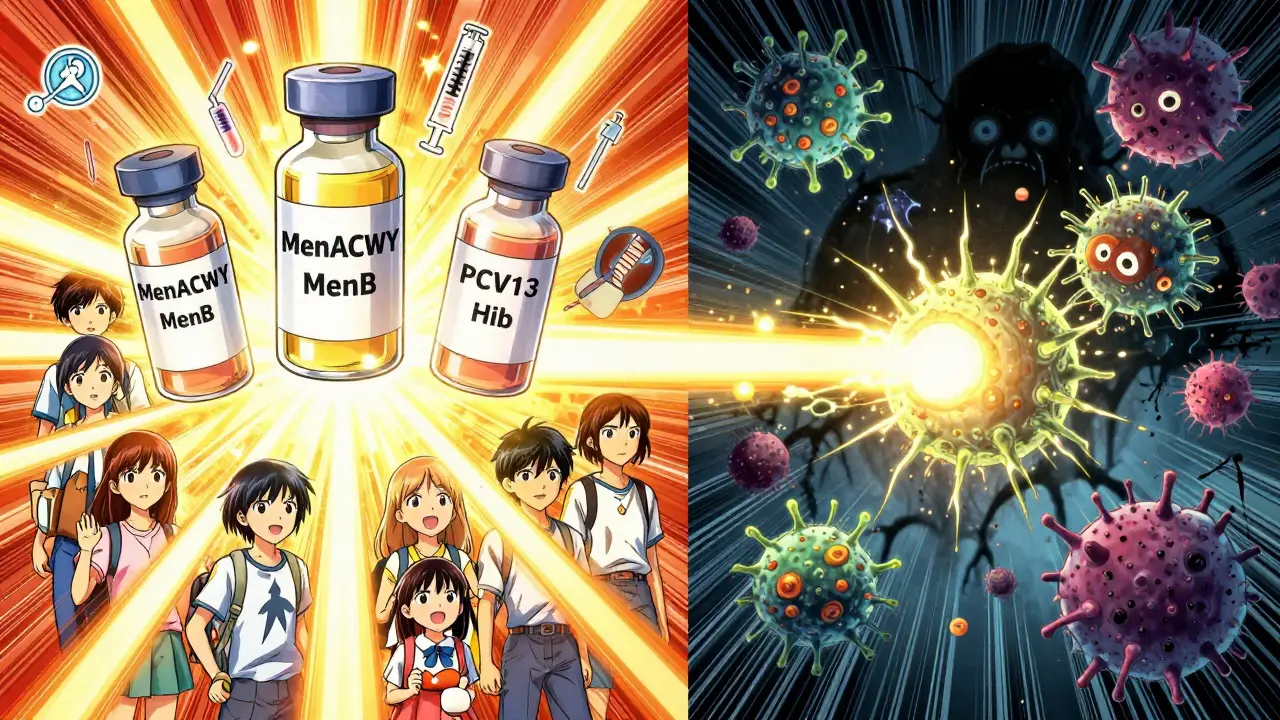
If you want to avoid meningitis, vaccines are your best tool. They’ve cut bacterial meningitis cases by up to 99% in countries with strong immunization programs.MenACWY vaccines (Menveo, MenQuadfi) protect against four dangerous strains: A, C, W, and Y. The CDC recommends two doses: one at age 11-12, and a booster at 16. If you get the first dose between 13 and 15, you still need that second shot before 18. For teens getting their first dose at 16 or older, one shot is enough. These vaccines are 80% to 85% effective.
MenB vaccines (Bexsero, Trumenba) target serogroup B, which causes about 1 in 3 cases in teens and young adults. Until 2024, these were only for high-risk groups-like college dorm residents or people with immune disorders. But new data showed the cost per life saved was worth it. Now, the CDC recommends MenB for all adolescents, ideally between 16 and 18. They’re 60% to 70% effective against circulating strains.
Pneumococcal vaccine (PCV13) protects against the most common cause of bacterial meningitis in young kids. It’s given in four doses before age 2. It cuts pneumococcal meningitis by 80% in children under 5.
Hib vaccine was one of the biggest public health wins. Before it existed, Hib was the leading cause of bacterial meningitis in kids under 5. Now, in countries with routine shots, cases have dropped by 99%.
These vaccines don’t just protect the person who gets them. They stop the spread. When enough people are vaccinated, the bacteria can’t find new hosts. That’s called herd immunity.
What If You’ve Been Exposed?
If someone in your home, dorm, or close circle gets bacterial meningitis, you need to act fast. Close contacts-like roommates, family members, or anyone who shared utensils or kissed-are at risk.Antibiotics like ciprofloxacin or rifampin can prevent infection if taken within 24 hours of exposure. This drops the chance of getting sick from 1%-5% to less than 0.1%. But here’s the problem: most people don’t know they’ve been exposed until it’s too late. Health departments struggle to trace contacts quickly. Only 65% of close contacts get prophylaxis on time.
That’s why vaccination before exposure matters more than ever. Waiting until someone gets sick is already too late.
What About Non-Vaccine Prevention?
Vaccines are the gold standard, but good habits help too.- Wash your hands often-this cuts transmission by 30% to 50%
- Don’t share drinks, toothbrushes, or eating utensils-reduces risk by 25%
- For pregnant women: avoid unpasteurized dairy and undercooked meats to prevent listeria, a rare but deadly cause of meningitis
- Keep your immune system strong. Fungal meningitis mostly hits people with weak defenses
These steps won’t stop all cases-but they reduce your chances, especially when combined with vaccines.
Why So Many People Delay Care
A 2023 survey by the National Meningitis Association found that 68% of survivors waited over 38 hours before going to the hospital. Why? Many thought it was the flu. Others assumed they’d get the rash first. One Reddit thread with nearly 300 healthcare workers found that 73% had treated patients who waited because “they didn’t have the rash.”That’s dangerous. Every hour counts. If treatment is delayed more than 4 hours, the death rate jumps from 5% to 21%. In emergency rooms that used standardized screening tools, delays dropped from over 8 hours to under 4 hours-and deaths fell by half.
Also, 42% of survivors said doctors first told them it was just a migraine or a bad cold. Even experienced providers can miss it if they’re not looking for the full picture.
What’s New in 2026?
The fight against meningitis is evolving. In early 2024, the WHO approved a new low-cost MenACWY vaccine called MenFive, priced at just $0.50 per dose. It’s being rolled out across Africa’s meningitis belt, where epidemics used to kill thousands each year. Since 2010, MenA vaccines have cut cases by 99% there.Also in 2024, the CDC expanded MenB recommendations to all teens-not just those at high risk. Cost-effectiveness models showed it saves lives at a price society can afford.
Research is moving fast. A new universal meningococcal vaccine, tested in Phase II trials, showed 92% effectiveness against all serogroups by targeting proteins common to every strain. If it passes Phase III, it could replace multiple current vaccines with one shot.
But challenges remain. Antibiotic resistance in pneumococcal meningitis is rising. In the U.S., penicillin resistance jumped from 15% in 2010 to 32% in 2023. That means doctors now start with stronger antibiotics right away.
And while vaccines are safe, some people worry about side effects. The CDC tracked 3.5 million children and found only 2.3% had minor reactions-like soreness at the injection site or a low fever lasting less than two days. No serious side effects were linked to the vaccines.
Final Thoughts: Protection Is Possible
Meningitis doesn’t have to be a death sentence. It doesn’t have to leave survivors with lifelong damage. We have the tools. We know how to stop it.Get the vaccines. Know the symptoms. Don’t wait for the rash. If you or someone you love has a sudden fever, headache, and confusion-go to the ER. Don’t call your doctor first. Don’t wait until morning. Bacterial meningitis doesn’t wait.
The science is clear. The vaccines work. The warning signs are real. The only thing missing is action.
Can you get meningitis more than once?
Yes, but it’s rare. Most people who get viral meningitis develop immunity to that specific virus. For bacterial types, you can get infected again if exposed to a different strain-like getting meningococcal serogroup C after previously having serogroup B. Vaccines cover specific strains, so staying up to date matters.
Are meningitis vaccines safe for pregnant women?
The MenACWY and pneumococcal vaccines are considered safe during pregnancy if the risk of infection is high. MenB vaccines are not routinely recommended for pregnant women unless they’re at increased risk. Always talk to your doctor. The risk of getting meningitis while pregnant is far greater than any vaccine risk.
Do college students really need the MenB vaccine?
Yes. College dorms are hotspots for meningococcal B transmission. Close living quarters, shared spaces, and social behaviors increase risk. Before MenB vaccines were available, outbreaks on campuses were common. Since vaccines became standard, outbreaks have dropped by 75% in schools with high compliance.
Can you get meningitis from the vaccine?
No. None of the meningitis vaccines contain live bacteria. They use harmless pieces of the bacteria to teach your immune system how to fight it. You might get a sore arm or low fever, but you cannot get meningitis from the shot.
What if I missed my booster shot?
It’s not too late. If you got your first MenACWY shot at 13 and didn’t get the booster by 16, get it as soon as possible. The protection fades over time, and teens aged 16-18 are at highest risk. Even if you’re older, getting the vaccine still helps. Talk to your doctor about catch-up schedules.
Donna Fleetwood
January 29, 2026 AT 16:14Just got my MenB shot last week and honestly felt so much better knowing I’m protected. My roommate almost got hospitalized last year from what they thought was a bad flu - turned out to be early meningitis. Don’t wait for the rash. Just get vaccinated.
Also, if you’re in college? Please don’t share drinks. It’s not cool. It’s dangerous.
Sheila Garfield
January 30, 2026 AT 04:30My dad had bacterial meningitis in the 80s before the vaccines. He’s lucky to be alive - lost most of his hearing and still gets migraines. I got all my kids vaccinated on time. No debate. This isn’t optional.
Also, if you think it’s just a headache - go to the ER. Seriously.
calanha nevin
January 31, 2026 AT 02:04Let’s be clear: vaccines are the only scalable solution. The data is overwhelming. MenACWY reduced cases by 99% in vaccinated populations. MenB is now recommended for all teens because the cost-benefit analysis is undeniable.
Antibiotic prophylaxis after exposure works - but only if you act within 24 hours. Most people don’t even know they were exposed until it’s too late. Prevention beats reaction every time.
Also, the new MenFive vaccine at $0.50/dose? That’s a global game changer. Africa’s meningitis belt is finally getting real protection. This is public health at its best.
Amy Insalaco
February 1, 2026 AT 00:53While the article is technically accurate, it fails to address the epistemological limitations of herd immunity as a sociopolitical construct. The assumption that mass vaccination is inherently ethical ignores the ontological autonomy of the individual immune system. Moreover, the conflation of statistical efficacy with moral imperative constitutes a classic appeal to technocratic authority.
Furthermore, the CDC’s expansion of MenB recommendations lacks sufficient phenomenological grounding in longitudinal cohort studies. The cost-effectiveness model is predicated on actuarial reductionism, not clinical phenomenology. One must ask: who benefits? The pharmaceutical-industrial complex? Or the patient?
And let’s not forget the placebo effect of vaccine confidence - a self-reinforcing narrative that may inadvertently suppress critical inquiry into alternative immunomodulatory pathways.
Eliana Botelho
February 2, 2026 AT 01:27Okay but have you considered that maybe vaccines aren’t the real issue? Like, what if the real problem is that people are just too lazy to wash their hands? I mean, I read somewhere that handwashing reduces transmission by 30-50% - so why are we throwing billions at vaccines when the solution is literally soap and water?
Also, I heard a guy on YouTube say the meningitis vaccine causes autoimmune disorders in 1 in 500 people. I don’t know if it’s true but I’m not taking it until I see the full FDA documents. And no, I don’t trust the CDC. They’re just in bed with Big Pharma.
And what about the guy who got meningitis after the vaccine? I saw his story on TikTok. He was fine until he got the shot. Coincidence? I think not.
Yanaton Whittaker
February 2, 2026 AT 13:07USA has the best vaccines in the world. If you’re not getting vaccinated, you’re not just putting yourself at risk - you’re putting AMERICA at risk. We lead the world in medical innovation, and you’re letting fear stop you?
Get the shot. Stop the whining. This isn’t Europe. We don’t wait for the government to hold our hands.
Also, if you think a 16-year-old needs a booster, you’re part of the problem. We’re not raising a generation of germaphobes. We’re raising warriors.
Jodi Olson
February 2, 2026 AT 18:29There’s a deeper question here: if we can prevent meningitis so effectively with vaccines, why do we still treat it like an emergency? Why aren’t we normalizing vaccination the way we do seatbelts or fluoride?
It’s not about fear. It’s about cultural inertia. We’ve built a medical system that rewards crisis over prevention. We celebrate the ER doctor who saves a life but ignore the public health worker who never lets the disease show up.
Maybe the real epidemic isn’t meningitis. It’s our willingness to wait until it’s too late.
Rob Webber
February 4, 2026 AT 04:03My cousin died from meningitis at 19. They told her it was a migraine. She was dead in 14 hours.
I haven’t slept right since. I got every vaccine. I tell everyone. I post about it. I don’t care if it’s annoying.
If you’re not getting vaccinated, you’re playing Russian roulette with your brain. And if you’re waiting for the rash - you’re already dead.
Lisa McCluskey
February 5, 2026 AT 06:17Just want to add: if you’re pregnant and at risk, MenACWY and pneumococcal are safe. Talk to your OB. The risk of meningitis during pregnancy is far higher than any vaccine side effect.
And yes - you can get meningitis more than once, but only from different strains. Vaccines cover specific ones, so staying current matters.
Also, don’t skip the booster. Protection fades. Teens 16-18 are the highest risk group. Don’t wait.
Claire Wiltshire
February 5, 2026 AT 15:31For those asking about college students and MenB - yes, absolutely. Dorms are breeding grounds. Outbreaks in the 2010s were devastating. Since mandatory vaccination policies were implemented, campus cases have dropped by 75%.
And no, you cannot get meningitis from the vaccine. None contain live bacteria. They’re subunit or conjugate vaccines - meaning they present only a harmless piece of the pathogen to train your immune system.
Minor side effects? Yes. Fever, sore arm. Serious reactions? Nearly zero in 3.5 million doses tracked.
This isn’t speculation. It’s science. And it’s saving lives.
Katie and Nathan Milburn
February 6, 2026 AT 16:27It is a matter of considerable public health significance that the dissemination of accurate, evidence-based information regarding meningitis prophylaxis remains inconsistent across demographic strata. While the efficacy of conjugate vaccines is well-documented, the persistence of misinformation in digital media ecosystems presents a formidable barrier to herd immunity.
It is therefore imperative that healthcare institutions prioritize targeted public education campaigns, particularly among adolescent and young adult populations, where behavioral risk factors are most pronounced.
Furthermore, the temporal proximity of vaccine administration to the onset of clinical symptoms underscores the necessity of preemptive rather than reactive intervention strategies.