
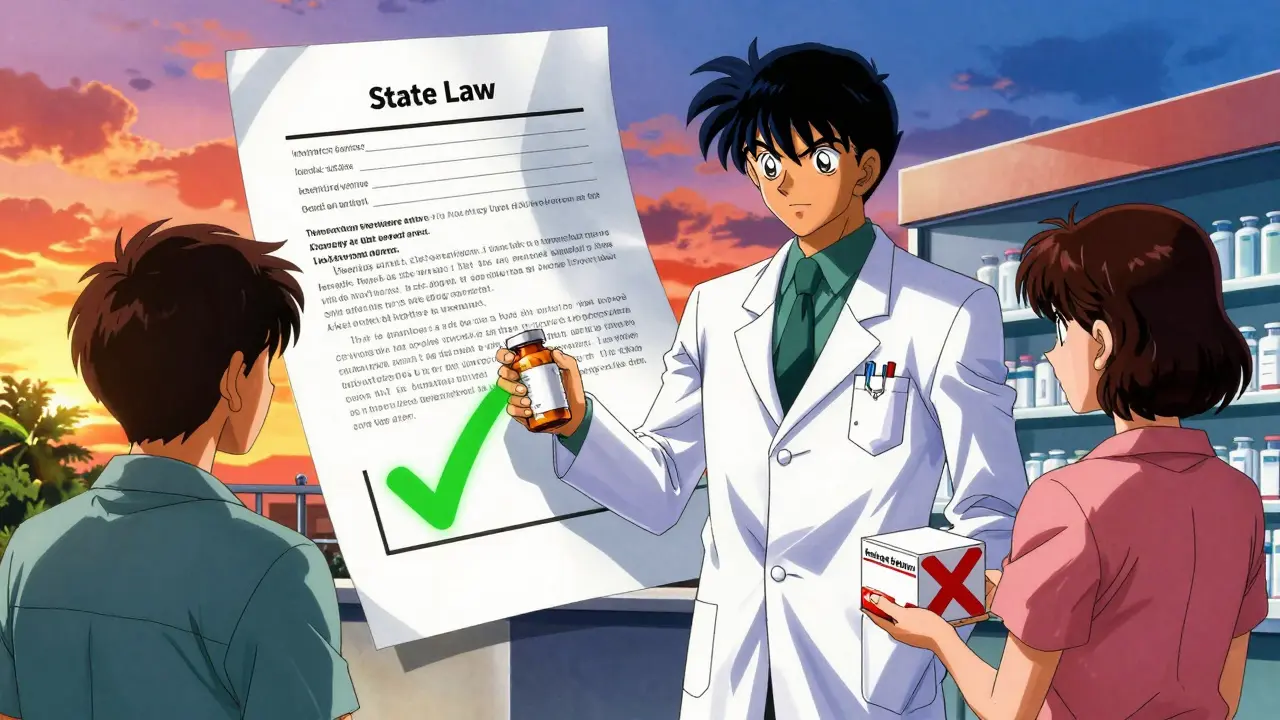
When you pick up a prescription, you might assume the pharmacist will give you the cheapest version of your medicine. But that’s not always true. It depends on where you live. In some states, pharmacists must swap your brand-name drug for a generic. In others, they can only do it if you say yes. These differences aren’t just paperwork-they affect how much you pay, whether you take your medicine, and even your health outcomes.
What’s the Difference Between Mandatory and Permissive Substitution?
Mandatory substitution means the law forces pharmacists to switch your brand-name drug for a generic version-unless your doctor specifically says not to. Permissive substitution means pharmacists are allowed to switch, but they don’t have to. They can choose to give you the brand-name drug even if a cheaper generic is available.
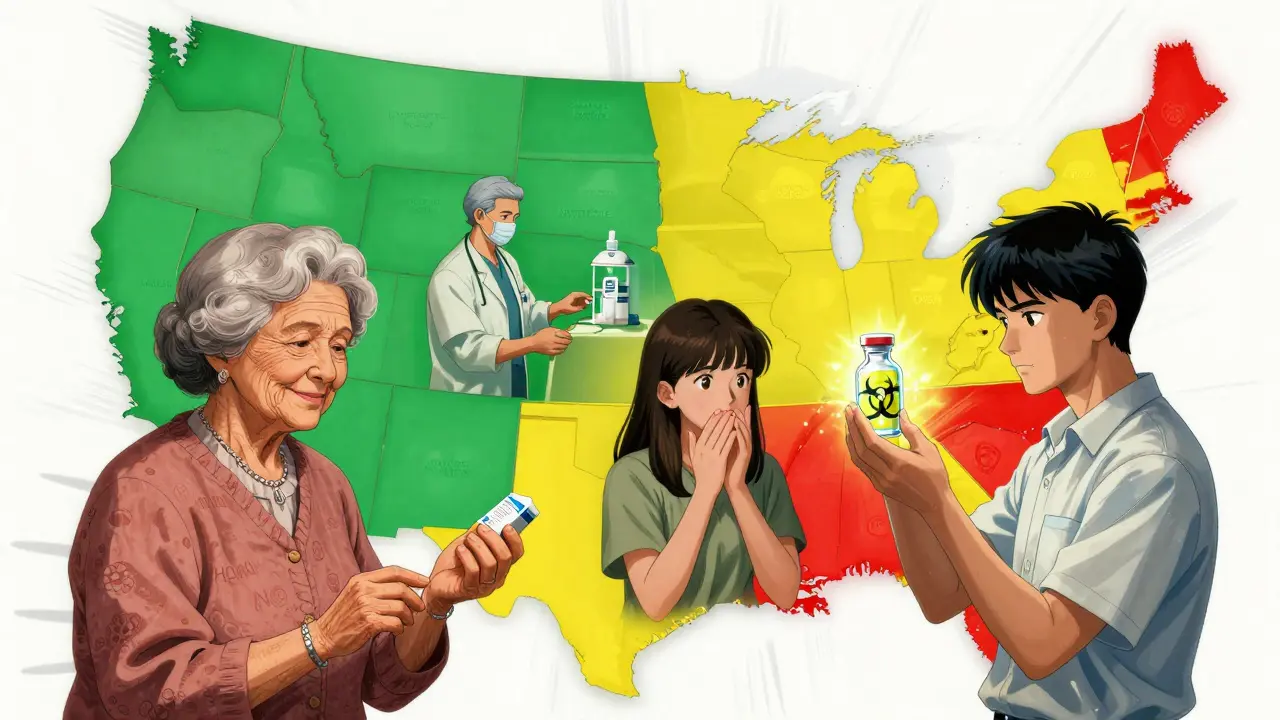
This isn’t about pharmacy policy. It’s about state law. Every state sets its own rules. As of 2020, 19 states-including Alabama, Colorado, Massachusetts, and West Virginia-require pharmacists to substitute generics whenever possible. The rest leave the decision up to the pharmacist, often with extra steps like getting your consent or notifying you in writing.
The difference sounds small, but the impact is huge. In states with mandatory substitution, nearly 50% of prescriptions for drugs like simvastatin were filled with generics within six months of patent expiration. In permissive states? Only 30%. That’s nearly a 20-point gap in generic use-just because of where you live.
How Do States Decide What Counts as a Substitute?
Most states rely on the FDA’s Orange Book, a public list that identifies which generic drugs are therapeutically equivalent to brand-name ones. If a generic is listed there, it’s considered a legal substitute. But some states go further. A few use positive formularies-lists of drugs that pharmacists can or must substitute. Others use negative formularies-lists of drugs that are off-limits for substitution, like certain heart or seizure medications.
For drugs with a narrow therapeutic index-where even tiny changes in dosage can cause serious side effects-states are extra cautious. Some require doctors to explicitly write “Dispense as Written” on the prescription. Others still allow substitution unless the doctor says no. The rules vary so much that a pharmacist in New York might have to do one thing, while a pharmacist in Texas does another, even for the same drug.
Do You Need to Give Permission to Switch?
One of the biggest surprises? In most states, you don’t have to say yes for a generic to be given to you. But in seven states and Washington, D.C., pharmacists must get your explicit consent before swapping your brand-name drug. That means they have to ask you, you have to say “yes,” and they have to document it.
That one requirement changes everything. In states that require consent, only 32% of simvastatin prescriptions were filled with generics six months after the brand went off-patent. In states without consent requirements? Nearly 98%. That’s not because patients didn’t want generics. It’s because asking for permission creates friction. Pharmacists don’t always ask. Patients don’t always understand. And the switch doesn’t happen.
Even worse, in mandatory substitution states that also require consent, pharmacists are almost twice as likely to skip substitution for high-risk drugs. Why? Because they’re afraid of getting it wrong. The law says they must substitute-but if you say no, they can’t. So they play it safe and don’t switch at all.
What Happens When the Doctor Says No?
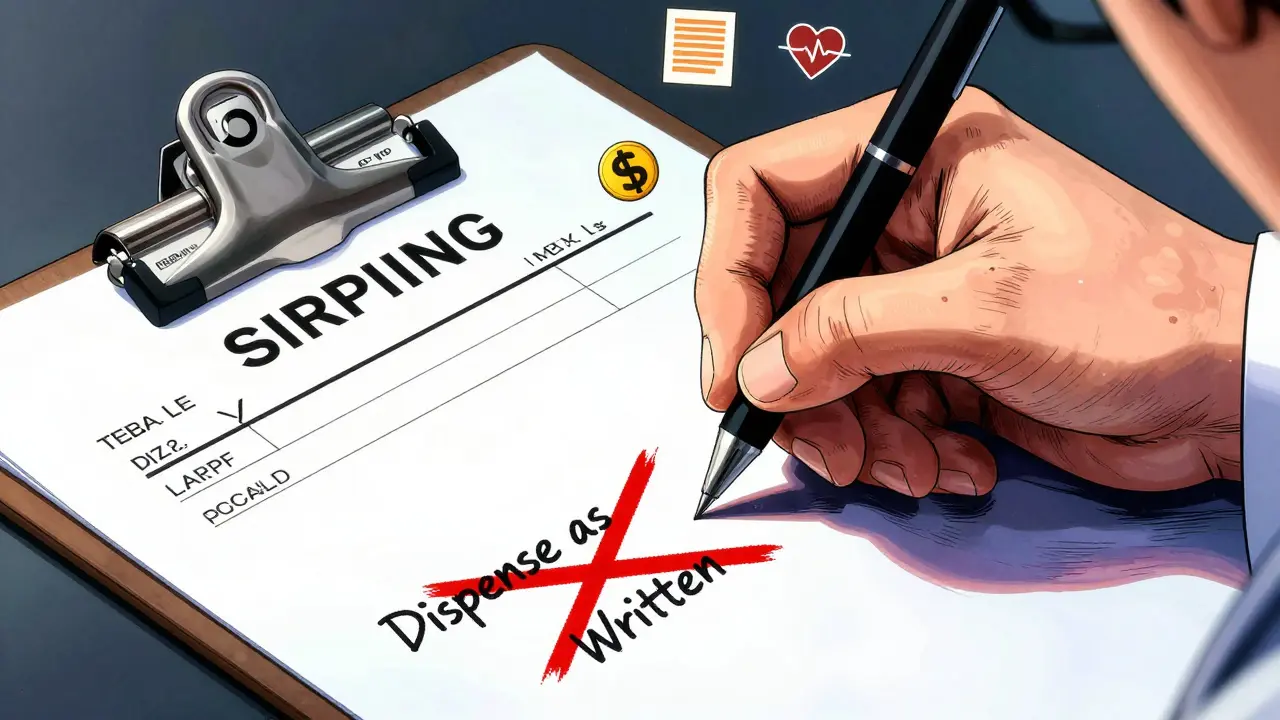
Every state allows doctors to block substitution. They can write “Dispense as Written,” “Brand Medically Necessary,” or “Do Not Substitute” on the prescription. But how they do it matters. In some states, the prescription pad has two lines-one for the doctor to sign the prescription, and another to approve substitution. If they sign only the top line, substitution is allowed. If they sign both, it’s blocked.
In other states, there’s no special form. The doctor must write the exact phrase to prevent substitution. If they forget, the pharmacist can switch the drug. That’s why some doctors end up writing “Do Not Substitute” on every prescription-even when they don’t mean it-just to be safe.
And here’s the catch: some states require doctors to explain why they’re blocking substitution. Others don’t. That means a patient in Florida might get a generic unless their doctor writes a note. A patient in California might get the brand name unless their doctor says otherwise.
Why Does This Matter for Your Health and Wallet?
Generic drugs cost 80% to 85% less than brand-name drugs. That’s not a small savings. For people on Medicaid or Medicare, it can mean the difference between filling a prescription and skipping doses. A study found that increasing generic use by just 1 percentage point saves Medicare Part D $160 million a year. Multiply that by 20 percentage points-and you’re talking billions.
But money isn’t the only issue. Medication adherence matters. If you’re paying less, you’re more likely to take your medicine regularly. In states with mandatory substitution, patients are more likely to stick with their treatment. In permissive states, confusion and delays can lead to missed doses.
And it’s not just about cost. In states with strict consent rules, pharmacists avoid switching high-risk drugs even when it’s safe. That means patients might stay on expensive brand drugs longer than needed-just because the system is too complicated to change.
What About Biologics and Biosimilars?
Biologics-drugs made from living cells, like insulin or rheumatoid arthritis treatments-are a whole different story. They’re expensive, complex, and harder to copy. The FDA has approved biosimilars, which are similar but not identical to the original biologic. But states treat them differently than regular generics.
Forty-five states have stricter rules for biosimilars than for small-molecule generics. Most require the doctor to be notified before substitution. Some require patient consent. A few even demand extra recordkeeping. Only nine states and D.C. treat biosimilars the same way as regular generics.
This caution makes sense. Switching biologics can trigger immune reactions in rare cases. But it also means patients pay more. Biosimilars can cut costs by 30% to 50%. Yet because of state laws, many patients never get the chance to try them.
Who’s Affected the Most?
Low-income patients on Medicaid feel the impact hardest. They’re more likely to rely on generics to afford their meds. In states with mandatory substitution, they get cheaper drugs faster. In permissive states, they might wait months-or never switch at all.
Prescribers are caught in the middle. They have to learn 50 different sets of rules. A doctor in Maine might assume their patient can get a generic. But if that patient moves to New York, the same drug might be blocked by law. That confusion leads to mistakes, delays, and unnecessary costs.
Pharmacists are the frontline. In mandatory states, they’re expected to act. In permissive states, they’re expected to judge. But without clear guidelines, many just stick with the brand-especially if they’re worried about liability. Twenty-four states don’t protect pharmacists from lawsuits if something goes wrong after a substitution. That’s a big reason why substitution doesn’t happen, even when it’s safe.
What’s Changing?
The number of states with mandatory substitution has grown-from 14 in 2014 to 19 in 2020. That’s a clear trend: more states are pushing for generics to lower costs. But as new drugs like biosimilars enter the market, lawmakers are adding more rules, not fewer.
Some states are starting to simplify. They’re removing consent requirements. Others are updating their formularies to include more generics. But progress is slow. The system remains a patchwork. And that patchwork costs patients money and health.
What Should You Do?
If you’re on a long-term medication, ask your pharmacist: “Is there a generic version? And does my state require them to give it to me?” Don’t assume it’s automatic. Check your prescription label. If you’re switched without being told, ask why.
If you’re a patient with a chronic condition, talk to your doctor. Ask if your prescription says “Dispense as Written.” If it does, and you’re not sure why, ask if a generic would work. You might save hundreds a year.
If you move to a new state, check their substitution rules. Your medication might be switched-or blocked-just because of your zip code.
These laws were meant to save money and improve access. But without clear, consistent rules, they’re doing the opposite. The fix isn’t complicated. Remove unnecessary consent steps. Protect pharmacists from liability. Make the rules the same across states. Then let generics do what they’re designed to do: help people get the medicine they need, at a price they can afford.
What’s the difference between mandatory and permissive substitution?
Mandatory substitution means pharmacists are legally required to give you a generic drug when it’s available and approved, unless your doctor says not to. Permissive substitution means pharmacists can choose to give you a generic, but they don’t have to-they can give you the brand-name drug instead, even if a cheaper generic exists.
Do I need to give consent for a generic drug to be substituted?
In most states, no-you don’t need to give consent. But in seven states and Washington, D.C., pharmacists must ask you and get your permission before switching your brand-name drug to a generic. This requirement can reduce generic use by more than half, even when the generic is safe and approved.
Can my doctor stop a generic substitution?
Yes. Every state allows doctors to block substitution by writing phrases like “Dispense as Written,” “Brand Medically Necessary,” or “Do Not Substitute” on the prescription. Some states require specific wording or special prescription forms. If your doctor doesn’t write anything, substitution is usually allowed.
Why are biosimilars treated differently than regular generics?
Biosimilars are more complex than traditional generics because they’re made from living cells, not chemicals. States treat them more cautiously due to concerns about immune reactions and switching effects. Forty-five states require extra steps like doctor notification or patient consent before substituting a biosimilar, even though they’re proven safe and effective.
How much money can I save with generic substitution?
Generics typically cost 80% to 85% less than brand-name drugs. In states with mandatory substitution, generic use is nearly 20 percentage points higher than in permissive states. That means patients in mandatory states save hundreds or even thousands of dollars a year on medications like cholesterol or blood pressure drugs.
Are pharmacists protected if something goes wrong after a substitution?
No-not in 24 states. In those places, pharmacists can still be held legally liable if a patient has an adverse reaction after a generic substitution, even if the drug is FDA-approved and properly dispensed. This fear of liability is one reason why pharmacists sometimes avoid substitution, even when it’s allowed.
Why do some states have different rules for substitution?
The federal government lets each state set its own rules. This started with the Hatch-Waxman Act in 1984, which created the generic drug approval system but left substitution laws to the states. As a result, we have 50 different systems-some focused on cost savings, others on caution, and many caught in between.
How can I find out my state’s substitution rules?
Ask your pharmacist-they’re required to know the rules. You can also check your state’s board of pharmacy website. Look for terms like “generic substitution,” “therapeutic equivalence,” or “dispense as written.” Some states post their laws online in plain language.
Laia Freeman
January 29, 2026 AT 06:10OMG I had no idea this was a thing?? I just assumed generics were automatic?? Like, I’m on simvastatin and my pharmacy switched me without asking, but my friend in Texas got the brand name and paid triple?? This is insane. Why does my zip code decide if I can afford to live??
Megan Brooks
January 31, 2026 AT 03:49The variation in state-level pharmaceutical substitution policy reflects a broader tension between cost-containment imperatives and clinical autonomy. While mandatory substitution may enhance aggregate adherence and fiscal efficiency, it inadvertently undermines the physician-patient relationship by depersonalizing therapeutic decision-making. The absence of federal harmonization creates a regulatory patchwork that complicates care coordination, particularly for mobile populations.
Doug Gray
February 1, 2026 AT 14:07So… we’re just letting pharmacists play god with my meds now? 😏 And doctors have to write ‘DO NOT SUBSTITUTE’ like it’s a magical incantation? LMAO. This isn’t healthcare, it’s a Choose Your Own Adventure book written by a bureaucrat who hates joy.
LOUIS YOUANES
February 2, 2026 AT 23:40Let’s be real - this whole system is designed to make you feel guilty for wanting to save money. Meanwhile, Big Pharma is sipping champagne on a yacht somewhere while you’re debating whether to skip your blood pressure med this month. Pathetic. And don’t even get me started on biosimilars - they’re basically generics with a PhD and a price tag to match.
Jasneet Minhas
February 4, 2026 AT 05:42Interesting how the U.S. treats drug substitution like a state fair game - every booth has different rules. Meanwhile, in India, generics are the default, and nobody bats an eye. Maybe we need less bureaucracy and more trust in science? 🤔
Eli In
February 5, 2026 AT 15:22I just moved from California to Florida last year and my asthma inhaler went from $4 to $80 overnight because they wouldn’t substitute. I cried in the pharmacy. No one asked me if I wanted the brand - they just assumed. I didn’t even know I could ask. This isn’t just policy. It’s trauma.
Sheryl Dhlamini
February 6, 2026 AT 03:32Wait… so if I’m in a state that requires consent, but the pharmacist doesn’t ask me, and I get the brand name… am I being overcharged… or under-served? 🤯 This system is so broken it’s almost poetic. Like, ‘Here’s your medicine, sir. We didn’t ask because we were afraid you’d say no.’
Kristie Horst
February 6, 2026 AT 21:24It is profoundly ironic that a system ostensibly designed to reduce financial burden on patients simultaneously imposes cognitive and emotional labor upon them - requiring patients to become legal advocates for their own pharmacological rights. This is not patient-centered care. This is patient burden.
Andy Steenberge
February 8, 2026 AT 19:36The real problem isn’t the laws - it’s the lack of education. Most patients don’t know what ‘therapeutic equivalence’ means. Pharmacists aren’t trained to explain it clearly. Doctors don’t know their own state’s rules. We’ve created a system where the only people who understand it are the lawyers who wrote it. Fix the communication, not just the statute.
rajaneesh s rajan
February 10, 2026 AT 00:30India has over 90% generic use and zero lawsuits over substitution. Why? Because we trust science, not paperwork. Here, you need a notary, a consent form, and a signed affidavit just to save $50. The U.S. healthcare system is like a phone that only works if you speak 17 dialects of bureaucratic Latin.
paul walker
February 11, 2026 AT 06:12Wait so if my doc didn’t write ‘do not substitute’… they can just swap my med?? I didn’t even know that was a thing… I thought the pharmacist had to ask me… this is wild. I need to check my last script.
Alex Flores Gomez
February 12, 2026 AT 19:12Bro, the fact that 24 states still let pharmacists get sued for giving you a generic is the most unhinged thing I’ve ever heard. It’s like saying ‘you can drive this car… but if you hit a pothole, we’re suing you.’ This isn’t medicine - it’s Russian roulette with pills.
Frank Declemij
February 13, 2026 AT 23:28Generics save billions. End of story. The rest is noise.