
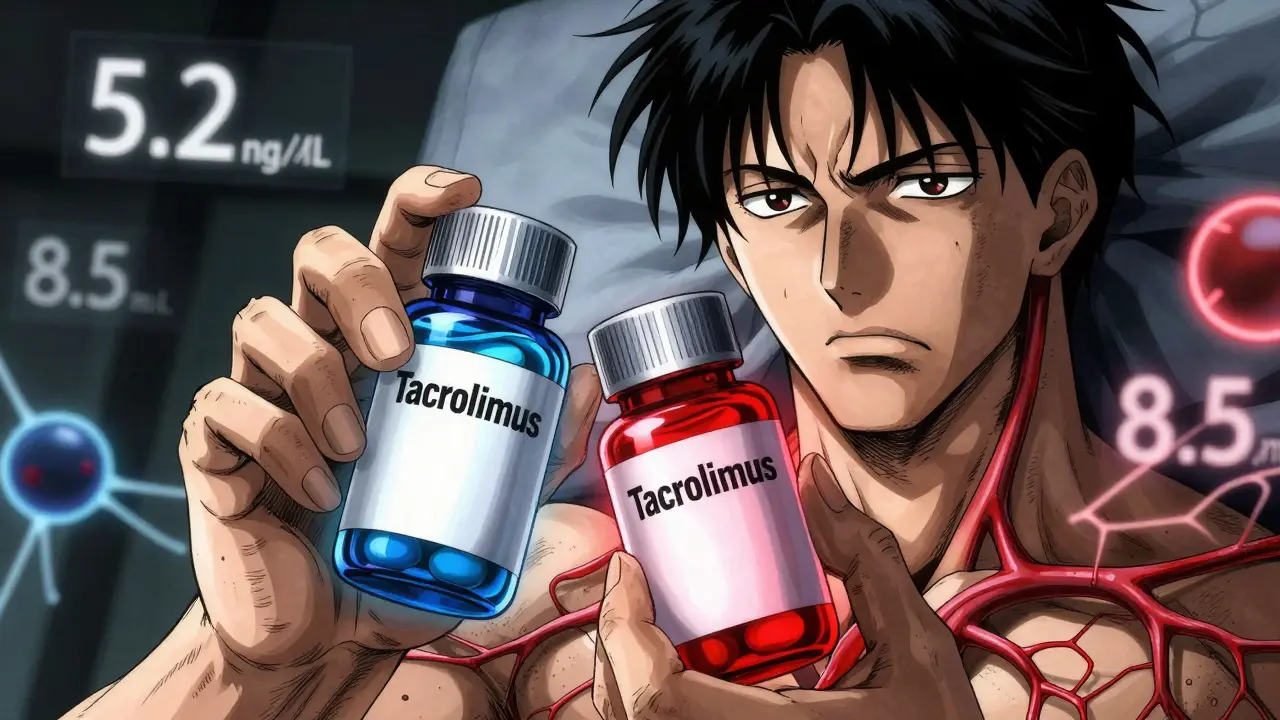
Switching from brand-name immunosuppressants to generics can save thousands a year - but for transplant patients, it’s not just about cost. With drugs like cyclosporine and tacrolimus, even tiny changes in blood levels can trigger rejection, toxicity, or hospitalization. These aren’t ordinary pills. They’re narrow therapeutic index (NTI) drugs, meaning the difference between a safe dose and a dangerous one is razor-thin. And when you switch between different generic versions, that line gets even blurrier.
Why These Drugs Are So Sensitive
Cyclosporine and tacrolimus work the same way: they block calcineurin, a protein that tells T-cells to attack the new organ. But that’s where the similarity ends. Tacrolimus is 20 to 100 times more potent than cyclosporine. A typical daily dose of tacrolimus is around 5 mg twice a day. Cyclosporine? About 150 mg twice a day. That’s a 30-fold difference in pill count - and a huge margin for error.
Both drugs are metabolized by the same liver enzyme, CYP3A4. That means anything that affects this enzyme - grapefruit juice, antibiotics, antifungals, even some herbal supplements - can send blood levels soaring or crashing. But the real problem comes from the pills themselves.
Generic versions of these drugs aren’t identical. They use different fillers, coatings, and oil-based carriers. For cyclosporine, the old Sandimmune formulation was unreliable. The newer microemulsion version (Neoral) fixed some of that - but even then, different generic manufacturers use different formulations. One company’s cyclosporine might dissolve faster than another’s. That changes how much gets into your bloodstream.
Tacrolimus is even trickier. It’s absorbed poorly and inconsistently. One study showed that switching between generic tacrolimus brands caused blood levels to fluctuate by up to 40% in some patients - enough to cause rejection or kidney damage. The FDA says generics must be within 80-125% of the brand’s absorption. Sounds tight? For a drug with a therapeutic range of only 5-15 ng/mL, that’s like hitting a bullseye while wearing blindfolds.
Real Consequences: Rejection, Toxicity, and Hospitalizations
It’s not theoretical. In 2023, a Reddit thread with over 140 comments from transplant patients revealed a pattern: after switching to a new generic tacrolimus, levels dropped. One user went from 8.5 ng/mL to 5.2 ng/mL in two weeks. That’s below the minimum safe level. He had a mild rejection episode. Another user’s cyclosporine levels spiked after switching brands - she ended up in the ER with tremors and confusion, signs of toxicity.
A 2022 survey of 1,247 transplant patients found that 42.7% noticed new or worse side effects after switching to a generic. Nearly one in five (18.3%) needed a dose change because their blood levels became unstable. Non-adherence rates jumped 15.3% among those on generics - not because they forgot, but because they didn’t trust the new pills.
And it’s not just patients. Transplant centers report that 73% of them had to change their monitoring protocols after patients switched generics. Weekly blood tests became standard for at least a month after any switch. Some centers now refuse to let patients switch brands unless they’re under direct supervision.
Why Tacrolimus Took Over - and Why Generics Are Still a Problem
Tacrolimus replaced cyclosporine in most transplant centers because it works better. A 2005 study showed patients on tacrolimus had less than half the rate of acute rejection compared to those on cyclosporine. Two years after transplant, their kidney function was significantly better. But tacrolimus comes with its own risks: higher rates of diabetes, tremors, and nerve tingling.
Still, by 2023, 98.7% of new kidney transplant patients in the U.S. started on tacrolimus. And 86.3% of those were on generics. The cost difference is massive. Brand-name Prograf could cost $1,200-$1,500 a month. Generic tacrolimus? $300-$500. That’s why Medicare and private insurers push generics hard.
But here’s the catch: there are 14 FDA-approved generic versions of tacrolimus from eight different manufacturers. Each one has a slightly different formulation. And most doctors don’t know which one a patient is on - because the label just says “tacrolimus.”

What You Can Do to Stay Safe
If you’re on one of these drugs, here’s what actually works:
- Stick with one generic brand. Once you find a generic that keeps your levels stable, ask your pharmacist to refill it - and never switch unless absolutely necessary. Some transplant centers now sign contracts with pharmacies to supply only one generic brand to all their patients.
- Get blood tests done regularly. After any switch - even to a different batch of the same generic - get your levels checked within 7-10 days. Then again at 2 and 4 weeks. Don’t wait for symptoms.
- Avoid grapefruit, Seville oranges, and pomegranate. These can double your tacrolimus levels. Even one glass can be dangerous.
- Take your dose at the same time every day. These drugs have short half-lives. Missing a dose or taking it 3 hours late can cause a drop in levels. Set phone alarms.
- Know your numbers. Ask your doctor for your target range. For tacrolimus, it’s usually 5-15 ng/mL in the first 6 months. For cyclosporine, 100-200 ng/mL. Keep a log. If your level drops below 5 ng/mL or rises above 15 ng/mL, call your transplant team immediately.
The Bigger Picture: Who’s Responsible?
Insurance companies want to cut costs. Generic manufacturers want to sell. Patients want to survive. But the system is broken. Only 41.7% of generic manufacturers provide detailed bioequivalence data to doctors. That means your pharmacist might not even know which version they’re dispensing - let alone whether it’s safe to switch.
The European Medicines Agency and the FDA have both warned that switching between generics without monitoring can lead to rejection or toxicity. In 2024, the EMA updated its guidelines to require bioequivalence studies in actual transplant patients - not just healthy volunteers. That’s a step forward. But in the U.S., the rules haven’t changed.
Meanwhile, companies are trying to fix this. Astellas launched a new extended-release tacrolimus in late 2023 that smooths out blood level spikes. Early results show fewer fluctuations. But it’s still expensive - and not yet widely available as a generic.
Another promising path? Genetic testing. About half of people have a gene variant (CYP3A5*3) that makes them metabolize tacrolimus slower. If you’re one of them, you need a lower dose. A 2023 study showed that using genetic testing to guide dosing cut the time to reach stable levels by 63%. It’s not standard yet - but it should be.

Bottom Line: Generics Save Money - But Not at the Cost of Your Transplant
Generic cyclosporine and tacrolimus are essential. Without them, many patients couldn’t afford their meds. But they’re not interchangeable. A $900 monthly savings means nothing if you lose your new kidney.
Don’t let your insurance force a switch without a plan. Ask your transplant team: Which generic brand am I on? Can I stay on it? What should I do if I get a different one? Keep your blood levels stable. Stick with one brand. Document everything. Your life depends on it.
Can I switch between different generic versions of tacrolimus or cyclosporine?
Switching between different generic brands of tacrolimus or cyclosporine is not recommended without close medical supervision. Even small differences in formulation can cause significant changes in blood levels, leading to rejection or toxicity. If a switch is necessary, your transplant team should monitor your drug levels weekly for at least four weeks after the change.
Why is tacrolimus more dangerous than cyclosporine when switching generics?
Tacrolimus has a narrower therapeutic window - its safe range is only 5-15 ng/mL - and it’s absorbed inconsistently from the gut. A 20% change in absorption can push you from a safe level to a toxic one. Cyclosporine’s range is wider (100-200 ng/mL), but its absorption is still affected by food and formulation. Both are risky, but tacrolimus’s lower dose and tighter range make it more sensitive to small changes.
How often should I get my blood levels checked after switching to a generic?
After switching to any new generic version of tacrolimus or cyclosporine, you should have your blood levels checked within 7-10 days, then again at 2 and 4 weeks. After that, if levels remain stable, your doctor may return to monthly checks. Never assume a new generic is safe without testing.
Are all generic versions of cyclosporine the same?
No. Cyclosporine comes in different formulations - microemulsion (like Neoral) and older oil-based versions. Even within microemulsion generics, different manufacturers use different excipients (fillers and carriers), which affect how well the drug is absorbed. Some patients tolerate one brand well but have unstable levels with another. Always ask which specific generic you’re receiving.
What should I do if my insurance forces me to switch to a different generic?
Request a medical exception from your insurer. Your transplant team can submit documentation showing that switching could put your graft at risk. Many insurers will approve continued use of your current generic if you’ve had stable levels on it. Keep records of your blood levels and any side effects - they’re your strongest evidence.
Can grapefruit juice really affect my immunosuppressant levels?
Yes. Grapefruit, Seville oranges, and pomegranate block the enzyme that breaks down both tacrolimus and cyclosporine. This can cause drug levels to spike by 200-300%, leading to kidney damage, tremors, or seizures. Avoid all forms - juice, fruit, and even flavorings in food or supplements.
Is there a way to avoid generic switching altogether?
Some transplant centers now use "single generic source" contracts, meaning they only dispense one brand of generic tacrolimus or cyclosporine to all patients. If your center doesn’t, ask if they can advocate for it. You can also request a prior authorization for your current generic if it’s working well - many insurers will approve it if you show stable levels and no side effects.
Next Steps: What to Do Today
Check your last blood test result. Do you know your current tacrolimus or cyclosporine level? If not, call your transplant clinic and ask. Look at your prescription bottle - is the generic manufacturer listed? If it says "tacrolimus" without a brand name, ask your pharmacist which company made it. Write it down.
Set a reminder for your next blood test. If you’ve switched generics in the last month, schedule a level check now - don’t wait. Talk to your doctor about staying on one brand. If you’re being forced to switch, ask for a medical exception. Your transplant isn’t a commodity. Your meds shouldn’t be either.
David Chase
December 28, 2025 AT 20:08THIS IS WHY AMERICA IS FALLING APART!! 🤬 You let some corporate pharmacy switch my Prograf to some no-name generic and I almost lost my kidney!! I had tremors, nausea, and my wife thought I was having a stroke!! 😱 The FDA is a joke!! Why do they even approve these?!! I want blood!!
Emma Duquemin
December 30, 2025 AT 01:49OMG I CRIED READING THIS. 😭 My brother got a liver transplant in 2021 and they switched him to a generic tacrolimus without telling him. He went from 10.2 to 4.8 in 10 days. We rushed him to the ER - they thought he was gonna die. Now we have a laminated card in his wallet that says: ‘DO NOT SWITCH MY MEDS.’ I’m screaming at the top of my lungs: THIS ISN’T JUST A DRUG - IT’S HIS LIFE. 🙏 #TransplantWarrior
Kevin Lopez
December 31, 2025 AT 19:15NTI drugs. CYP3A4 polymorphisms. Bioequivalence thresholds. The FDA’s 80-125% window is statistically meaningless for tacrolimus. Pharmacokinetic variance exceeds therapeutic index. You’re not managing a chronic condition - you’re playing Russian roulette with a loaded chamber. And yes, this is why transplant centers now mandate single-source generics. It’s not preference. It’s survival.
Jasmine Yule
January 2, 2026 AT 02:14I just want to say thank you for writing this. I’m a nurse in a transplant unit and I see this every single week. Patients panic when they get a different pill. They don’t know what’s changed. They think they’re ‘being paranoid.’ But they’re not. They’re survivors. And they’re right to be scared. Please don’t let insurance companies treat this like a coupon swap. These aren’t pills. They’re lifelines.
Himanshu Singh
January 3, 2026 AT 00:03Bro this is so important! I am from India and my cousin got kidney transplant last year. He switched generic and got fever and headache. We had to fly him back to hospital. Now we only buy one brand. I shared this with my group. Everyone must know this!! 💪❤️
Jim Rice
January 3, 2026 AT 20:32So you’re saying we shouldn’t save money? That’s rich. My insurance pays $1200/month for Prograf. You want me to pay $300? No. You want me to get blood tests every week? That’s $500 every time. So now I’m paying $2000/month instead of $1200? Brilliant. You’re not helping. You’re just making the system more expensive. Let people choose. Let the market decide.
Teresa Rodriguez leon
January 5, 2026 AT 01:47I’ve been on generic cyclosporine for 8 years. Never had an issue. Your fear-mongering is doing more harm than good. Not everyone has a bad experience. Some of us are fine. Stop scaring people into thinking every switch is a death sentence.
Manan Pandya
January 6, 2026 AT 18:14Actually, the real solution is not just sticking to one brand - it’s implementing pharmacogenomic testing at scale. About 50% of people are CYP3A5 non-expressors and need 30-50% lower tacrolimus doses. If we tested everyone upfront, we could predict stability before even prescribing. Why aren’t transplant centers doing this routinely? It’s cheaper than monthly labs. And it’s evidence-based. The data is here. We just need the will.
Amy Cannon
January 7, 2026 AT 09:39As someone who has spent 14 years as a transplant coordinator in a major U.S. hospital, I can tell you - this isn't just a pharmacology issue. It's a systemic failure. We have patients who can't afford brand-name drugs. We have pharmacists who don't know which generic they're dispensing. We have insurers who auto-switch without consent. We have doctors who assume 'tacrolimus' is 'tacrolimus'. And we have patients who are too terrified to speak up. This post? It's a lifeline. But we need policy change. Not just awareness. We need legislation that requires manufacturer labeling on all immunosuppressant generics - and mandatory monitoring protocols after any switch. Anything less is medical negligence. 🤕