

For years, doctors and patients relied on simple letter grades-A, B, C, D, X-to decide if a drug was safe during pregnancy. But those letters didn’t tell the full story. They made people think a drug labeled "C" was just "a little risky," when in reality, it could mean anything from "no human data" to "serious animal findings." That’s why the FDA replaced the old system in 2015 with something much more detailed: the Pregnancy and Lactation Labeling Rule (PLLR). Now, instead of a single letter, you get real information-numbers, timelines, risks, and practical advice. If you’re pregnant, breastfeeding, or helping someone who is, learning how to read these new labels can make all the difference.
What Changed with the FDA’s New Drug Labels?
Before June 30, 2015, drug labels used five letter categories:- A: Human studies show no risk (rare-less than 2% of drugs)
- B: Animal studies show no risk, but human data is limited (about 15% of drugs)
- C: Risk can’t be ruled out (70% of drugs-this was the most common)
- D: Clear evidence of human risk, but benefits may outweigh risks (10% of drugs)
- X: Contraindicated in pregnancy-risks clearly outweigh benefits (less than 1%)
- 8.1 Pregnancy
- 8.2 Lactation
- 8.3 Females and Males of Reproductive Potential
How to Read the Pregnancy Section (8.1)
This is where you find the real meat of the information. Forget the letters. Look for three things:1. Risk Summary: Numbers, Not Letters
Instead of "C," you’ll see something like:"The background risk of major birth defects in the U.S. general population is 2-4%. In a prospective cohort of 1,200 pregnancies exposed to [Drug Name] during the first trimester, the rate of major birth defects was 4.8% (95% CI: 3.6-6.3%). This represents a 1.5-fold increased risk compared to background."That’s powerful. It tells you:
- What the normal risk is (2-4%)
- What the risk is with the drug (4.8%)
- Whether the increase is statistically meaningful (1.5-fold)
2. Clinical Considerations: What to Do
This part gives you actionable steps:- "Avoid use during the first trimester due to risk of cardiac defects."
- "Monitor fetal growth with ultrasound every 4 weeks after 20 weeks gestation."
- "Consider switching to [Alternative Drug] in the second trimester."
3. Data: Where the Info Came From
This section is for the curious or the professionals. It lists:- Study type (e.g., "prospective cohort," "retrospective case-control")
- Sample size (e.g., "n = 870 pregnant women")
- Limitations (e.g., "no data on exposure beyond 32 weeks," "underrepresentation of Hispanic women")
How to Read the Lactation Section (8.2)
Breastfeeding and medications? That’s a whole different question. The old system didn’t even try to answer it. Now, you get specifics:1. Drug Transfer into Breast Milk
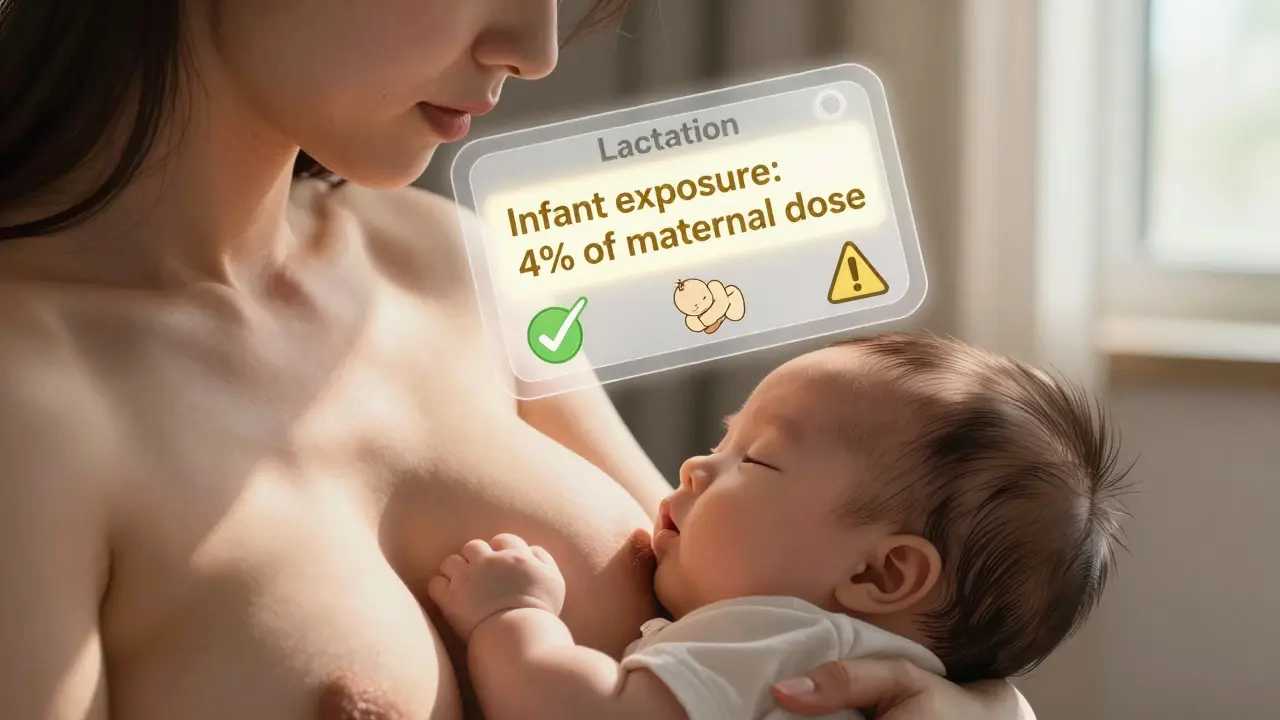
Look for phrases like:"Maternal serum concentration: 120 ng/mL. Infant serum concentration: 5 ng/mL. Infant exposure: 4% of maternal weight-adjusted dose."That means the baby gets only 4% of what the mom takes. For most drugs, that’s considered low risk.
2. Potential Effects on the Infant
The label will tell you if there’s any known impact:- "No adverse effects reported in 90 breastfed infants exposed to [Drug Name]."
- "Case reports of drowsiness and poor feeding in infants exposed to high maternal doses."
- "Monitor infant for irritability, poor feeding, or jaundice."
3. Recommendations
Sometimes it’s clear:- "Breastfeeding is not recommended during treatment."
- "Breastfeeding is compatible with use; no special precautions needed."
"Consider timing doses to minimize infant exposure-administer immediately after breastfeeding and delay next feeding for 4 hours."This kind of detail helps you make smart choices without stopping breastfeeding.
What About Fertility and Contraception? (Section 8.3)
This section often gets overlooked, but it’s critical. If a drug can affect fertility or cause birth defects, this part tells you:- "Pregnancy testing required before starting treatment."
- "Two forms of contraception required during treatment and for 3 months after last dose."
- "Use of hormonal contraception contraindicated due to increased risk of thromboembolism."
- "Reversible infertility reported in 2% of male patients after 6 months of use."
Why the New System Is Better (Even If It’s Harder)
The old letter system was fast. The new one isn’t. But it’s accurate. A 2017 FDA study showed that with the old system, 68% of providers misjudged risk. With the new narrative format, that dropped to 31%. That’s a huge improvement. The downside? It takes time. A 2018 study found 62% of obstetricians felt overwhelmed at first. Pharmacists now spend 5-7 extra minutes per prescription counseling patients. Clinicians report needing 3-5 label reviews before they feel confident. But here’s the upside:- You know the actual risk, not a guess.
- You understand when during pregnancy a drug is most dangerous.
- You can compare risks across multiple drugs.
- You can talk to your provider with real data, not vague warnings.

What If the Label Doesn’t Help?
Not every drug has perfect data. Some labels still say: "Limited human data available." That’s frustrating, but it’s honest. When that happens, turn to trusted resources:- MotherToBaby: Free, expert advice by phone or chat. They review FDA labels and give personalized guidance.
- TERIS: A clinical database used by OB/GYNs and pharmacists for teratogenic risk assessment.
- FDA’s PLLR Navigator App: Search any drug and pull up the exact labeling section.
What’s Next for Drug Labeling?
The FDA is working on making these labels even clearer. In 2023, they proposed adding simple visual icons:- A green checkmark for "safe with monitoring"
- An orange warning triangle for "use with caution"
- A red X for "avoid"
Bottom Line: What You Need to Do
If you’re pregnant, breastfeeding, or planning to be:- Don’t rely on old advice or internet rumors. Always check the current FDA label.
- Look for the three sections: Pregnancy, Lactation, Reproductive Potential.
- Focus on the Risk Summary and Clinical Considerations first-they’re your action plan.
- If the label is unclear, call MotherToBaby (1-866-626-6847) or ask your pharmacist to pull up the official labeling.
- Remember: A "C" doesn’t mean "don’t take it." A 4% infant exposure doesn’t mean "dangerous." Context matters.
What do the old pregnancy letter categories (A, B, C, D, X) mean now?
The letter categories (A, B, C, D, X) were officially removed from all drug labels by December 2017. They no longer appear on new or updated labels. If you see them on an old bottle or website, they’re outdated and misleading. Always refer to the current FDA-mandated narrative sections: Pregnancy (8.1), Lactation (8.2), and Females and Males of Reproductive Potential (8.3).
Can I trust the new pregnancy labels if they’re so long and complicated?
Yes-because they’re based on real data, not simplified guesses. While they’re longer, they’re more accurate. The FDA found that 68% of providers misused the old letter system. With the new labels, that dropped to 31%. If the text feels overwhelming, focus on the Risk Summary and Clinical Considerations. These are the parts meant for decision-making. Use MotherToBaby or your pharmacist if you need help translating the details.
What if my drug doesn’t have a lactation section?
All drugs approved after June 30, 2015, must include a lactation section. If you’re looking at an older label, it may still be outdated. Check the FDA’s website or use the PLLR Navigator app to find the most current version. If no lactation data exists, it means there’s insufficient evidence-not that the drug is unsafe. In those cases, consult MotherToBaby or your provider to assess risk based on similar drugs or pharmacokinetic data.
How do I know if a drug is safe for my baby while breastfeeding?
Look for two key numbers in the Lactation section: infant exposure as a percentage of maternal dose, and any reported infant effects. If infant exposure is under 10% and no adverse effects are noted, it’s generally considered safe. For example, a drug with 4% infant exposure and no reported side effects in 90 breastfed infants is low risk. If the label says "monitor for drowsiness or poor feeding," follow up with your pediatrician. Never assume a drug is unsafe just because it’s not labeled "safe"-many drugs are compatible with breastfeeding even without a perfect label.
Do generic drugs have the same labeling as brand-name versions?
Yes. The FDA requires generic drugs to have identical labeling to their brand-name counterparts, including the full Pregnancy, Lactation, and Reproductive Potential sections. If the brand-name version has updated PLLR labeling, the generic must too. If you see different labels, one is likely outdated. Always verify the most current version using the FDA’s website or a reliable drug database.
Are there any apps or tools to help me read these labels faster?
Yes. The FDA offers the free "PLLR Navigator" app, which lets you search any drug and pull up its current labeling in seconds. MotherToBaby also has a website and phone line (1-866-626-6847) where specialists help interpret labels in plain language. Many electronic health records now include PLLR summaries, but not all are well designed. If your provider’s system doesn’t make it easy to read, ask them to show you the official FDA label directly.
Oluwatosin Ayodele
December 25, 2025 AT 23:53The old A-B-C-D-X system was pure nonsense. I've seen nurses hand out "C" drugs like candy and act like it's a green light. The FDA finally got it right. Now you can actually see the numbers - 4.8% defect rate vs 2-4% baseline? That's real data. No more guessing. If you're still using the old letters, you're not just outdated - you're dangerous.
Mussin Machhour
December 27, 2025 AT 19:42Finally! I’ve been yelling about this for years. I work in OB and we used to have to Google everything because the labels were useless. Now I can show a patient the exact risk numbers and they actually get it. My wife was on an SSRI during her pregnancy - we looked up the label, saw the data, and didn’t panic. That’s huge. Thank you, FDA.
Bailey Adkison
December 29, 2025 AT 06:41Don't let the FDA fool you. This 'improvement' is just bureaucratic bloat. They replaced four letters with three paragraphs of jargon. Who has time to read this? Your OB doesn't. Your pharmacist doesn't. Your insurance company doesn't. You're just being forced to read a 10-page essay for a decision that should take 3 seconds. This isn't progress. It's overregulation dressed up as transparency.
Gary Hartung
December 30, 2025 AT 10:20Oh my god. I just spent 45 minutes reading the label for my prenatal vitamin. FOURTY-FIVE MINUTES. And what did I learn? That the background risk of birth defects is 2-4%. I already knew that. I didn’t need a 2000-word essay on prospective cohorts and confidence intervals to tell me that. This isn’t science. It’s a performance. The FDA wants us to feel like we’re doing our homework so we don’t sue them when something goes wrong. It’s all theater.
Carlos Narvaez
December 31, 2025 AT 23:09Simple truth: The new system works. The old one didn't. Period. If you can't handle reading a few paragraphs to make a life-or-death decision, that's on you. Stop blaming the format. The data is there. Use it.
Harbans Singh
January 1, 2026 AT 13:23I’m from India and we don’t have great access to this info. But I showed my sister-in-law how to use MotherToBaby last week. She was terrified about her blood pressure med. We looked up the label together - infant exposure was 3.2%, no adverse reports. She cried. Not from fear - from relief. This system isn’t perfect, but it’s the first time I’ve seen a drug label that didn’t make me feel like I was gambling with my baby’s life.
Justin James
January 2, 2026 AT 16:01Did you know the FDA changed this system right after the 2016 election? Coincidence? No. They’re pushing this because they want to control what women take during pregnancy. The old letter system was simple. Now they’ve got you drowning in data so you’ll second-guess every pill. And who benefits? Big Pharma. They pay for the studies. They shape the data. They profit from the confusion. This isn’t transparency - it’s psychological manipulation. You think you’re informed? You’re being gaslit with statistics.
Rick Kimberly
January 4, 2026 AT 01:30It is worth noting that the transition to the Pregnancy and Lactation Labeling Rule, while operationally burdensome for clinicians, represents a significant epistemological advancement in pharmacovigilance. The shift from categorical heuristics to quantitative, evidence-based risk communication aligns with best practices in risk perception theory as articulated by Slovic (1987) and Fischhoff (1995). The reduction in misinterpretation from 68% to 31% is not merely statistically significant - it is clinically transformative.
Katherine Blumhardt
January 5, 2026 AT 07:41ok so i just read the label for my anxiety med and it says "monitor infant for irritability" but i dont even know what that looks like?? like is it just crying more?? or is it like screaming and throwing things?? also i think the app is broken i clicked on it and it just took me to a page about gummy bears??
sagar patel
January 5, 2026 AT 23:50They replaced letters with paragraphs so they can charge more for counseling. Every time a patient asks about a drug, the pharmacist now has to spend 7 minutes reading the label. That’s 7 minutes they’re not billing. So they’ll start pushing the old letters again. It’s not about safety - it’s about money. You think the FDA cares? They’re just following the cash.