
Every time you pick up a prescription, there’s a hidden safety check built into the label - if you know where to look. Many people don’t realize that the tiny print on their medication bottle could be the difference between taking the right dose and a dangerous mistake. In the U.S., medication errors linked to incorrect strength or quantity cause over 1.3 million incidents every year. Most of these are preventable - and the first line of defense is you.
What Medication Strength Really Means
Strength isn’t just a number. It’s the exact amount of active drug in each dose. For a pill, it’s usually written as 500 mg, meaning each tablet contains 500 milligrams of the medicine. For liquids, it’s a ratio: 250 mg/5 mL means every 5 milliliters of liquid contains 250 milligrams. That’s critical because if you mistake the ratio, you could give your child ten times the intended dose.
Here’s how strength appears on common formulations:
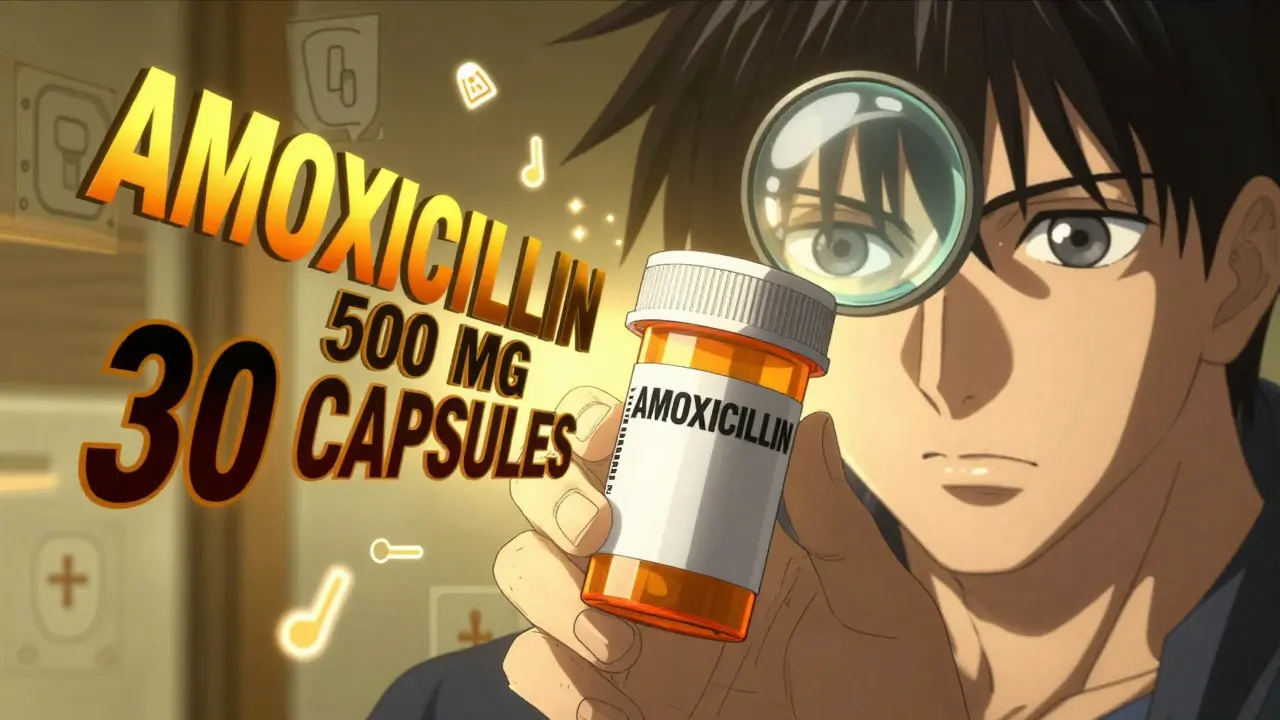
- Tablets/Capsules: AMOXICILLIN 500 MG
- Liquids: 5 MG/5 ML (or 1 MG/ML)
- Creams/Ointments: HYDROCORTISONE 1% (meaning 1 gram of drug per 100 grams of cream)
- Injections: 1000 IU/mL
Units matter. mcg (micrograms) and mg (milligrams) look similar but are 1,000 times different. A 0.5 mg dose isn’t the same as 5 mg - that’s a tenfold error. The FDA banned abbreviations like U for units because it can be mistaken for a zero. Now, labels must spell out unit to avoid confusion.
What Quantity Tells You
Quantity is the total amount dispensed. It doesn’t tell you how much to take - just how much you got. For example:
- 30 tablets = 30 pills total
- 120 mL = 120 milliliters of liquid
- 30 grams = 30 grams of cream
Don’t confuse quantity with daily dose. If your label says 30 tablets and your doctor says take one daily, you’ll have a 30-day supply. But if the label says 30 mg - that’s strength, not quantity. Mixing those up is one of the most common mistakes.
Where to Find Strength and Quantity on the Label
By law, U.S. pharmacies must place strength directly next to the drug name. You’ll usually find it:
- Right below the medication name (CVS)
- In parentheses after the name (Walgreens)
- Bolded or in larger font - federal guidelines recommend this
Look for two lines:
- Drug Name: AMOXICILLIN
- Strength: 500 MG
- Quantity: 30 CAPSULES
Some labels also include the prescription number (Rx#) and directions. Always cross-check the strength and quantity against your doctor’s written instructions. If your doctor prescribed 250 mg but the label says 500 mg - stop. Don’t take it. Call the pharmacy.
Why This Matters: Real Stories
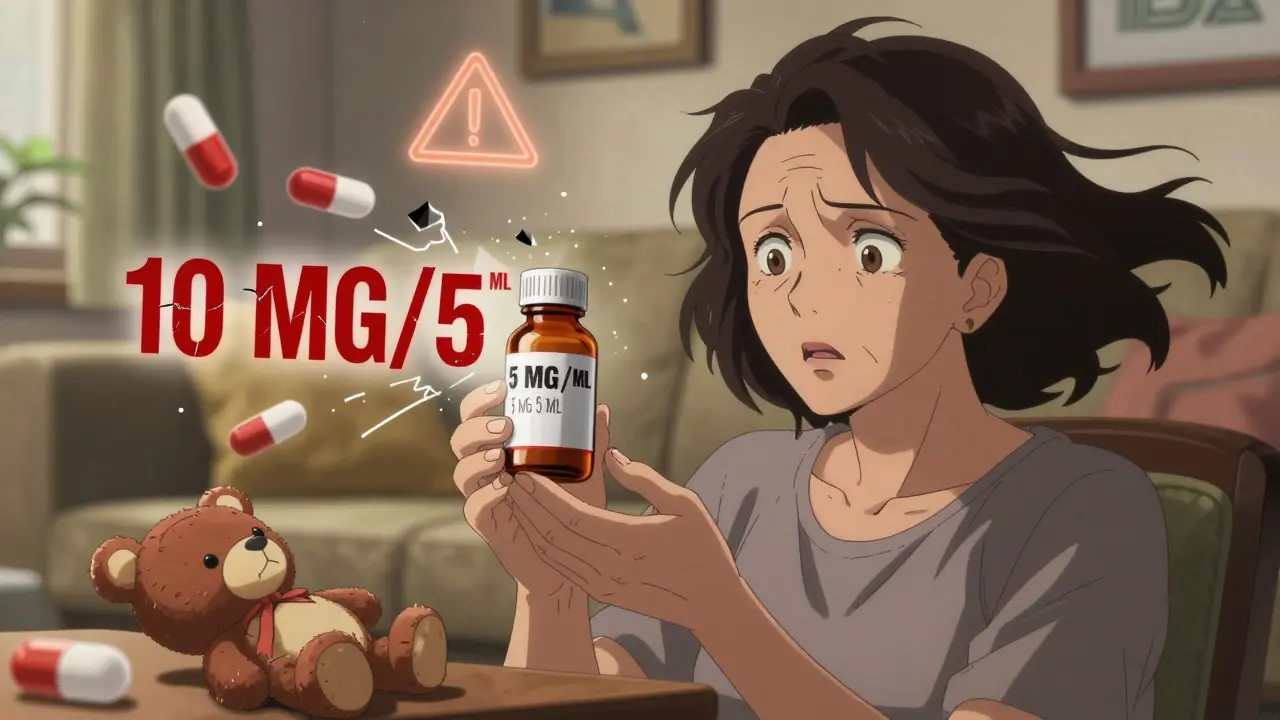
A mother on Reddit caught her son’s amoxicillin was labeled 500 mg/5 mL instead of 250 mg/5 mL. She almost gave him double the dose. Another person in Arizona found their blood pressure pill was labeled 10 mg instead of 2.5 mg. The pills looked similar, but the strength was wrong. Without checking the label, they might have suffered a dangerous drop in blood pressure.
According to the Institute for Safe Medication Practices, 28% of dosing errors are caught by patients who double-check their labels. Elderly patients are at highest risk - over 37% of strength-related errors happen in people over 65. Why? Font size, complex regimens, and multiple medications make it harder to keep track.
How to Verify Your Medication: A 4-Step Check
Follow this simple routine every time you get a new prescription:
- Locate the strength. Find the number right next to the drug name. Is it in mg, mcg, or IU? Write it down.
- Compare to your prescription. Does it match what your doctor wrote? If your script says 5 mg and the label says 10 mg - question it.
- For liquids, check the ratio. Is it 5 mg/5 mL? That’s 1 mg per mL. If it’s 50 mg/5 mL, that’s 10 mg per mL - ten times stronger. Don’t assume.
- Count the quantity. If you’re supposed to take one pill a day for 30 days, you should get 30 pills. If you get 60, ask why.
Use a magnifying app on your phone. Many pharmacies now offer high-contrast labels for low vision. Ask for them. It’s your right.
What to Do If Something Looks Wrong
If the strength or quantity doesn’t match your prescription:
- Don’t take the medication.
- Call the pharmacy immediately.
- Ask them to confirm the prescription with your doctor.
- Request to speak with the pharmacist - not just the technician.
Pharmacists are trained to catch these errors. A 2023 survey found that 76% of pharmacists say patients who ask questions prevent mistakes. Your vigilance saves lives.
What’s Changing in Labeling
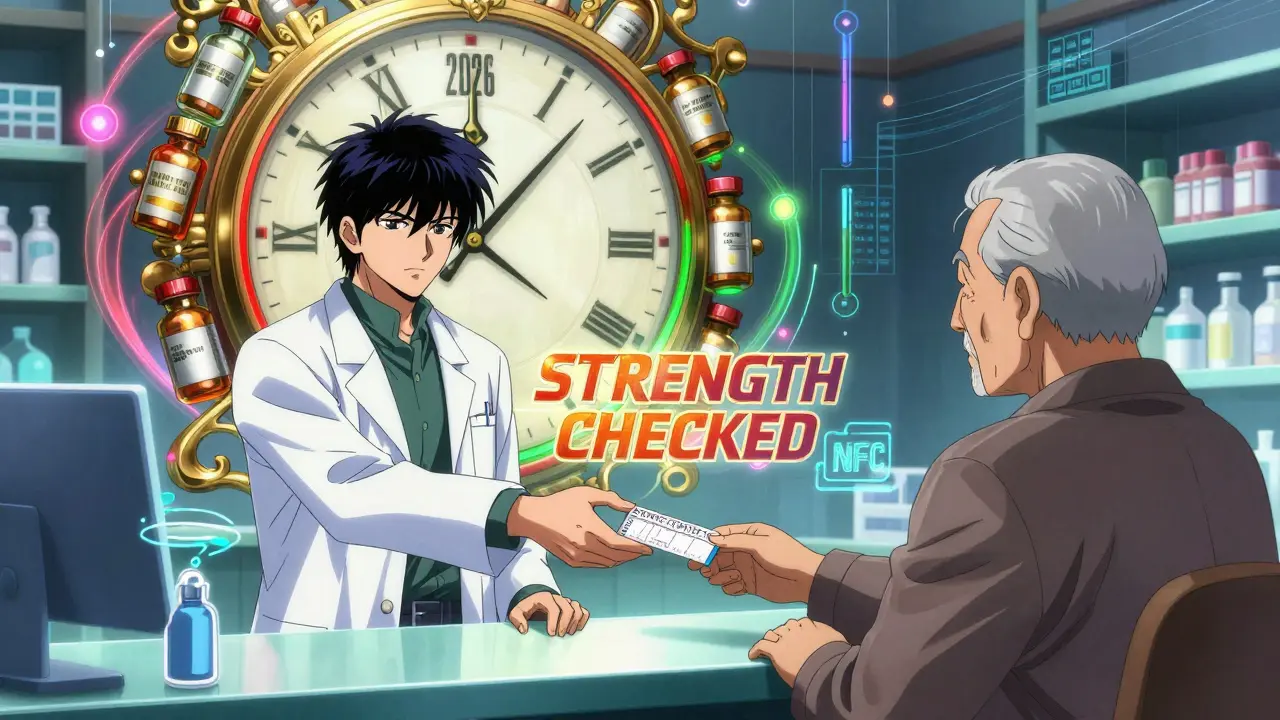
The FDA is pushing for better labeling. By January 2025, high-risk drugs like insulin and blood thinners must have clearer strength indicators - possibly color-coded borders. Some pharmacies are testing NFC chips on labels. Tap your phone, and it reads the strength, shows dosage instructions, and even warns if it conflicts with your other meds.
By 2026, color-coding for strength levels may become standard. Red borders for high-alert drugs. Green for routine ones. It’s still early, but the goal is simple: make it impossible to miss.
Final Tip: Make It a Habit
It only takes 30 seconds to check your label. Do it every time. Even if you’ve taken the same pill for years. Pharmacies change suppliers. Generic brands switch manufacturers. The pill might look the same - but the strength might not be.
Patients who check their labels report feeling 78% more confident about their medication safety. That peace of mind? It’s worth the extra second.
What if the prescription label says different strength than my doctor prescribed?
Do not take the medication. Contact the pharmacy immediately and ask them to verify the prescription with your doctor. Pharmacies sometimes make filling errors - especially with similar-sounding drugs. Always confirm the strength matches your written prescription. If the pharmacy insists it’s correct, ask to speak with the pharmacist on duty. You have the right to a second verification.
Can I ask for a larger font on my prescription label?
Yes. Under the Americans with Disabilities Act and CMS accessibility guidelines, pharmacies are required to provide high-contrast or large-print labels upon request. This is especially common for Medicare patients. Just ask the pharmacist when you pick up your prescription. Many chains also offer printed copies with enlarged text you can keep for reference.
How do I know if a liquid medication’s strength is correct?
Look for the concentration ratio: e.g., 5 mg/5 mL. That means 5 milligrams of medicine in every 5 milliliters of liquid. To find the dose per mL, divide: 5 mg ÷ 5 mL = 1 mg per mL. If you’re supposed to take 2.5 mg, you’d need 2.5 mL. Always use the measuring device that came with the medicine - never a kitchen spoon. A teaspoon can vary from 3 mL to 7 mL. A dosing syringe is accurate.
Why do some labels use brand names and others use generic names?
In the U.S., pharmacies can list either the brand name (like Lipitor) or the generic (atorvastatin), depending on what the prescriber wrote. Most prescriptions now allow generic substitution. If you’re unsure, ask the pharmacist: “Is this the same as what my doctor ordered?” The active ingredient must be identical. The brand name may be listed first, but the strength and quantity are what matter.
Are there apps that help me verify medication strength?
Yes. Many pharmacy chains like CVS, Walgreens, and Kaiser Permanente offer apps that scan your prescription barcode and show you the exact strength, dosage instructions, and drug interactions. Some third-party apps like Medscape or MyTherapy also let you manually enter your meds and alert you if the label doesn’t match your profile. These tools are especially helpful if you take multiple medications or have trouble reading small print.
Next Steps
Start today. The next time you get a prescription, pause. Read the label out loud. Write down the strength and quantity. Compare it to your doctor’s note. If anything feels off - speak up. You’re not being difficult. You’re being smart. And you’re not alone: millions of people check their labels every day. It’s the single most effective way to avoid a medication error - and it costs nothing.
Laura Gabel
March 17, 2026 AT 21:28Jeremy Van Veelen
March 19, 2026 AT 00:13Prathamesh Ghodke
March 20, 2026 AT 03:17jerome Reverdy
March 21, 2026 AT 12:11Srividhya Srinivasan
March 23, 2026 AT 00:11Justin Archuletta
March 23, 2026 AT 19:53Andrew Mamone
March 25, 2026 AT 06:55Sanjana Rajan
March 25, 2026 AT 19:46Kyle Young
March 26, 2026 AT 00:08Kendrick Heyward
March 27, 2026 AT 04:58Laura Gabel
March 28, 2026 AT 12:50