
When you pick up a prescription, you might not realize that the choice between a brand-name pill and its generic version isn’t just up to you or your doctor. In many states, the system is rigged-on purpose-to push you toward the cheaper option. And it’s working. States have spent decades building a quiet but powerful set of rules that make generics cheaper, easier, and sometimes the only option. This isn’t about government overreach. It’s about saving billions of dollars without sacrificing care.
How States Make Generics Cheaper
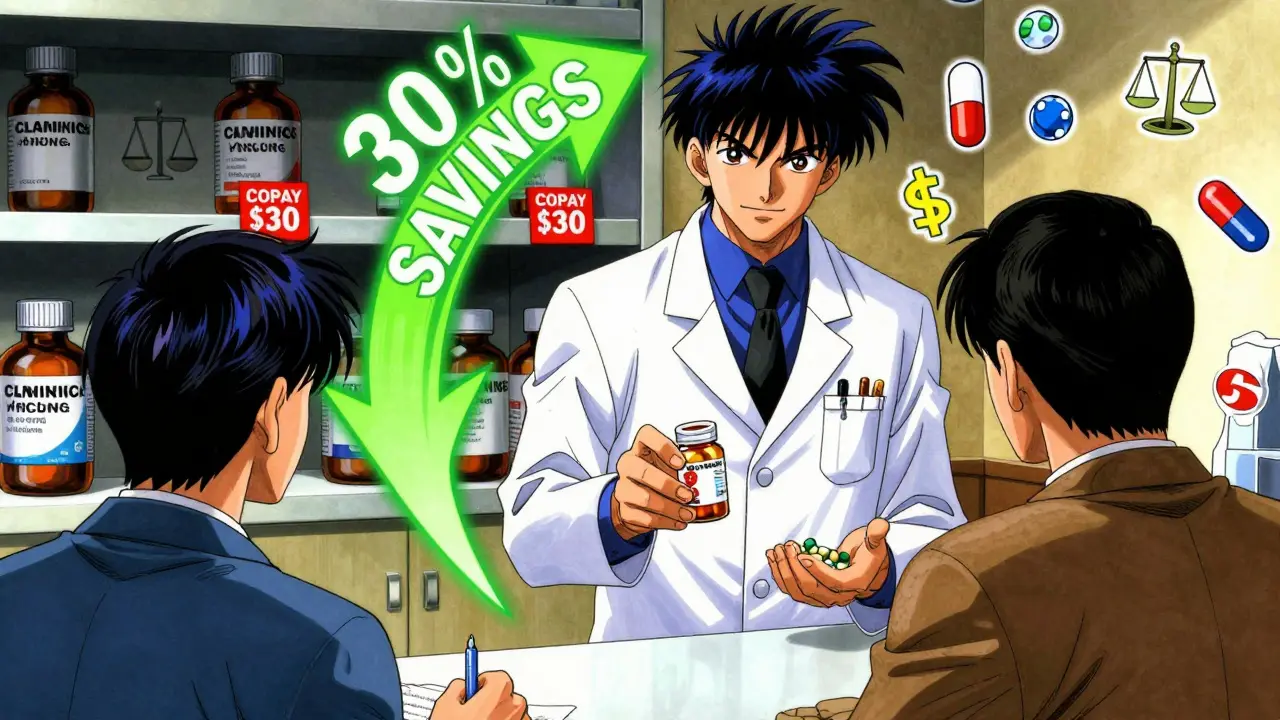
The simplest way states encourage generic use? Make the brand-name version cost more. Most Medicaid programs and many private insurers now require patients to pay a higher copay for brand-name drugs when a generic is available. For example, you might pay $5 for a generic blood pressure pill but $30 for the brand-name version-even if they’re chemically identical. That $25 difference isn’t just a sticker shock; it’s a nudge. Studies show that when copays are higher for brands, patients switch. And they stick with the generic.
This isn’t new. Back in the late 1990s, the gap between generic and brand-name dispensing fees for pharmacies was just eight cents. But copay differentials? They kept growing. States realized that if patients feel the financial pinch, they’ll choose the cheaper option. And that’s exactly what happened. Generic prescriptions jumped from 33% of all fills in 1993 to 45% by 1998. Even though brand-name drug prices rose faster than ever, the shift to generics kept overall spending from exploding.
Preferred Drug Lists: The State’s Secret Weapon
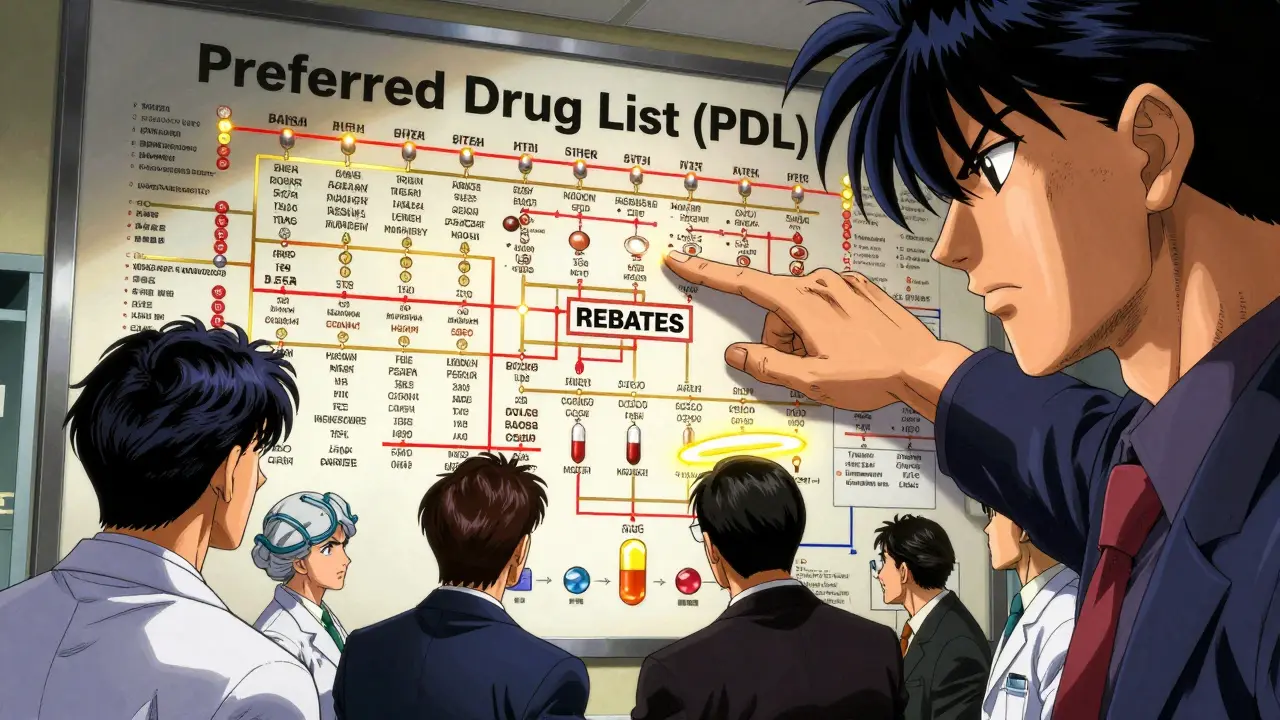
Every state with a Medicaid program has what’s called a Preferred Drug List-or PDL. Think of it like a grocery store’s sale rack. Only the drugs on the list get the best pricing. If your doctor prescribes something off the list, you’re stuck with higher costs, or worse, you need prior authorization just to get it covered.
As of 2019, 46 out of 50 states used PDLs. That’s not a coincidence. These lists are managed by Pharmacy and Therapeutics (P&T) committees-groups of doctors, pharmacists, and health economists who decide which drugs get top billing. They don’t just pick the cheapest. They look at safety, effectiveness, and cost. And they update the lists regularly. Twenty states review theirs every year. Ten do it quarterly. That’s how fast these systems adapt.
But here’s the catch: brand-name drugmakers fight back. They offer huge rebates to Medicaid programs to get their drugs back on the list. Sometimes, those rebates are so big that even a more expensive brand becomes cheaper for the state than a generic. That’s when the system breaks. States end up paying more for a brand-name drug than they should, just because the manufacturer is playing the rebate game.
Pharmacists Can Substitute-If the Law Lets Them
Here’s where it gets personal. When your doctor writes a prescription for, say, Lipitor, can your pharmacist give you atorvastatin instead-the generic version-without asking you? It depends on your state.
In 11 states, pharmacists can swap generics automatically. That’s called presumed consent. They assume you’re okay with it unless you say no. In the other 39, they have to ask you first-explicit consent. That might sound more respectful, but research shows it doesn’t work as well.
A 2018 NIH study found that presumed consent laws increased generic dispensing by 3.2 percentage points. That’s not small. If all 39 explicit consent states switched, they’d save $51 billion a year. That’s more than the entire annual budget of the CDC. Why? Because people don’t say no. They don’t even think about it. They just take the pill. If you have to stop, ask, and wait, you’re more likely to just take the brand name-even if it costs more.
Why Mandatory Substitution Laws Don’t Work
You might think: why not just force pharmacists to substitute every time? Some states tried that. They passed laws saying: no brand names unless the doctor says “do not substitute.” But guess what? It barely moved the needle.
Why? Because pharmacists already had a financial reason to substitute. They make more money dispensing generics. The profit margin is higher. So even without a law, they were already doing it. The mandatory laws just added paperwork. They didn’t change behavior. Presumed consent? That changes patient behavior. That’s what works.
The Hidden Cost: When Generics Disappear
There’s a dark side to all this. States are so focused on cutting costs that they’re accidentally pushing some generic manufacturers out of the market.
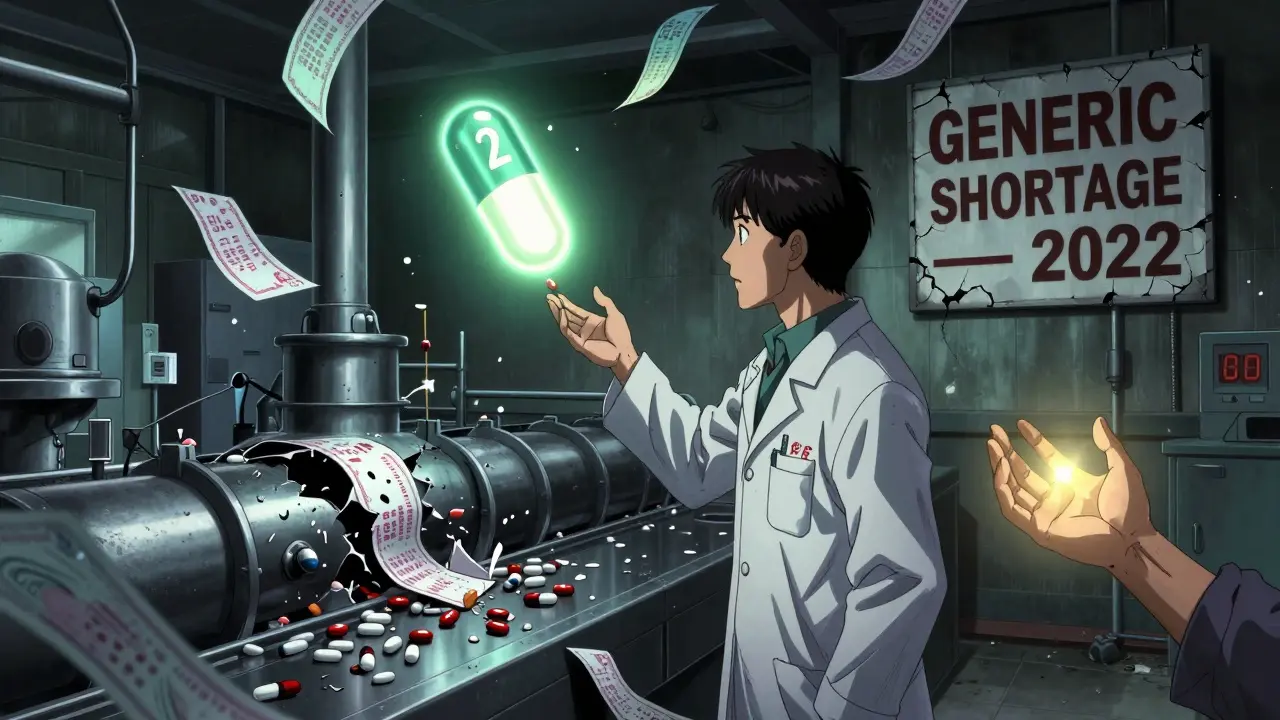
Under the Medicaid Drug Rebate Program, drugmakers must pay the state a rebate for every pill sold. That’s fine-until the rules change. A 2022 Avalere Health report found five scenarios where generic makers get hit with big rebates even though they didn’t raise prices:
- Supply shortages
- Increased raw material costs
- Seasonal demand spikes
- Changes in customer base
- Mature markets with no growth
In those cases, the rebate can eat up their entire profit. So they stop making the drug. And suddenly, the generic you relied on? Gone. The state saved money last year. This year, you’re stuck with a more expensive brand-or no option at all.
It’s a classic unintended consequence. The system was built to save money. But if no one’s making the generic, the savings vanish. And the patient loses.
What’s Next? The Drug List
Federal agencies are watching. CMS, the agency that runs Medicare, is testing a new idea: a $2 Drug List. The goal? Make low-cost generics cost no more than $2 for Medicare Part D patients. No copays. No coinsurance. Just $2.
This isn’t mandatory. But if it works, states will copy it. Why? Because it’s simple. Patients understand it. Pharmacists can explain it in five seconds. And it removes the guesswork. If you can get your blood pressure pill for $2, why would you pay $15?
States that already have strong generic incentives-like those with presumed consent and high brand copays-are ahead of the curve. But the $2 model could be the next big leap. It turns cost-saving from a bureaucratic rule into a clear, consumer-friendly promise.
Why This Matters to You
If you take any regular medication, these state policies affect you-even if you’re not on Medicaid. Private insurers copy Medicaid’s rules. Employers use the same logic when they design their drug plans. Pharmacy benefit managers (PBMs) follow the same patterns. The system is interconnected.
Right now, you’re probably paying more than you need to for generics. Check your copay. If your brand-name drug costs three times more than the generic, you’re being nudged. And that’s okay-unless the generic isn’t available. Then the system has failed.
The goal isn’t to eliminate brand-name drugs. It’s to make sure you’re not paying extra for a pill that does the exact same thing. States have built a smart, if imperfect, system to do that. But it only works if generics stay in stock, prices stay fair, and patients aren’t left with no choice at all.
Do all states have the same generic prescribing rules?
No. Every state sets its own rules. Forty-six states use Preferred Drug Lists. Only 15 have laws specifically requiring copay differentials for generics. Eleven states allow pharmacists to substitute generics without asking you (presumed consent), while the rest require your permission. There’s no national standard.
Can my pharmacist switch my brand-name drug to a generic without telling me?
Only in states with presumed consent laws-currently 11. In those states, pharmacists can substitute unless your doctor writes "dispense as written" or you say no. In the other 39, they must ask you first. Always check your state’s law or ask your pharmacist.
Why is my generic drug sometimes out of stock?
Many generic manufacturers operate on thin margins. When Medicaid rebate rules change-like when input costs rise or demand spikes-they can lose money on each pill. If the rebate is too high, they stop making the drug. That’s why shortages happen, even with high demand. It’s not about supply chain issues; it’s about economics.
Are generic drugs really as good as brand-name ones?
Yes. The FDA requires generics to have the same active ingredient, strength, dosage form, and route of administration as the brand. They must also be bioequivalent-meaning they work the same way in your body. The only differences are inactive ingredients like fillers or dyes, which rarely affect effectiveness.
How do I know if my state has a preferred drug list?
If you’re on Medicaid, your state’s health agency publishes the PDL online. If you have private insurance, ask your insurer or check your plan’s formulary. Many PBMs make these lists available on their websites. Look for terms like "preferred," "tier 1," or "generic-first." If your drug isn’t on the list, you’ll likely pay more.
Will the $2 Drug List come to my state?
Not directly-it’s a Medicare Part D program. But states often follow Medicare’s lead. If the $2 model proves successful, states will likely adapt it for Medicaid and even private plans. The goal is simplicity: if a drug costs $2, make it cost $2. No confusion. No copays. Just access.
Jake Moore
January 19, 2026 AT 10:08Genetics aren’t the only thing that runs in families-so do copay structures. I’ve been on lisinopril for 8 years, and my copay jumped from $3 to $25 when they stopped covering the brand. I switched to generic in 2017 and haven’t looked back. My BP’s stable, my wallet’s happier, and my pharmacist knows me by name now. This system works because it doesn’t force you-it just makes sense.
Pro tip: Always ask your pharmacist if your script is on the PDL. Most don’t volunteer that info unless you ask.
Praseetha Pn
January 20, 2026 AT 02:13OMG this is a BIG PHARMA SLEEPOVER. They don’t want you to know this, but the FDA lets generics have up to 20% variation in absorption? That’s not ‘bioequivalent’-that’s a gamble with your life. And don’t get me started on how the same factory makes both brand and generic-just relabels it. They’re playing you like a fiddle. The ‘$2 drug list’? That’s just the next step to make you dependent on government-controlled pills. Wake up, sheeple!
Also, did you know the WHO says 70% of generic shortages are caused by U.S. rebate policies? That’s not a bug-it’s a feature. They want you sick so you keep buying.
Nishant Sonuley
January 20, 2026 AT 16:00Look, I get it-cost control is sexy. But let’s not pretend this is all about ‘saving patients money.’ It’s about PBMs and insurers squeezing every drop out of the system while pretending they care. I’m a pharmacist in Kerala, and I’ve seen this play out in India too: generics disappear because the rebate math doesn’t add up. The state thinks it’s being smart, but it’s just outsourcing the crisis.
And yeah, presumed consent sounds great-until you’re the one who gets stuck with a generic that gives you migraines because the filler’s different. No one told you that. No one *wants* to tell you that. We’re all just pawns in a spreadsheet game where the only winner is the accounting department.
Also, the $2 list? Cute. But if you can’t get the damn drug because the manufacturer went bankrupt last month, what’s the point? Policy without supply chain foresight is just performative activism with a formulary.
Emma #########
January 20, 2026 AT 20:57I just want to say thank you for writing this. My mom’s on 7 medications, and I spent months trying to figure out why her prescriptions kept changing. This explains everything. The PDL thing? I had no idea. Now I know to check her plan’s formulary before each refill.
Also, I cried when I read the part about generics disappearing. My aunt lost access to her seizure med last year. It wasn’t a shortage-it was a rebate trap. No one told us until it was too late. This needs more attention.
Andrew Short
January 21, 2026 AT 05:34Pathetic. You call this ‘smart policy’? It’s social engineering disguised as healthcare. You’re conditioning people to accept substandard care because ‘it’s cheaper.’ What’s next? Rationing insulin because ‘there’s a generic version that’s 95% as effective’? This isn’t saving money-it’s sacrificing lives on the altar of bureaucracy.
And don’t even get me started on the ‘FDA says they’re the same’ lie. Ever heard of bioavailability variance? Ever seen a patient who got a rash from a generic because of the dye? No? Because the industry buries those reports.
Wake up. This isn’t healthcare. It’s corporate welfare with a side of patient blame.
Robert Cassidy
January 22, 2026 AT 09:19America’s greatest export? Not Hollywood. Not tech. It’s the myth that ‘cheaper = better.’ We’ve turned healthcare into a discount aisle at Walmart. And now we’re shocked when the generic breaks down after 3 months?
They say ‘same active ingredient.’ Yeah, and so does the knockoff iPhone. But you don’t see me trusting a $20 clone to hold my data, do you?
They’re not saving money-they’re just making the problem invisible. You think the $51 billion they ‘save’ by pushing generics is real? Nah. That money just gets funneled into PBMs and hospital admin salaries. Meanwhile, people skip doses because they’re scared of the side effects from the ‘equivalent’ pill.
This isn’t innovation. It’s decay dressed in a lab coat.
Andrew Qu
January 23, 2026 AT 09:21Hey, I’m a nurse in rural Ohio, and I see this every day. A lot of folks think generics are ‘lesser’ because they’re cheaper. But here’s the truth: 9 out of 10 patients do just fine on them. I’ve had patients cry because they couldn’t afford the brand. Then they switch, and their numbers improve.
The real issue isn’t the generic-it’s the system that lets manufacturers game the rebate rules until the drug vanishes. That’s the failure. Not the policy. The policy’s working. The loopholes are broken.
If we fix the rebate math, we fix the shortages. And if we make presumed consent national? We save lives. Not just money.
Don’t hate the tool. Fix the design.
Jodi Harding
January 23, 2026 AT 15:36Generics are just as good. But the system? It’s rigged. And the people who lose? The ones who don’t know how to ask.
Zoe Brooks
January 24, 2026 AT 08:00I love how this post doesn’t just say ‘generics good’ but actually shows the messy, human side of it. The pharmacist who has to ask you if you’re okay with the switch? That’s a moment of dignity. And the ones who don’t? That’s efficiency. But efficiency without empathy is just cold.
Also, the $2 list? I’d pay $2 for my antidepressant and not think twice. That’s the kind of policy that could actually change lives. Not because it’s cheap-but because it’s simple.
Also, I just checked my copay. $28 for the brand. $5 for the generic. I’m switching tomorrow. 🙌
Kristin Dailey
January 25, 2026 AT 11:11Stop letting Big Pharma dictate our health. Ban brand-name drugs. Full stop.