
Every year, millions of people take generic drugs because they’re affordable, effective, and widely available. But what if the pill in your bottle isn’t what it claims to be? Fake generic drugs aren’t just a distant problem-they’re slipping into pharmacies, hospitals, and online orders right now. And the way they get there is more sophisticated than most people realize.
How Fake Drugs Are Made
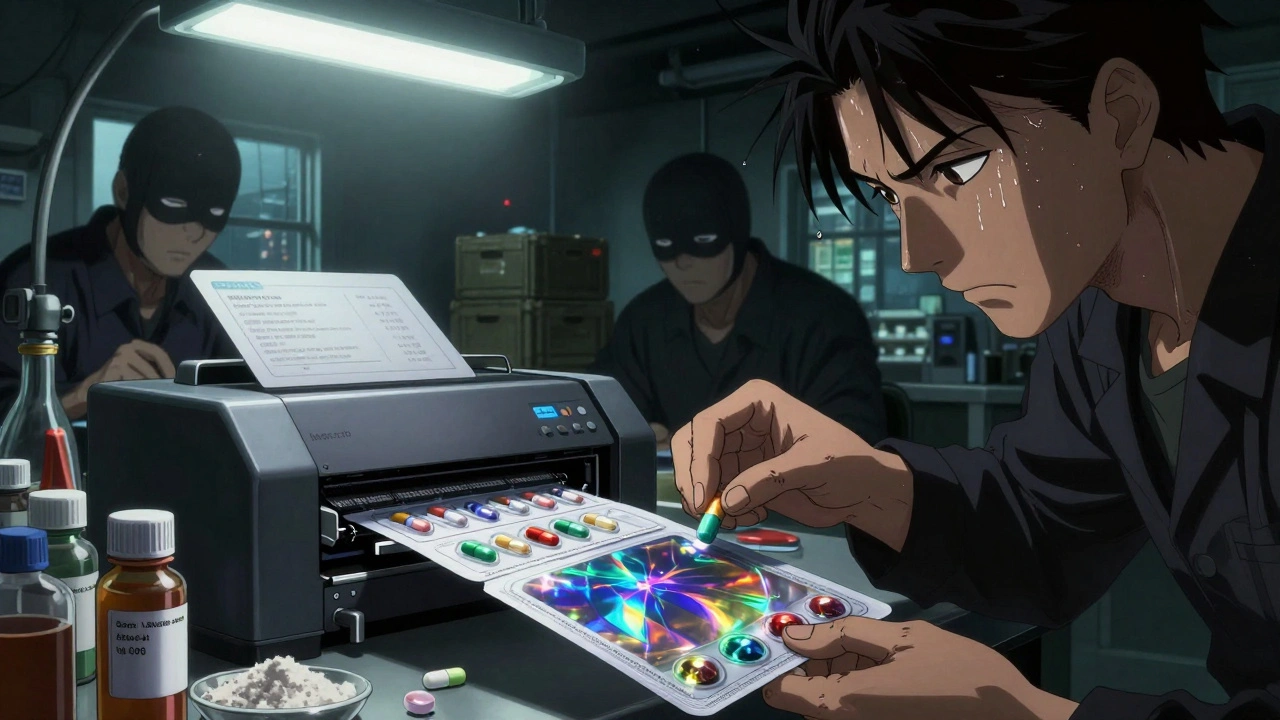
Counterfeit generic drugs don’t appear out of thin air. They’re made in hidden factories, often in countries with weak oversight. Places like parts of Southeast Asia, Eastern Europe, and West Africa have become hotspots because regulation is patchy, and enforcement is rare. These labs don’t need fancy equipment. A $2,000 printer, some chemical powders, and a copy of the real packaging are often enough.They copy the shape, color, and logo of real drugs down to the tiniest detail. Some fakes even have the same imprint codes and tablet scoring. In 2023, TrueMed Inc. found that 95% of counterfeit packaging looked identical to the real thing under normal inspection. That’s not luck-it’s deliberate engineering.
But the real danger isn’t just the packaging. It’s what’s inside. Instead of the right active ingredient, counterfeiters use cheaper substitutes. Sometimes it’s chalk, sugar, or industrial dyes. Other times, it’s a chemical that looks similar but doesn’t work-or worse, causes harm. In 2008, contaminated heparin from China led to 149 deaths in the U.S. because it was laced with a toxic substance that mimicked the real drug’s structure.
The Three Main Entry Points
Fake drugs don’t just show up on store shelves. They sneak into the legal supply chain through three main routes.1. Parallel Importation - This happens when drugs are bought legally in one country, then resold in another where prices are higher. It’s legal in some places, but it creates gaps. A batch of blood pressure pills made in India might be shipped to Germany, then diverted to a warehouse in Poland where it gets mixed with fake versions. Because the original packaging is real, regulators don’t flag it.
2. Grey Market Sales - These are unauthorized distributors who buy legitimate drugs in bulk and then mix in fakes. They don’t need to make the drugs-they just need to repack them. A wholesaler in Brazil might buy 10,000 bottles of metformin from a licensed supplier, then replace 1,000 of them with counterfeits and sell the whole lot as one shipment. The paperwork looks clean. The barcodes scan. But 10% of the pills are useless.
3. Online Pharmacies - This is the biggest growing threat. The National Association of Boards of Pharmacy (NABP) says 95% of online pharmacies are illegal. You search for “cheap Lipitor,” click a site that looks like a real pharmacy, pay with cryptocurrency, and get a box shipped from a warehouse in China. The pills may look real. But tests by the U.S. Pharmacopeia show that 70% of drugs bought from unverified websites contain no active ingredient-or worse, dangerous ones.
Why the System Is So Vulnerable
The global drug supply chain is long, complex, and full of weak links. A single generic drug can pass through six or more intermediaries before it reaches you: manufacturer → distributor → wholesaler → regional agent → pharmacy → patient.Only 40% of countries have any kind of track-and-trace system. That means once a drug leaves the factory, no one knows where it’s been. The U.S. Drug Supply Chain Security Act (DSCSA) tried to fix this by requiring digital serialization by 2023. But only 22 of the 194 WHO member states have fully working systems. In places like Nigeria, Kenya, or Pakistan, drugs move in unmarked trucks, through unlicensed warehouses, and into clinics without any digital record.
Generic drugs are especially vulnerable because they’re cheaper and less monitored. Once a brand-name drug’s patent expires, dozens of companies can make the same pill. That’s good for patients-it lowers prices. But it also creates confusion. A fake metformin tablet doesn’t need to look like the original brand. It just needs to look like one of the 20 generic versions sold in the same region.
Who’s Getting Hurt
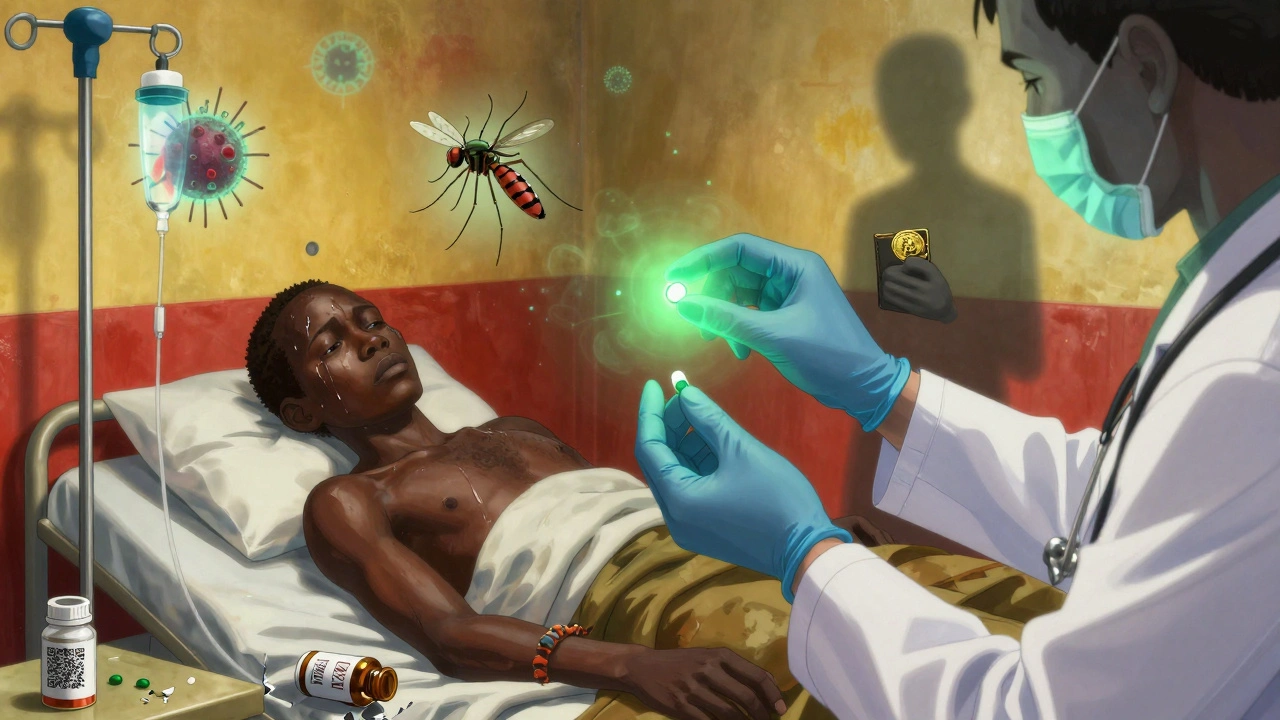
The human cost is staggering. The WHO estimates that 1 in 10 medical products in low- and middle-income countries is fake. In Africa, 42% of all substandard or falsified medicines are found there, according to IFPMA’s 2023 report.Antimalarials are the most common target. In rural clinics across Ghana and Tanzania, doctors report patients getting worse after taking “artemisinin” pills that contain only 10-20% of the needed ingredient. The result? Drug-resistant malaria spreads faster.
Antibiotics are another big target. If you take a fake antibiotic, you don’t get cured. You get stronger bacteria. The World Health Organization calls this one of the top 10 global public health threats.
Even in the U.S., people are being affected. A 2022 survey by the International Pharmaceutical Federation found that 68% of pharmacists had seen suspected fake generics. One Reddit user, u/PharmaWatcher, bought what he thought was Lipitor from a Canadian online pharmacy. The pills had the wrong scoring and a slightly different color. He sent them to a lab. They contained no atorvastatin at all.
How Detection Works-And Why It Often Fails
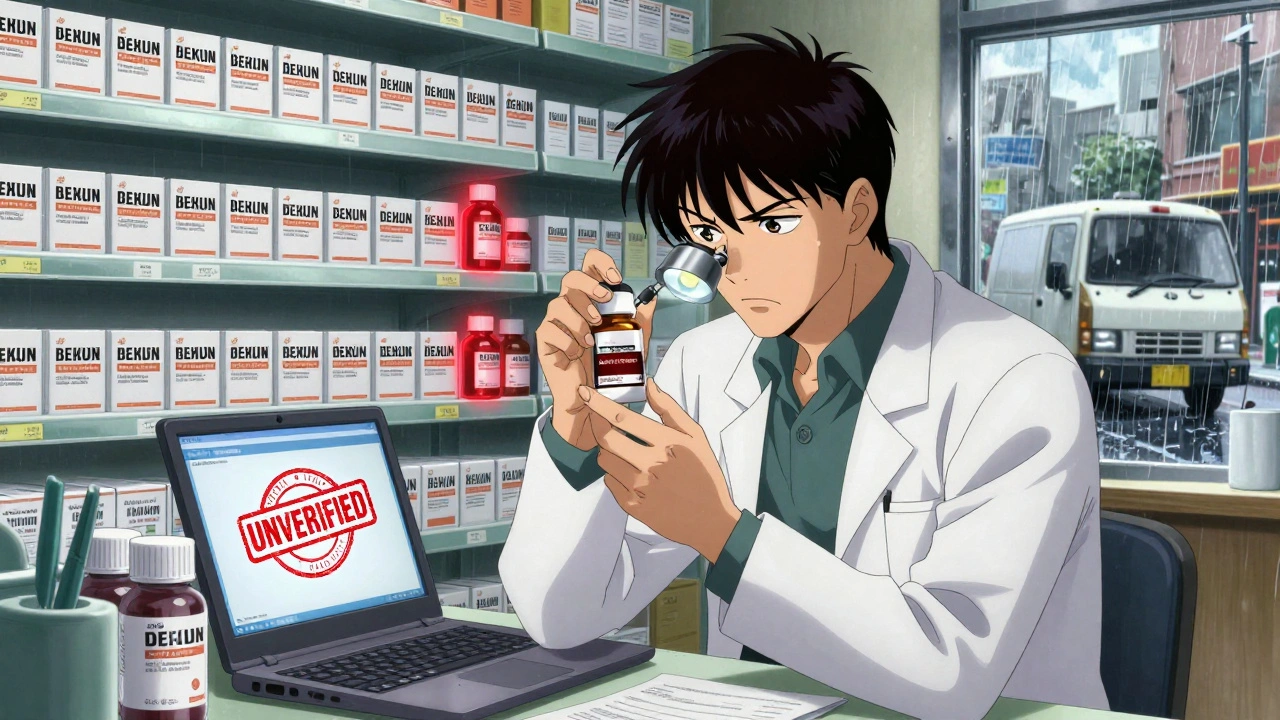
Pharmacists and regulators use a few tools to spot fakes: visual checks, chemical tests, and digital verification.Visual checks look for tiny flaws: mismatched fonts, blurry logos, wrong batch numbers. But today’s counterfeits are too good. Europol reported in 2022 that some fakes now use AI to generate perfect holograms and color-shifting ink. What used to take months to replicate now takes hours.
Chemical testing is more reliable. Labs can test for the presence of active ingredients. But most clinics and small pharmacies can’t afford this. A single test costs $50-$200. For a pharmacy that sells 500 pills a day, testing every batch isn’t practical.
Digital systems like blockchain (used by companies like MediLedger) can track a drug from factory to pharmacy with 97% accuracy. But these systems are expensive. WHO estimates it costs $0.02-$0.05 per unit to add a digital tag. For a $0.10 generic pill, that’s a 50% cost increase. Most manufacturers won’t pay it.
What’s Being Done-And What’s Not
Some progress is being made. The EU’s Falsified Medicines Directive, launched in 2019, required all prescription drugs to have a unique identifier and tamper-proof seal. Since then, counterfeit penetration in Europe has dropped by 18%, according to the European Medicines Agency.Pfizer’s anti-counterfeiting program has blocked over 302 million fake doses since 2004. They work with customs, pharmacies, and law enforcement. But that’s one company. The problem is global.
Meanwhile, the OECD warns that without coordinated action, counterfeit drugs could make up 5-7% of global medicine sales by 2030. The rise of dark web pharmacies and cryptocurrency payments makes tracing harder than ever.
Most countries still lack strong laws. The TRIPS Agreement and the Medicrime Convention set international standards, but enforcement is up to each nation. In many places, penalties for selling fake drugs are lighter than for selling pirated movies.
What You Can Do
You can’t stop counterfeit drugs alone-but you can protect yourself.- Buy from licensed pharmacies only. If it’s not on the NABP Verified Internet Pharmacy Practice Sites list, don’t trust it.
- Check your pills. Compare them to the description on the manufacturer’s website. Look for color, shape, and scoring differences.
- Ask your pharmacist to verify the source. Most will do it for free.
- Report anything suspicious. In the U.S., go to fda.gov/safety/reportaproblem. In the EU, use EudraVigilance.
Don’t assume a cheap price means a fake. But do assume that if a deal seems too good to be true, it probably is.
What’s Next
The fight against fake drugs isn’t over. New technologies like AI-powered packaging and nanoscale tracers are being tested. But the real solution isn’t tech-it’s transparency. We need global standards. We need mandatory serialization. We need penalties that actually hurt counterfeiters.Until then, the system stays broken. And every time you take a pill you didn’t verify, you’re rolling the dice.
How can I tell if my generic drug is fake?
Look for inconsistencies in the packaging-wrong font, blurry logo, mismatched batch numbers. Compare the pill’s color, shape, and scoring to the manufacturer’s official description online. If you’re unsure, ask your pharmacist to verify the source or send a sample to a lab. Real generic drugs should match the FDA or EMA’s public drug database exactly.
Are online pharmacies ever safe?
Only if they’re verified by the National Association of Boards of Pharmacy (NABP). Look for the VIPPS seal on the website. If the site doesn’t require a prescription, sells drugs from overseas, or only accepts cryptocurrency, it’s almost certainly illegal. Over 95% of online pharmacies operate outside the law.
Why are generic drugs targeted more than brand-name ones?
Because they’re cheaper, more widely used, and less closely monitored. Once a brand-name drug’s patent expires, dozens of manufacturers can make the same pill. That makes it easier for counterfeiters to blend in. Fake generics don’t need to copy one specific brand-they just need to look like any of the common versions sold in your area.
What are the most common fake drugs?
Antimalarials, antibiotics, and cardiovascular drugs are the top targets. These are high-demand, high-profit medications. Fake antimalarials often contain only 10-20% of the needed active ingredient. Fake antibiotics may have no active ingredient at all, contributing to drug-resistant infections. Heart medications like lisinopril or metformin are also commonly faked because millions take them daily.
Can counterfeit drugs cause long-term health damage?
Absolutely. Taking a fake antibiotic can lead to untreatable infections. A fake blood pressure pill can cause a stroke. Fake cancer drugs can allow tumors to grow unchecked. In 2008, contaminated heparin killed 149 people in the U.S. because it contained a toxic substance that mimicked the real drug. Even if a fake doesn’t kill you right away, it can cause chronic harm by delaying real treatment or triggering dangerous side effects.
Paul Dixon
December 11, 2025 AT 19:29Man, I just bought some generic metformin last week for $5. Thought I scored. Now I’m second-guessing every pill in my bottle. 😅
Ariel Nichole
December 12, 2025 AT 19:37This is such an important read. I work in a community pharmacy and we’ve had a few suspicious batches come through. Always double-check the packaging now. Small things like font spacing or a slightly off color can be a red flag. Thanks for laying this out so clearly.
matthew dendle
December 14, 2025 AT 15:36So let me get this straight… we’re trusting our lives to pills made by some dude in a garage with a 3D printer and a Google image search? And the FDA is fine with this? Lmao. We’re literally playing Russian roulette with our meds. 🤡
Lisa Stringfellow
December 15, 2025 AT 17:28Of course this is happening. Everything in America is broken. We let corporations cut corners and then act shocked when people die. It’s not a surprise. It’s just capitalism with a stethoscope.
Kristi Pope
December 17, 2025 AT 16:37There’s hope though. I’ve seen pharmacists in rural clinics team up with local health workers to do spot checks on pills-just by comparing them to the FDA’s online database. It’s low-tech but it works. And people are starting to ask questions. That’s the first step. We’re not powerless here.
Jimmy Kärnfeldt
December 18, 2025 AT 04:38It’s wild to think that the same system that lets us get insulin for $30 in Canada costs $300 here. The price gap is what fuels this whole black market. We’re not just fighting counterfeiters-we’re fighting economic inequality wrapped in a pill bottle.
Katherine Liu-Bevan
December 19, 2025 AT 09:10According to the U.S. Pharmacopeial Convention, over 80% of counterfeit drugs seized at U.S. ports originate from India and China. The supply chain vulnerabilities are systemic, not accidental. Digital serialization isn’t a luxury-it’s a necessity. And it’s cheaper than treating the side effects of fake antihypertensives.
Courtney Blake
December 20, 2025 AT 14:20Why are we even letting foreign countries make our meds? This isn’t globalization-it’s national security failure. We outsource our medicine and then wonder why people die. Fix this. Now.
Aman deep
December 22, 2025 AT 12:19I’m from India and I’ve seen this firsthand. Many small labs make generics with good intent-they just lack proper testing. It’s not always malice, sometimes it’s just lack of resources. But the outcome? Same danger. We need global support-not blame. Maybe donate testing kits instead of calling names.
Eddie Bennett
December 24, 2025 AT 09:17My grandma took a fake blood pressure pill last year. She ended up in the ER. Didn’t even know it was fake until the pharmacist called us. Now she only gets meds from the big chain pharmacy. I wish more people knew how easy it is to get scammed. This isn’t just about money-it’s about trust.
Sylvia Frenzel
December 25, 2025 AT 13:53So let me get this straight-your solution is to ‘ask your pharmacist’? Like they’re gonna test every single pill? That’s not a solution. That’s a joke. We need federal mandates, not pep talks.
john damon
December 26, 2025 AT 04:32Just bought a bottle of generic Lipitor from a site that looked legit. Got it in 3 days. Took a pic of the pill. Compared it to the FDA database. The scoring was off by 0.2mm. Sent it in. They confirmed it was fake. 💀