
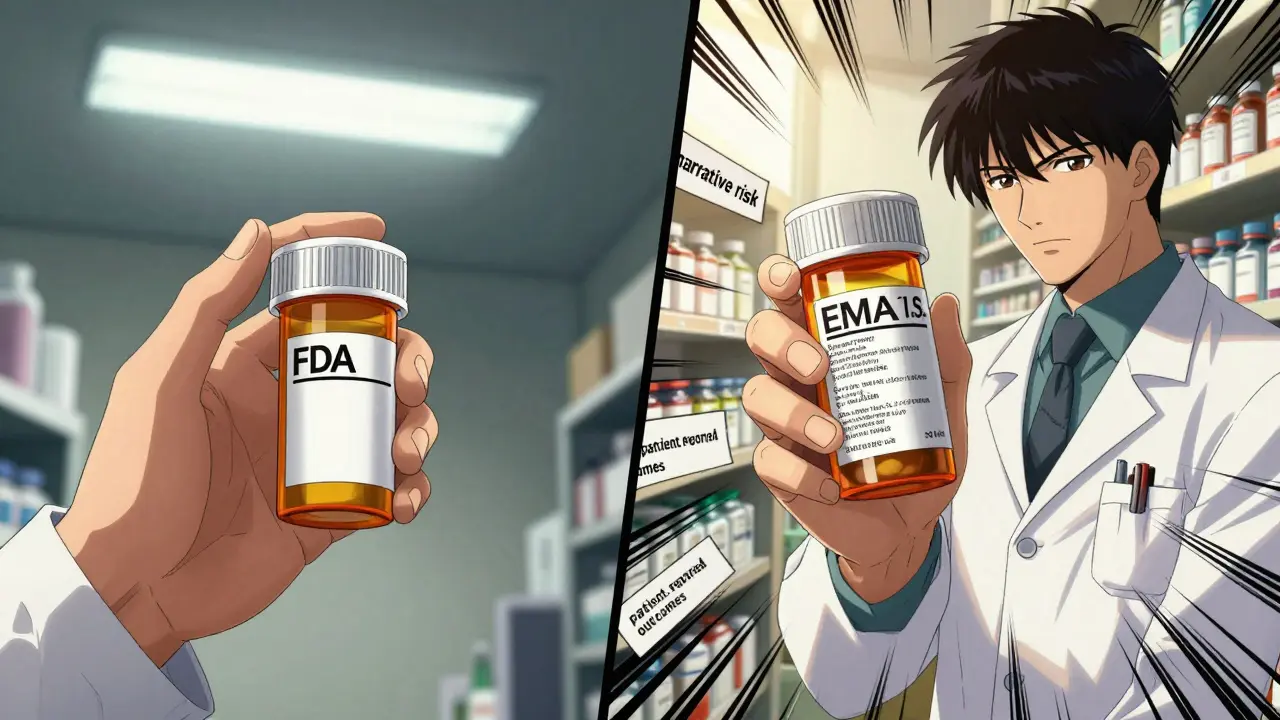
EMA vs FDA Drug Labeling Comparison Tool
This tool compares key differences between EMA and FDA drug labeling regulations across multiple dimensions. Select a category from the dropdown above to see detailed comparisons.
Important note: These differences impact drug access, patient safety, and global healthcare coordination. Understanding them is crucial for healthcare professionals, patients, and regulatory affairs teams.
When a new drug hits the market in the U.S. or the EU, the label you read isn’t just a piece of paper-it’s the result of two very different regulatory philosophies. The EMA and FDA may both aim to protect patients, but how they write the instructions, warnings, and uses for the same drug can be wildly different. And for patients, doctors, and pharmacies, those differences matter more than you think.
Why the Same Drug Has Different Labels
The European Medicines Agency (EMA) and the U.S. Food and Drug Administration (FDA) don’t just use different languages-they use different rules. The FDA operates as a single, centralized agency with final authority over U.S. drug labeling. The EMA, on the other hand, coordinates with 27 national regulators across the EU. That structural difference shapes everything: how data is reviewed, what evidence counts, and how risks are communicated. Take a drug approved for both markets. The FDA might say, “Use only if benefits outweigh risks,” while the EMA says, “Use in patients with confirmed diagnosis of X.” That’s not just wording. It’s a difference in how each agency interprets the same clinical trial results. A 2019 study found that in over half of the cases where approval differed between the two agencies, it wasn’t because one had more data-it was because they interpreted the same data differently.What’s in the Label: Indications and Claims
The approved uses of a drug-its indications-are one of the biggest points of divergence. The FDA tends to be more cautious. If a drug shows benefit in a small subgroup of patients, the FDA often won’t approve it for that group unless the evidence is rock-solid. The EMA is more willing to approve narrower uses, especially for rare diseases. For example, in oncology, the EMA has approved drugs based on surrogate endpoints like tumor shrinkage, even when overall survival data isn’t yet available. The FDA usually waits for proof that patients live longer. That’s why some cancer drugs reach European patients months or even years before they’re available in the U.S. Patient-reported outcomes (PROs) are another area where labels diverge. Between 2006 and 2010, 47% of drugs approved by both agencies had at least one PRO claim on their EMA label-things like “improves fatigue” or “enhances daily functioning.” Only 19% had those same claims on the FDA label. The EMA accepts patient experience as valid evidence. The FDA doesn’t, unless it’s tied to hard clinical endpoints.Pregnancy, Breastfeeding, and Risk Communication
If you’re pregnant or breastfeeding, the label you read could be the difference between taking a needed medication or going without. The FDA uses a rigid, letter-based system (A, B, C, D, X) that’s been around since the 1970s. It’s simple but outdated. The EMA uses narrative language: “Use with caution,” “Avoid unless necessary,” “Data limited.” A 2023 analysis of three drugs found that for two of them, the EMA included a statement about human data during pregnancy, while the FDA omitted it entirely-even when the same studies were submitted. The FDA’s approach is often seen as overly conservative, sometimes leaving doctors and patients guessing. The EMA’s narrative style gives more context, but it’s less standardized.Risk Management: REMS vs RMPs
When a drug has serious side effects, both agencies require risk management plans. But the way they enforce them is night and day. The FDA uses Risk Evaluation and Mitigation Strategies (REMS). These are rigid, legally binding systems. For some drugs, REMS means you can only get the medication through a single pharmacy, or your doctor must complete special training. Some REMS even require patients to sign forms acknowledging the risks. The EMA uses Risk Management Plans (RMPs). These are more flexible. Companies submit them, but there’s no mandatory enforcement system. The EMA trusts national regulators to monitor compliance. That means fewer administrative hurdles at the pharmacy level-but also less uniformity across countries. For manufacturers, this means designing one drug for the U.S. might require building an entire logistics system just to comply with REMS. In Europe, they can focus on training materials and monitoring reports.
Language and Translation: The Hidden Cost
Here’s a fact most people don’t realize: every EMA-approved drug must be labeled in all 24 official languages of the European Union. That’s not just English, French, and German. It’s Croatian, Maltese, Irish, and more. The FDA? Only English. That single difference adds 15-20% to the cost of bringing a drug to market in Europe. It’s not just translation-it’s validation, formatting, legal review, and printing for each language. For small biotech firms, this can be a dealbreaker. Even the format matters. The EMA requires a Summary of Product Characteristics (SmPC), a Patient Package Leaflet (PPL), and a full labeling document. The FDA combines all this into one Prescribing Information (PI) document. That means companies must create two entirely different document structures for the same product.Approval Speed and Post-Marketing Requirements
The EMA approves drugs faster in the first round. In 2019, 92% of applications passed initial review at the EMA, compared to 85% at the FDA. Why? The FDA turns down more applications upfront because it demands more complete data. The EMA is more likely to approve with conditions-like “collect more safety data after launch.” That’s where the trade-off lies. The EMA gets drugs to patients quicker. But companies then face longer-term obligations: ongoing studies, additional reporting, and updates to labels based on real-world use. The FDA’s approvals often come with fewer post-marketing requirements, but you have to jump higher to get in the door. For orphan drugs (used for rare diseases), the EMA has a special pathway called “exceptional circumstances.” It allows approval even when full clinical data isn’t possible. The FDA doesn’t have an exact equivalent. Companies developing drugs for ultra-rare conditions must tailor their evidence strategy for each agency.How This Affects Patients and Doctors
Imagine a patient in Germany gets a drug for chronic pain. Their label says, “May improve ability to walk and reduce fatigue.” Their doctor in Texas sees the same drug, but the label says, “Indicated for moderate to severe pain.” The doctor doesn’t know about the fatigue benefit-because it’s not on the U.S. label. So the patient doesn’t get the full benefit. Or take vaccines. A 2020 study looked at 12 vaccines approved by both agencies. Not one had matching labeling elements. Dosing schedules, contraindications, side effect lists-all varied. That’s not a minor inconsistency. It’s a potential safety risk if patients or providers rely on the wrong version. Doctors treating international patients or those who’ve traveled abroad often don’t know the label differences. Pharmacists in the U.S. may not realize a drug they’re dispensing has a different risk profile in Europe.
What’s Changing-and What’s Not
There’s been progress. The FDA and EMA now share confidential data through a 2020 confidentiality agreement. They hold joint scientific advice meetings. The International Council for Harmonisation (ICH) has pushed for common standards in clinical trials and safety reporting. But the core differences remain. Why? Because they’re not just technical-they’re cultural. The U.S. system values legal certainty and clear boundaries. The EU system values flexibility and context. One is rule-based. The other is principle-based. AI and machine learning tools are now being used by both agencies to analyze real-world data. That could eventually help align labeling. But don’t expect them to disappear. Experts predict the gap will narrow-but not close.What Pharmaceutical Companies Must Do
If you’re developing a drug for both markets, you’re not just doing R&D-you’re doing regulatory engineering. You need:- Dedicated teams to track each agency’s evolving guidelines
- Separate document templates for EMA SmPCs and FDA PIs
- Translation and localization workflows for 24 languages
- Strategies to satisfy both REMS and RMP requirements
- Clinical trial designs that account for differing endpoints
Final Takeaway: Two Systems, One Goal
The EMA and FDA don’t agree on everything-and they never will. But they both want safe, effective drugs to reach the people who need them. The differences in labeling aren’t mistakes. They’re the result of different legal systems, cultural attitudes toward risk, and patient expectations. For patients, it means reading the label that matches where you live. For doctors, it means asking: “Is this the U.S. or EU version?” For global health, it means recognizing that one-size-fits-all doesn’t work in medicine. The next time you pick up a prescription, look at the label. What you’re holding isn’t just instructions. It’s a snapshot of two regulatory worlds-and the real-world consequences of their choices.Why do the same drugs have different labels in the U.S. and Europe?
The FDA and EMA have different legal frameworks, risk tolerance levels, and approval philosophies. The FDA tends to require stronger evidence for approval and uses rigid labeling formats. The EMA accepts more flexible evidence, especially for rare diseases, and allows narrative risk descriptions. Even when both agencies review the same clinical data, they often interpret it differently, leading to variations in approved uses, warnings, and dosing instructions.
Which agency approves drugs faster, the EMA or the FDA?
The EMA typically has a higher first-cycle approval rate-about 92% compared to the FDA’s 85%. The FDA often requests more data upfront, leading to more initial rejections. The EMA may approve drugs with conditions, like requiring additional post-marketing studies. This means patients in Europe often get access to new drugs sooner, but with ongoing monitoring obligations for the manufacturer.
Does the FDA accept patient-reported outcomes on drug labels?
Rarely. Between 2006 and 2010, only 19% of drugs approved by the FDA included patient-reported outcome (PRO) claims like improved fatigue or quality of life. In contrast, the EMA approved such claims for 47% of the same drugs. The FDA generally requires PRO data to be tied to hard clinical endpoints like survival or hospitalization. The EMA accepts patient experience as direct evidence of benefit, especially in chronic conditions.
Why does EMA labeling need to be in 24 languages?
The European Union recognizes 24 official languages. By law, all EMA-approved drug labeling-including the Summary of Product Characteristics and Patient Package Leaflet-must be translated into each of these languages. This ensures patients across all member states can understand how to use their medication safely. The FDA requires labeling only in English, which simplifies the process for manufacturers but limits access in non-English-speaking U.S. communities.
What’s the difference between FDA REMS and EMA RMPs?
FDA Risk Evaluation and Mitigation Strategies (REMS) are legally enforced systems that may require special training, restricted distribution, or patient registries. EMA Risk Management Plans (RMPs) are more flexible-companies submit them, but enforcement is left to national regulators. REMS often create logistical barriers for pharmacies and prescribers. RMPs rely on monitoring and reporting, with less direct control over access.
Can a drug approved in the EU be used off-label in the U.S.?
Yes. Doctors in the U.S. can prescribe any FDA-approved drug for uses not listed on the official label-this is called off-label use. But the label itself doesn’t change. If a drug’s EMA label includes a benefit like improved mobility that the FDA label omits, U.S. doctors can still prescribe it for that purpose based on clinical judgment. However, insurance coverage and hospital policies may not support off-label use without strong evidence.
Are EMA and FDA working to align their labeling rules?
Yes, but progress is slow. Both agencies participate in the International Council for Harmonisation (ICH) and share confidential data through a 2020 agreement. They’ve aligned on clinical trial design and safety reporting. But core differences in legal structure, risk tolerance, and patient communication remain. Experts believe the gap will narrow over time but won’t disappear entirely due to fundamental philosophical and regulatory differences.
Stuart Shield
January 4, 2026 AT 14:14Man, I just read this and thought about my cousin in Manchester who got that cancer drug a year before her doc in Chicago could even prescribe it. The EMA’s narrative stuff? It’s not just fluff-it’s human. Like, ‘use with caution’ tells me the doc actually *thought* about her, not just checked a box. The FDA’s letter grades feel like a 1970s school report card. We need more storytelling in medicine, not less.
Also, 24 languages? That’s beautiful. Makes me proud to be European. The US just says ‘English only’ and calls it efficient. But what about the Spanish-speaking grandma in Florida who can’t read the label? Efficiency shouldn’t mean exclusion.
Rachel Wermager
January 5, 2026 AT 12:04Actually, the FDA’s conservatism isn’t ‘overly cautious’-it’s statistically rigorous. The EMA’s reliance on surrogate endpoints is a recipe for post-marketing disasters. Tumor shrinkage ≠ survival. PROs without clinical correlation? That’s anecdotal noise masquerading as evidence. The ICH guidelines are there for a reason-harmonization isn’t about making things easier, it’s about making them *correct*. If you’re using ‘fatigue improvement’ as a primary endpoint, you’re not a regulator-you’re a wellness influencer.
Leonard Shit
January 6, 2026 AT 16:28so like… the ema lets you say ‘this might help you feel less tired’ and the fda says ‘prove it saves lives’? sounds like one’s a therapist and the other’s a forensic accountant.
also, 24 languages? bro, i can barely get my local pharmacy to print the thing in spanish. imagine printing it in maltese. who even *uses* maltese for meds? but i guess if you’re gonna make a whole eu, you gotta do it right. or at least, really, really overdo it.
reminds me of when my aunt got her german prescription and the pill bottle had a 40-page booklet in 12 languages. she cried. not from joy.
Gabrielle Panchev
January 8, 2026 AT 01:21It’s not just the EMA being ‘flexible’-it’s that they’re fundamentally undermining evidence-based medicine by accepting patient-reported outcomes as legitimate endpoints without rigorous psychometric validation, and then, in the same breath, they’re demanding narrative risk descriptions that are inherently subjective, unquantifiable, and legally ambiguous-while the FDA, despite being criticized as ‘rigid,’ maintains a standardized, replicable, and legally defensible framework that prevents liability, protects public health, and ensures that every claim on a label has been subjected to peer-reviewed, double-blind, placebo-controlled scrutiny-so yes, it’s slower, but it’s also safer, and if you don’t understand that, you’re not just misinformed-you’re dangerously naive.
Matt Beck
January 9, 2026 AT 11:50EMA = ‘Let’s try it, see what happens’ 😌
FDA = ‘Prove it won’t kill us first’ 🤔
Turns out, both are right. And both are wrong.
Humanity needs both. Like yin and yang. Or coffee and chaos. ☕️💥
Also, 24 languages? That’s not bureaucracy. That’s poetry.
Ryan Barr
January 11, 2026 AT 01:20EMA: flexible. FDA: precise. Pick one. The rest is noise.
Cam Jane
January 11, 2026 AT 15:31Okay, real talk-this is why I love global health. The EMA’s narrative approach? It’s giving doctors permission to *think* with their patients. Not just follow a script. And the 24 languages? That’s equity in action. Yeah, it’s expensive. But imagine being a kid in Croatia and your mom can actually read the instructions. No translator. No guesswork. Just clear, safe care.
And the REMS vs RMP thing? The FDA’s system feels like a prison guard. The EMA’s feels like a mentor. One’s about control. The other’s about trust. Guess which one patients feel more respected by?
Also, if you’re a small biotech? Yeah, it’s brutal. But if you’re building for humanity, not just profit? You adapt. You don’t complain. You build better.
Dana Termini
January 13, 2026 AT 02:27Both systems have strengths. The FDA’s rigor protects people from hype. The EMA’s flexibility gets life-saving drugs to those who need them now. Maybe the answer isn’t choosing one over the other-but learning from both. We don’t need to be the same. We just need to be smarter together.
Wesley Pereira
January 13, 2026 AT 04:33fr tho, the FDA’s REMS are a nightmare. i work in pharma logistics and we had to build a whole custom portal just for one drug’s REMS compliance. 12 people just to manage sign-offs. Meanwhile, the EMA RMP? We sent a pdf and called it a day.
and the 24 languages? yeah it’s a pain. but honestly? if you’re gonna have a union that speaks 24 languages, you kinda gotta do it. the fda’s ‘english only’ is just… lazy. and kinda racist tbh. not everyone in the us speaks english. but sure, let’s ignore them.
also, ‘patient-reported outcomes’? bro, if your drug makes someone feel less like crying while doing laundry, that’s a win. stop acting like numbers are the only truth.