
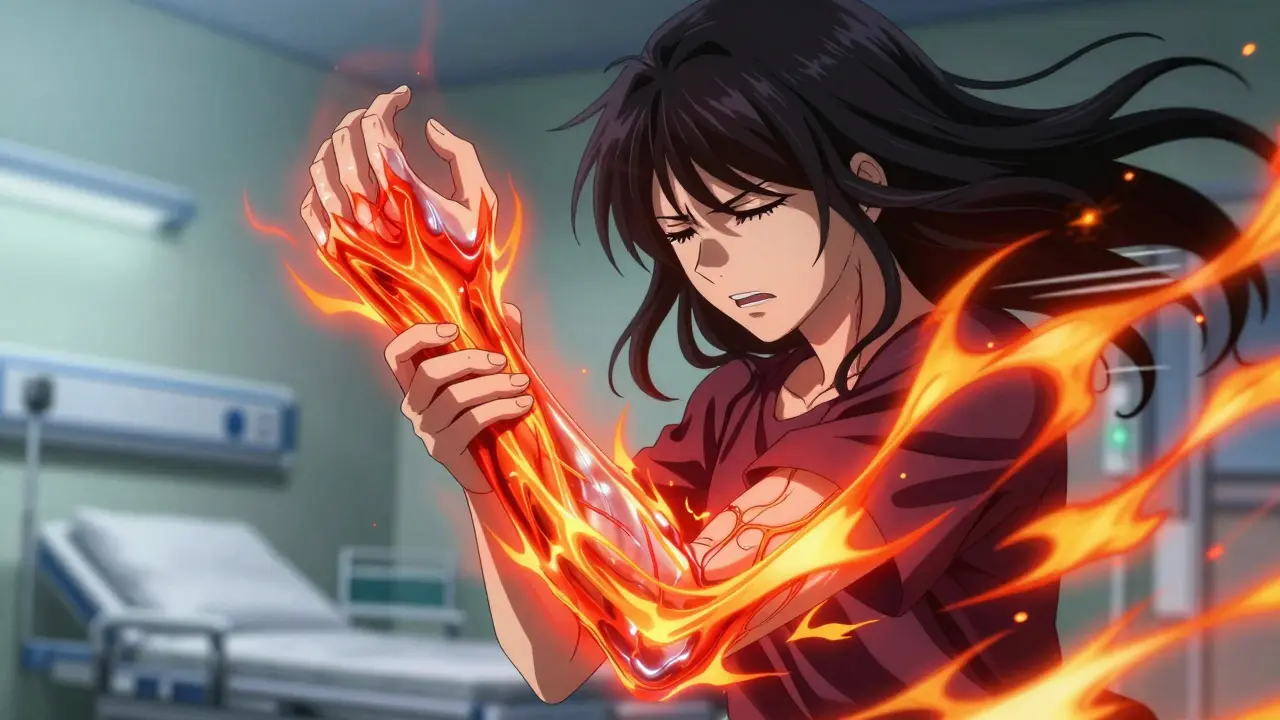
After a broken wrist, a sprained ankle, or even minor surgery, most people expect pain to fade over weeks. But for some, the pain doesn’t just stick around-it gets worse. It starts as a dull ache and turns into a constant, searing burning pain that feels like glass under the skin. Even the lightest touch, a breeze, or a change in room temperature can send shockwaves through the limb. This isn’t normal healing. This is Complex Regional Pain Syndrome, or CRPS.
What Exactly Is CRPS?
CRPS is a neurological condition where the nervous system goes haywire after an injury. It’s not just pain. It’s pain that’s out of proportion to what happened. A simple fracture, a cut, or even a needle stick can trigger it. The pain doesn’t match the damage. It’s like your nerves are stuck on maximum volume, screaming even when there’s no real threat.
There are two types. Type I (about 90% of cases) happens without a clear nerve cut. Type II means a specific nerve was damaged. Both cause the same symptoms. It usually hits arms or legs, but it can spread. The pain is deep, constant, and often described as burning, stabbing, or electric. Many people say it feels like their limb is on fire from the inside.
Why Does It Happen?
No one knows exactly why some people get CRPS and others don’t. Even with the same injury, one person recovers, another spirals into chronic pain. But researchers have identified key players:
- Inflammation: In the early weeks, chemicals flood the injured area, making nerves hypersensitive. This isn’t just swelling-it’s nerve irritation.
- Nerve damage: Tiny sensory and autonomic nerve fibers get damaged. These are the ones that control pain signals, temperature, and sweat. When they’re hurt, they misfire.
- Sympathetic nervous system: This part of your nervous system handles fight-or-flight responses. In CRPS, it gets stuck in overdrive, amplifying pain signals instead of calming them.
- Brain changes: Over time, the brain starts rewiring itself to expect pain. It becomes more sensitive to any signal from the limb-even harmless ones.
Some studies suggest an autoimmune component. In about 30% of patients, the immune system mistakenly attacks nerve tissue, keeping inflammation alive long after the injury heals. This might explain why some cases get worse instead of better.
What Does It Feel Like?
CRPS doesn’t just hurt. It changes your body. Here’s what most people experience:
- Burning or throbbing pain: The signature symptom. It’s deep, constant, and often worse at night.
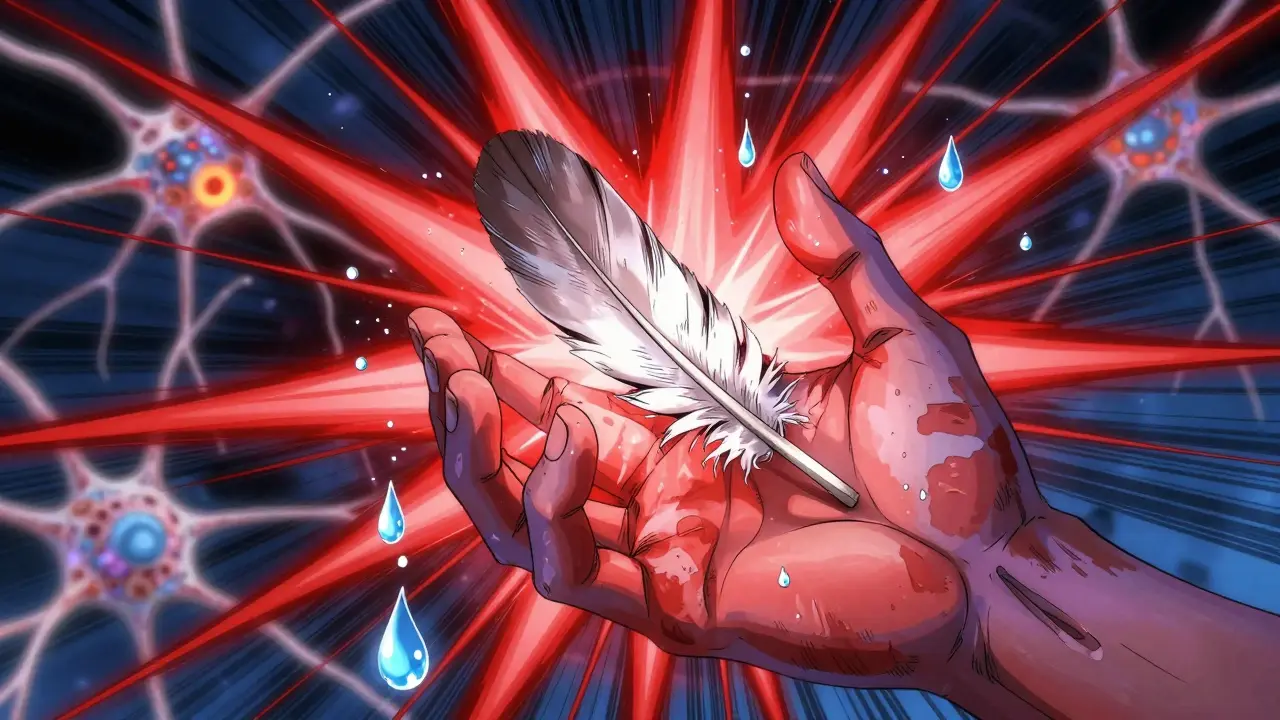
- Extreme sensitivity: Light brushing, a shirt sleeve, or even a fan blowing on your skin can cause sharp pain. This is called allodynia.
- Temperature changes: The affected limb might feel hotter or colder than the other. A difference of just 0.5°C to 1.5°C is common early on.
- Skin changes: Skin can turn blotchy, purple, red, or pale. It gets shiny, thin, and tight. Hair and nails may grow faster-or stop growing.
- Swelling and stiffness: Joints get stiff. Muscles spasm. You lose fine motor control-buttoning a shirt, typing, or holding a cup becomes hard.
- Tremors or spasms: Uncontrollable shaking or sudden muscle contractions can happen without warning.
These symptoms don’t always show up together. Some people have burning pain but no swelling. Others have stiff joints but mild pain. That’s why it’s often missed.
Who Gets CRPS?
It’s not random. Certain patterns show up:
- Gender: Women get CRPS about three times more often than men. Why? Hormones, immune differences, or pain perception may play a role-but no one knows for sure.
- Age: Most cases happen between 40 and 60. But teens and older adults can get it too.
- Trigger injuries: Fractures cause about 40% of cases. Wrist fractures are the most common. Surgery (like carpal tunnel repair), sprains, cuts, or even heart attacks can trigger it.
- Timing: Symptoms usually appear 4 to 6 weeks after the injury. But they can start in days-or months later.
Even weirder: some people get CRPS without any obvious injury. No trauma, no surgery, no accident. Just pain. That’s why doctors now say CRPS isn’t always triggered by injury-it can arise on its own.
How Is It Diagnosed?
There’s no blood test. No X-ray. No MRI that shows CRPS. Diagnosis is based on the Budapest Criteria, a set of clinical signs doctors look for:
- Pain that’s ongoing and disproportionate to any initial injury.
- Symptoms in at least two of these categories: sensory (like allodynia), vasomotor (temperature changes), sudomotor (sweating changes), or motor/trophic (weakness, hair/nail changes).
- At least one sign in two or more categories during examination.
- No other diagnosis explains the symptoms.
Early diagnosis is critical. If you wait too long, the nervous system locks into pain mode. The longer CRPS goes untreated, the harder it is to reverse.
Can It Go Away?
Some people recover fully-especially if treated early. Studies show that if you start treatment within the first 3 months, your chances of full recovery jump dramatically. But if it’s ignored for over a year, the pain often becomes permanent.
Many cases do improve on their own. But waiting for that to happen is risky. Without treatment, you risk permanent joint stiffness, muscle wasting, and emotional toll. Depression, anxiety, and sleep loss are common. The pain doesn’t just live in your limb-it lives in your life.
What Treatments Actually Work?
Treatment isn’t one-size-fits-all. It’s layered. The goal is to calm the nervous system, reduce inflammation, and retrain the brain.
- Physical therapy: This is the #1 first step. Gentle movement, stretching, and graded exposure to touch help your brain unlearn pain. Avoiding movement makes it worse.
- Medications: NSAIDs help in early stages. Corticosteroids reduce inflammation. Gabapentin or pregabalin calm overactive nerves. Antidepressants like amitriptyline can help with pain and sleep.
- Nerve blocks: Injecting numbing medicine near the sympathetic nerves can reset the system. If it works, it’s a sign CRPS is driven by nerve overactivity.
- Spinal cord stimulation: A small device sends mild electrical pulses to block pain signals. It’s for people who haven’t responded to other treatments.
- Psychological support: Chronic pain rewires your brain. Cognitive behavioral therapy (CBT) helps you manage fear, anxiety, and the emotional weight of living with constant pain.
Some newer treatments are being tested: ketamine infusions, immunotherapy, and advanced neuromodulation. These aren’t standard yet, but they’re showing promise in clinical trials.
What Doesn’t Work
Many people try things that sound logical-but backfire:
- Resting too much: Avoiding movement leads to stiffness and muscle loss. It tells your brain the limb is dangerous.
- Heavy painkillers: Opioids don’t work well for nerve pain. They carry addiction risks without fixing the root cause.
- Ignoring emotional health: Pain and stress feed each other. Therapy isn’t optional-it’s part of healing.
CRPS is not a mental illness. But ignoring your mental health makes it worse.
What to Do If You Suspect CRPS
If you had an injury and now have:
- Pain that’s burning and way worse than expected
- Skin changes, swelling, or temperature differences
- Sensitivity to touch or temperature
- Loss of movement or strength
Don’t wait. Go to a pain specialist or neurologist. Ask: “Could this be CRPS?” Bring a list of your symptoms and when they started. Early action makes all the difference.
Is CRPS the same as neuropathy?
No. Neuropathy usually means nerve damage from diabetes, chemotherapy, or other causes. CRPS is a specific condition triggered by trauma, where the nervous system becomes hyperactive. It includes inflammation, temperature changes, and skin changes-not just numbness or tingling.
Can CRPS spread to other body parts?
Yes. In about 70% of cases, the pain spreads to nearby areas-like from the wrist to the shoulder, or from the ankle to the knee. In rare cases, it can spread to the opposite limb. This is called mirror-image CRPS.
Why do some people get CRPS and others don’t?
We don’t know for sure. Genetics, immune response, stress levels, and even past trauma may play a role. But no single factor explains it. Two people with identical fractures can have completely different outcomes.
Does CRPS show up on MRI or X-ray?
Not directly. But advanced imaging can show bone changes (like osteoporosis) or swelling in later stages. These are signs of long-term CRPS, not proof of the condition itself. Diagnosis is still clinical.
Can stress make CRPS worse?
Absolutely. Stress triggers your nervous system to release chemicals that amplify pain signals. Anxiety, lack of sleep, or emotional trauma can turn a manageable flare into a full-blown crisis. Managing stress isn’t optional-it’s part of treatment.
Is there a cure for CRPS?
There’s no guaranteed cure, but many people recover fully-especially with early, aggressive treatment. The goal isn’t just pain relief-it’s restoring normal nerve function. With the right approach, most people regain movement, reduce pain, and return to daily life.
Chris Beckman
March 4, 2026 AT 20:11So let me get this straight-someone breaks their wrist, and suddenly their arm feels like it’s dipped in molten lava? Sounds like the body’s overreacting. I’ve had a sprained ankle and all I got was a week of limping. No burning, no weird skin changes. Maybe people with CRPS just have wimpy nerves? Or maybe they’re not doing enough physical therapy? I mean, come on.
Richard Elric5111
March 6, 2026 AT 01:08One is compelled to observe, with a degree of scholarly gravity, that the pathophysiology of Complex Regional Pain Syndrome represents not merely a neurological aberration, but a profound ontological rupture in the subject’s phenomenological experience of corporeal integrity. The body, once a vessel of agency, becomes an alien terrain-a landscape of involuntary torment wherein the nervous system, in its pathological hyperactivity, transmutes innocuous stimuli into metaphysical anguish. One must ask: is this pain a symptom-or a revelation?
Betsy Silverman
March 6, 2026 AT 12:17I’ve known a few people with CRPS. One was my sister-in-law-got it after a tiny cut during surgery. She went from walking fine to not being able to wear socks. It’s terrifying how fast it can spiral. What struck me most wasn’t the pain, but how isolated she felt. Doctors kept saying it was "all in her head." Like she was faking because it didn’t show up on a scan. The real tragedy isn’t the syndrome-it’s how little people understand it.
Ivan Viktor
March 8, 2026 AT 09:43So you’re telling me if I stub my toe real hard, I might end up with a limb that feels like it’s been deep-fried? Cool. Next thing you know, people are suing their coffee machines for triggering CRPS. Just don’t move. Don’t breathe. Don’t exist. That’s the real cure.
Zacharia Reda
March 10, 2026 AT 07:38Physical therapy is the unsung hero here. People think rest helps, but no-it’s like telling a broken radio to sit quietly until the static goes away. Movement isn’t punishment-it’s reprogramming. I’ve seen people go from crying at a breeze to hiking again. It’s slow, it’s brutal, but it works. Don’t give up. And for god’s sake, don’t let anyone tell you it’s "just psychological." It’s neurological-and that’s worth fighting for.
Jeff Card
March 11, 2026 AT 08:40I had a friend with CRPS after a car accident. She said the worst part wasn’t the pain-it was the silence. No one talks about this. You go to the ER with a broken arm, get a cast, and everyone says, "You’ll be fine in six weeks." But six weeks later, you’re screaming because your shirt feels like sandpaper. No one believes you. No one sees it. I wish more people knew how invisible this is. It’s not just nerve damage. It’s loneliness with a burning sensation.
Matt Alexander
March 12, 2026 AT 01:36CRPS is like your nerves got stuck on fire alarm mode. You don’t need a huge injury-just a little one-and boom, your body thinks it’s still in danger. The key is to move, even if it hurts. Don’t hide the arm. Don’t avoid touch. Your brain needs to learn it’s safe again. Medications help a little, but movement? That’s the real fix. And yeah, therapy matters too. Pain messes with your head. You gotta fight it on all fronts.
Gretchen Rivas
March 12, 2026 AT 02:04Early treatment saves limbs. I’ve seen it. Don’t wait. Go to a pain specialist. Bring your symptom list. Ask for the Budapest Criteria. If they don’t know it, find someone who does. This isn’t a "wait and see" thing. It’s a race against time.
Stephen Vassilev
March 14, 2026 AT 01:13Have you considered that CRPS may be a manufactured condition? Pharmaceutical companies fund research to sell gabapentin and spinal stimulators. The real cause? Electromagnetic fields from 5G towers, combined with vaccine-induced autoimmunity. Look at the correlation: CRPS spikes after public health interventions. Coincidence? I think not. The system wants you dependent. Don’t be fooled. Seek out holistic practitioners who understand the body’s true energy flow.
Mike Dubes
March 14, 2026 AT 20:17Man, this post really hit home. I didn’t even know what CRPS was until my cousin got it after a bike crash. She’s been through everything-nerve blocks, PT, therapy, even ketamine. It’s not easy. But she’s getting better. The key? Don’t give up. And don’t listen to people who say "it’s all in your head." It’s real. And it’s treatable. You’re not broken. Your nerves are just confused. With time and the right help? They can learn again. Hang in there.
Deborah Dennis
March 15, 2026 AT 15:28Ugh. Another one of these "pseudoscientific pain narratives." People are just lazy. Stop moving. Stop trying. Then they cry about "burning pain." If you’d just do your stretches, you wouldn’t have this. I’ve seen so many people game the system. And now we’re paying for their "treatments" with taxpayer money. Wake up.