
When you fill a prescription for a generic drug, you might assume the price is the same everywhere. But if you’ve ever compared the cost of generic drugs in Canada and the U.S., you’ve probably been surprised. In Canada, you might pay $45 for a 90-day supply of atorvastatin. In the U.S., the same amount costs $12. Yet, Canada spends far less overall on prescription drugs. How does that work? The answer lies in two completely different systems - one built for stability, the other for competition.
Canada’s System: Centralized Control, Not Free Market
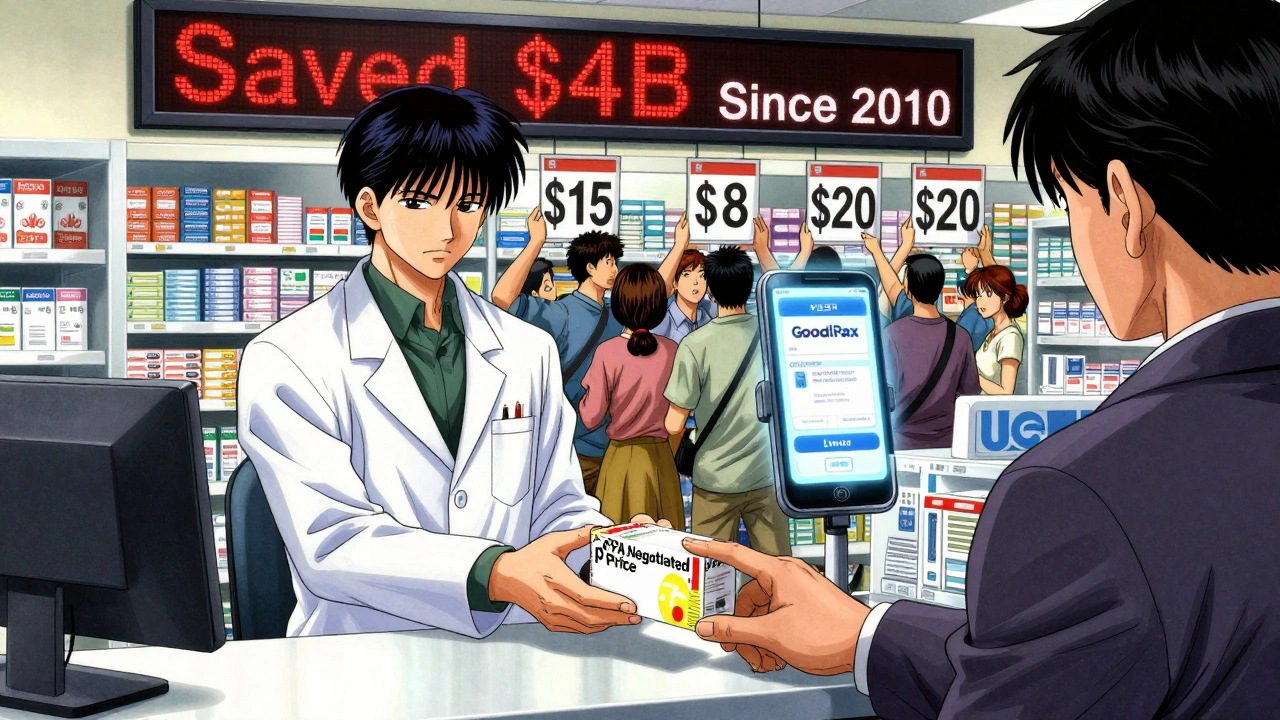
Canada doesn’t let drug prices float based on supply and demand. Instead, it uses a coordinated, government-backed approach called the pan-Canadian Pharmaceutical Alliance (pCPA). This group brings together all provincial and territorial drug plans to negotiate prices as one big buyer. Since 2010, this has saved over $4 billion for public drug programs. The goal isn’t just to cut costs - it’s to make sure medicines stay available, even when supplies get tight. The Patented Medicine Prices Review Board (PMPRB) controls prices for brand-name drugs, but it has no power over generics. That’s a key detail. Because branded drugs are capped, manufacturers shift focus to generics - where they can charge more. That’s one reason why some generic prices in Canada are higher than in the U.S. Generics in Canada are grouped into three pricing tiers based on how many companies make them. If only one company sells a drug, it gets a higher price. If five companies make it, the price drops. This system is designed to encourage competition, but Canada’s population is only about one-tenth the size of the U.S. So there are fewer manufacturers willing to enter the market. That limits competition - and keeps prices higher than they could be.The U.S. System: Chaos With Lower Prices
The U.S. has no federal price controls on generics. That means prices are set by the market. When a patent expires, dozens of companies jump in to make the same drug. The first one gets 180 days of exclusivity. After that, it’s a race to the bottom. Prices often drop 80-90% within six months. On average, there are 7.3 generic manufacturers for each drug in the U.S. In Canada, it’s 3.8. That’s why PharmacyChecker found U.S. generic prices are 68% lower on average. For 88% of the top prescribed generics, you’ll pay less in the U.S. - even after accounting for currency exchange. But there’s a catch. With no central coordination, prices vary wildly. You might pay $15 at CVS, $8 at Walmart, and $20 at a local pharmacy. That’s why 63% of U.S. consumers check three or more pharmacies before buying. GoodRx and other price-comparison tools exist because the system is fragmented.Why Are Some Canadian Generics More Expensive?
It seems backwards: a country with universal healthcare pays more for generics than a country without it. But the reason is structural. Because Canada caps brand-name drug prices, manufacturers have less incentive to innovate or negotiate lower prices for those drugs. So they focus on generics - where they can charge more. The Fraser Institute found that 33% of generics in Canada cost more than the same drug in the U.S. Seven specific generics were consistently pricier in Canada. That doesn’t mean Canada’s system is broken. It means it’s designed differently. Canada doesn’t try to win the lowest price on every drug. It tries to keep the whole system running smoothly. That includes making sure hospitals don’t run out of life-saving drugs.
Supply Shortages: Canada Wins by Being Proactive
One of the biggest differences isn’t price - it’s reliability. In 2022, albuterol inhalers vanished from U.S. pharmacies. Hospitals in Seattle went weeks without supply. Meanwhile, in Calgary, Health Canada stepped in. They worked with manufacturers to prioritize Canadian needs, and hospitals got what they needed. Canada has a formal system to track and prevent shortages. Health Canada monitors production, flags risks, and coordinates with companies to keep supply flowing. In the U.S., the FDA reacts after shortages happen. That’s why the risk of a shortage is 2.5 times higher for sole-source drugs in the U.S. than in Canada. Generic drugs make up over 90% of all shortages in both countries. But in Canada, even when a drug is made by only one company, the system has backup plans. Private labeling - where a pharmacy brand can sell a generic made by another manufacturer - helps fill gaps. The U.S. doesn’t have that flexibility.Who Pays? Public vs. Private Insurance
In both countries, about half of prescriptions are paid for by public insurance and half by private plans. But the structure is different. In Canada, 67% of people have some form of private drug coverage. That’s higher than the U.S., where it’s 54%. But Canada’s public plans are the ones doing the heavy lifting on price negotiations. Private insurers in Canada often follow the pCPA’s prices - they don’t have the leverage to negotiate better deals on their own. In the U.S., private insurers are the main drivers of pricing. They negotiate directly with pharmacy benefit managers (PBMs). That creates a tangled web of rebates, discounts, and hidden fees. The final price you pay at the counter often has little to do with what the insurer actually paid.
Genesis Rubi
December 2, 2025 AT 02:07Doug Hawk
December 2, 2025 AT 21:07John Morrow
December 3, 2025 AT 10:44Kristen Yates
December 3, 2025 AT 18:33Fern Marder
December 5, 2025 AT 04:09Carolyn Woodard
December 6, 2025 AT 14:42Saket Modi
December 8, 2025 AT 00:25Chris Wallace
December 8, 2025 AT 11:29william tao
December 9, 2025 AT 04:39Sheryl Lynn
December 10, 2025 AT 21:20Paul Santos
December 10, 2025 AT 22:53Eddy Kimani
December 11, 2025 AT 19:37Chelsea Moore
December 13, 2025 AT 02:11John Biesecker
December 13, 2025 AT 11:03