
Staring at screens all day is normal now. You’re checking emails before breakfast, scrolling during lunch, and binge-watching shows before bed. But your eyes? They’re tired. Dry. Burning. And you’re not sure if it’s just fatigue-or something worse. The truth? Blue light from screens isn’t the villain everyone says it is, but it’s not harmless either. What actually matters are your habits, your environment, and how you use your devices.
What Exactly Is Blue Light?
Blue light isn’t just from your phone or laptop. It’s part of natural sunlight, and your body needs it during the day to stay alert and regulate sleep. The problem isn’t blue light itself-it’s when and how much you’re exposed to it. The harmful range is between 415 and 455 nanometers. That’s the short-wavelength, high-energy part that can reach your retina. Studies show this specific range can trigger oxidative stress in eye cells, especially after long, uninterrupted exposure.
But here’s the twist: the blue light from your screen is nowhere near as intense as sunlight. A sunny day gives you about 50,000 lux of light. Your phone? Maybe 300 lux. So if you’re worried about permanent eye damage from scrolling, the science doesn’t back that up. The American Academy of Ophthalmology says there’s no proof blue light from screens causes macular degeneration or cataracts. So why do your eyes hurt so much?
Why Your Eyes Feel So Bad After Screen Time
It’s not the blue light. It’s what you’re doing while looking at screens.
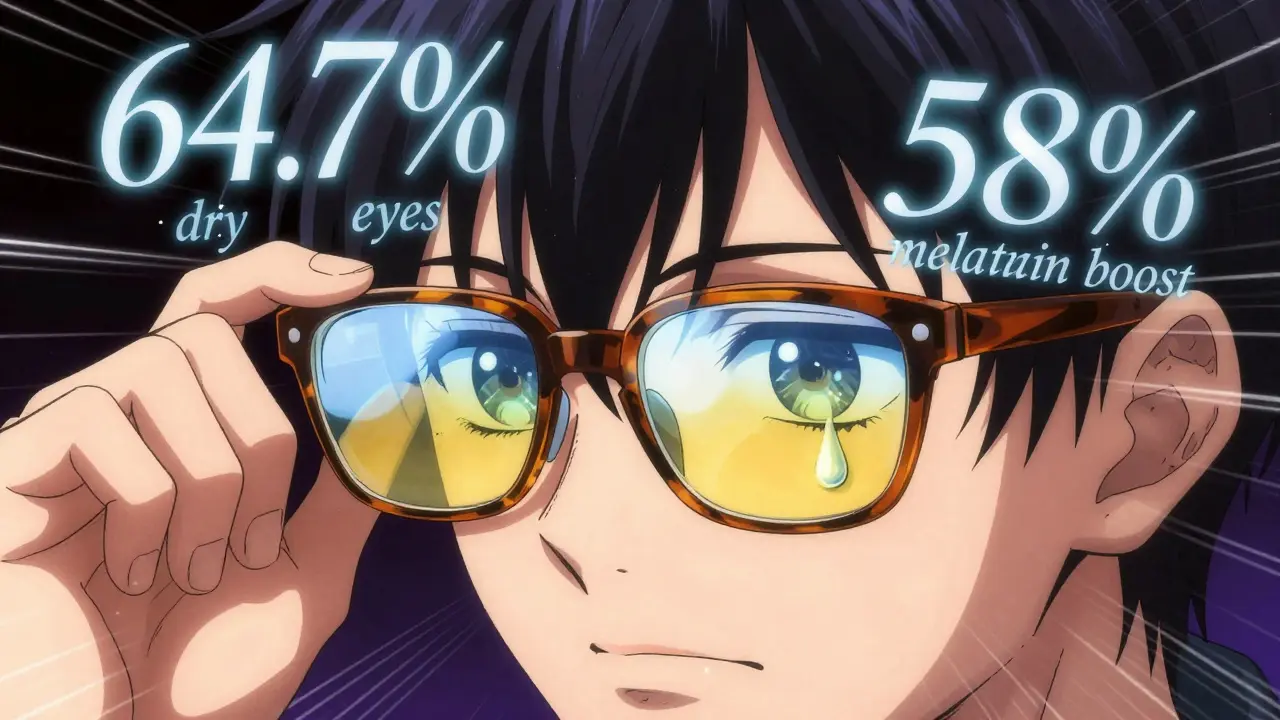
When you focus on a digital display, you blink about 60% less than normal. That means your eyes dry out faster. You’re also staring at a fixed distance for hours-your eyes are constantly strained to keep the text sharp. This is called digital eye strain, or computer vision syndrome. Symptoms? Dry eyes (64.7% of users), blurred vision (52.1%), headaches, and watery eyes (28.3%).
And then there’s sleep. Blue light at night suppresses melatonin, the hormone that tells your body it’s time to rest. Harvard research found that 6.5 hours of blue-rich light at night delayed melatonin release by over 100 minutes-longer than green or red light. That’s why scrolling in bed makes it harder to fall asleep, even if you feel tired.
Do Blue Light Glasses Work?
The market is flooded with them. Clear lenses claiming to block 20% of blue light. Amber-tinted glasses promising total relief. But do they actually help?
Let’s break it down.
Amber-tinted glasses block 65-100% of blue light. They’re effective at reducing melatonin suppression-great for nighttime use. But they make everything look yellow. For designers, photographers, or anyone who needs accurate color, they’re useless. One user on DPReview said: "It ruins my ability to judge skin tones." That’s not a small issue-it’s a dealbreaker for professionals.
Clear blue-light filtering lenses? They block only 10-25%. Independent testing by Consumer Reports found some brands claiming 20% reduction were actually blocking just 12%. And they don’t improve dry eyes or visual fatigue any better than regular lenses.
Here’s the reality: if you’re wearing blue light glasses during the day to relieve eye strain, you’re probably not getting much benefit. The main reason people report feeling better? The placebo effect-or because they’re finally taking breaks.
Screen Filters: Hardware vs. Software
There are two kinds of blue light filters: hardware (screen protectors, monitor settings) and software (Night Shift, f.lux, Windows Night Light).
Software filters reduce blue light by 10-20%. They’re free, easy to turn on, and don’t distort color much. But they miss the most harmful wavelengths (415-455 nm). The International Commission on Illumination calls this the "peak hazard" range. Most software filters don’t touch it.
Hardware filters-like screen protectors or built-in OLED adjustments-are better. Newer OLED displays from Samsung and Apple now reduce blue light emission by 30-40% at the source, without changing color. Apple’s iOS 17.4 introduced adaptive color temperature that adjusts based on ambient light. Testing showed it cut melatonin suppression by 37% compared to older Night Shift.
But here’s the catch: if you turn on night mode on your phone but leave your laptop on bright, you’re defeating the purpose. Inconsistent use is the #1 reason these tools fail.
The Real Solution: Habits Over Gadgets
Forget buying another pair of glasses or a screen filter. The most powerful tool you have is your behavior.
The 20-20-20 rule: Every 20 minutes, look at something 20 feet away for 20 seconds. Sounds simple? It works. A 2021 study in Optometry and Vision Science found this single habit reduced eye strain by 53.7%. People on Reddit who followed it reported less fatigue and better sleep.
Adjust your brightness: Your screen should match the room. Too bright? Your eyes work harder. Too dim? You squint. Aim for 300-500 lux in your workspace. Use a free light meter app on your phone to check.
Keep distance: Sit at least 20-30 inches from your screen. That’s about an arm’s length. Being too close increases accommodative demand by 3.7 diopters-your eyes are constantly straining to focus.
Use night mode, but start early: Turn on blue light reduction two hours before bed. University of Toronto research showed this boosts melatonin by 58%. Don’t wait until you’re already in bed.
Hydrate your eyes: Use artificial tears if they feel dry. Blink consciously. A 2022 study found no difference in dry eye symptoms between people who wore blue light glasses and those who didn’t-but those who blinked more often had significantly less discomfort.
What About Supplements?
There’s new research on lutein and zeaxanthin-nutrients found in leafy greens and eggs. They naturally collect in the macula, acting like internal sunglasses. A 2024 study in Nature Communications showed that taking 10mg lutein and 2mg zeaxanthin daily increased macular pigment density by 0.12. That’s equivalent to wearing 25% blue light-blocking lenses-without the yellow tint.
It’s not a magic fix, but if you’re already eating a healthy diet, adding these supplements might help. Talk to your doctor first.
What’s Next? The Future of Blue Light Protection
Manufacturers are moving away from aftermarket filters. New OLED and microLED screens are being designed to emit less blue light from the start. Samsung’s 2025 roadmap includes filters that reduce 415-455 nm light by 50% with less than 2% color shift. Quantum dot lenses are in testing-capable of blocking 45% of harmful blue light without distorting colors.
Meanwhile, the FDA cleared the first medical device in 2023 (Lumineyes) that delivers white light therapy with almost no blue light, helping reset circadian rhythms. This isn’t for everyday screen use-it’s for people with severe sleep disorders.
And here’s the kicker: sales of non-prescription blue light glasses are expected to drop 18% annually from 2025 to 2028. Why? Because the solution is being built into the screens you already own.
Final Take: What You Should Do Today
You don’t need expensive glasses or fancy filters. You need three things:
- Follow the 20-20-20 rule religiously. Set a timer if you have to.
- Turn on night mode on all your devices two hours before bed-and keep it on.
- Make sure your workspace lighting matches your screen brightness. No glare. No staring into a spotlight.
If you’re still having trouble sleeping or your eyes feel constantly dry, see an optometrist. You might have an underlying issue like dry eye syndrome or uncorrected vision-things blue light glasses won’t fix.
Blue light isn’t your enemy. Poor habits are. Fix those, and your eyes will thank you-no glasses required.
Do blue light glasses really protect your eyes from damage?
No, there’s no scientific evidence that blue light from screens causes permanent eye damage like macular degeneration or cataracts. The American Academy of Ophthalmology states blue light glasses are not necessary for eye health. What they can help with is reducing digital eye strain and improving sleep if worn at night-but only because they reduce blue light exposure before bed, not because they prevent retinal damage.
Is blue light at night really that bad for sleep?
Yes. Blue light in the evening suppresses melatonin more than any other color of light. Harvard studies show 6.5 hours of blue-rich light can delay melatonin release by over 100 minutes and shift your internal clock by 3 hours. That’s why scrolling before bed makes it harder to fall asleep-even if you’re exhausted. Using night mode two hours before bed can increase melatonin production by 58%.
What’s better: software filters or blue light glasses?
For sleep, software filters like Night Shift or f.lux are better for most people-they’re free, easy to use, and don’t distort color. Amber glasses block more blue light but make everything look yellow, which can interfere with work and social situations. If you’re using screens at night, turn on night mode. If you’re using them during the day, glasses won’t help eye strain. The real fix is taking breaks.
Can I fix digital eye strain without buying anything?
Absolutely. The 20-20-20 rule alone reduces eye strain by over 50%. Adjust your screen brightness to match your room. Sit at least 20 inches away. Blink more often. Use artificial tears if your eyes feel dry. None of this costs money. Most people who feel better after buying blue light glasses were actually benefiting from the breaks they started taking after buying them.
Are children more at risk from blue light?
Children’s eyes transmit more blue light to the retina than adults’, and their screen time is often longer. The French health agency ANSES warns about potential long-term retinal risks for kids under 3 exposed to more than 100 lux of blue light daily. For older children, the bigger concern is sleep disruption and eye strain from prolonged screen use. Limit screen time before bed, encourage outdoor play (natural light helps regulate circadian rhythms), and use night mode on all devices.
Do I need to wear blue light glasses if I work from home?
Not unless you’re using screens late at night. If you’re working during the day, blue light glasses won’t reduce eye strain any more than taking regular breaks will. The best advice for remote workers: follow the 20-20-20 rule, position your screen at arm’s length, use proper lighting, and take real lunch breaks away from the screen. That’s far more effective-and cheaper-than buying glasses.
ellen adamina
January 16, 2026 AT 07:39Finally, someone says it plainly: it’s not the blue light, it’s that we forget to blink. I used to blame my glasses until I started setting a timer for 20-20-20. My eyes haven’t felt this good in years.
Nat Young
January 16, 2026 AT 19:25Let’s be real-blue light is a distraction manufactured by tech companies to sell you overpriced glasses while they keep designing screens that glow like radioactive toast. The real issue? Corporate greed wrapped in pseudoscience. You think Apple cares about your retinas? They care about your wallet.
Nicholas Urmaza
January 18, 2026 AT 10:02If you’re still buying blue light glasses you’re wasting money and time. The 20-20-20 rule is free. Blinking is free. Turning off your screen two hours before bed is free. Stop looking for gadgets and start looking at your habits. Your eyes will thank you.
Niki Van den Bossche
January 19, 2026 AT 20:38Oh, so now we’re just supposed to accept that our digital lives are slowly frying our retinas like a cheap toaster? The irony is delicious: we’re told to optimize every aspect of our existence-sleep, diet, productivity-yet the very tools designed to elevate us are the ones poisoning our biology. And who profits? The same corporations that sell you the ‘fixes’ while ignoring the root cause. It’s not just eye strain-it’s a systemic betrayal of human physiology.
And don’t get me started on ‘night mode’-a feeble attempt to appease our guilt while the OLED panels still emit that insidious 415–455 nm rage. We’re being manipulated into believing we can outsmart evolution with software patches.
Meanwhile, children in urban apartments stare at tablets for 10 hours a day while their parents scroll through TikTok. The future is not just myopic-it’s spiritually hollowed out.
Frank Geurts
January 20, 2026 AT 17:59As a certified optometrist with over two decades of clinical experience, I must emphasize: the literature is unequivocal. There is no causal link between screen-derived blue light and retinal degeneration. The American Academy of Ophthalmology, the World Health Organization, and the International Commission on Illumination all concur. The discomfort reported by users is entirely attributable to reduced blink rate, accommodative fatigue, and poor ergonomics. Blue light glasses are, at best, a placebo with aesthetic consequences.
Moreover, the marketing of amber-tinted lenses as therapeutic devices constitutes a form of medical misinformation. Consumers are being exploited by companies that capitalize on fear, not science.
Jami Reynolds
January 21, 2026 AT 08:53Did you know the FDA cleared Lumineyes in 2023? That’s not a coincidence. The government knows what’s happening. They’ve known for years. Screen manufacturers are quietly redesigning their panels to reduce blue emission-but they won’t tell you. Why? Because if you knew the truth, you’d stop buying new devices. They want you dependent. They want you buying glasses. They want you believing you need fixes instead of changing your behavior.
Nishant Garg
January 22, 2026 AT 20:48Coming from India, where 80% of kids under 12 have smartphones and schools use tablets for 6+ hours a day, I can tell you-this isn’t a luxury concern. It’s a public health crisis. My niece couldn’t focus in class until we enforced 20-20-20 and banned screens after 8 PM. She’s 9. Her eyes are still developing. The real villains aren’t the screens-they’re the parents who think ‘it’s just a tablet’ and the schools that treat tech as a magic solution.
Supplements like lutein? Sure, they help. But nothing beats sunlight. We used to play outside till dusk. Now kids stare at screens till midnight. No amount of software filters can replace the rhythm of nature.
Sohan Jindal
January 23, 2026 AT 03:36Blue light is a socialist plot to make us weak. Real Americans used to work 12-hour days with no breaks and still had perfect vision. Now we need special glasses and apps to look at our phones? Weak. This whole thing is a distraction from real problems like inflation and border security. Turn off the screen. Get outside. Stop complaining.
Amy Ehinger
January 24, 2026 AT 15:10I used to be the person who bought every blue light product on Amazon. Lenses. Filters. Apps. Even those weird blue-blocking socks. Then I just started taking walks after dinner. No phone. Just me, the sky, and the birds. My eyes stopped burning. I slept better. And I didn’t spend $200. Sometimes the answer isn’t more tech-it’s less.
Mike Berrange
January 25, 2026 AT 01:21Interesting how the author dismisses blue light glasses but doesn’t mention that many people with photophobia or migraines *do* benefit from them. It’s not about preventing macular degeneration-it’s about managing neurological sensitivity. One size doesn’t fit all. To say they’re useless is just as reductive as saying they’re a miracle cure.
Dan Mack
January 25, 2026 AT 15:24They’re lying. The real reason blue light is dangerous? It’s not just the retina-it’s the pineal gland. The government knows this. That’s why they’re pushing ‘adaptive color temperature’-so they can control your circadian rhythm remotely. You think Apple cares about your sleep? They care about your data. And your sleep patterns are the most valuable thing you give them.
Diane Hendriks
January 26, 2026 AT 23:09Let me be perfectly clear: the notion that blue light from screens is harmless is a dangerous oversimplification. While it’s true that sunlight delivers vastly higher intensities, the cumulative, low-dose, 12-hour daily exposure-especially during critical developmental years-is biologically novel. Evolution did not prepare us for 24/7 retinal bombardment by artificial spectra. The absence of proof of permanent damage is not proof of absence of harm. We are conducting a global, uncontrolled experiment on human ocular physiology, and we are calling it ‘normal.’ That is not science. That is negligence.
And while the 20-20-20 rule is commendable, it assumes perfect compliance. What about shift workers? What about students cramming for exams? What about the elderly with dry eye syndrome? Habit-based solutions are noble, but they are not equitable. We need systemic design changes-not individual discipline.
Supplements like lutein? They’re a band-aid. The real solution is regulatory. Mandate manufacturers to reduce peak emission wavelengths. Require manufacturers to disclose spectral output. Fund independent testing. Stop letting corporations self-regulate a public health issue.
And yes-I still wear blue light glasses at night. Not because I fear blindness. But because I refuse to be a lab rat in someone else’s profit-driven experiment.
Iona Jane
January 28, 2026 AT 10:54They’re watching you. Every blink. Every scroll. Every time you turn on night mode. Your eyes are the new surveillance tool. The screens know when you’re tired. When you’re sad. When you’re lying awake. They’re not just stealing your attention-they’re stealing your sleep cycles. And soon, they’ll adjust your screen brightness based on your pupil dilation. You think that’s science fiction? It’s already in beta.
Amy Vickberg
January 29, 2026 AT 10:29This is the most balanced take I’ve read on this topic. Thank you for cutting through the noise. I’ve been telling my coworkers for years that blue light glasses are a scam-and they all laughed until they started using the 20-20-20 rule. Now they’re the ones asking me how to set reminders. Change starts small.
Ayush Pareek
January 30, 2026 AT 08:07As someone who teaches digital wellness to high schoolers in rural India, I’ve seen the shift firsthand. Kids used to play cricket after school. Now they’re glued to phones for hours. We introduced a ‘no-screen hour’ before bedtime-and within weeks, attendance improved, focus in class rose, and even the teachers reported fewer headaches. Simple changes. No gadgets. Just human habits returning to rhythm. It’s not about fear. It’s about returning to balance.