
Baseline CK Calculator
This tool calculates your expected creatine kinase (CK) baseline range based on your demographics. Knowing your individual baseline helps doctors distinguish between normal CK variations and actual statin-related muscle damage.
Your Expected CK Range
Clinical Action Thresholds
- CK < 3x ULN: No action needed without symptoms
- CK 3-10x ULN: Pause statin with muscle pain
- CK > 10x ULN: Medical emergency - stop statin immediately
Important: Recent exercise, injections, or medications can falsely elevate CK. Always inform your doctor about recent activities before testing.
When you start a statin, your doctor might order a blood test for creatine kinase (CK). But do you really need it? For most people, the answer is no. But for some, skipping this test could mean missing a red flag-or wrongly blaming the statin for symptoms that have nothing to do with it.
Why CK Matters with Statins
Creatine kinase (CK) is an enzyme found in your muscles. When muscle cells get damaged, CK leaks into the bloodstream. High levels can signal something serious like rhabdomyolysis, a rare but dangerous condition where muscle tissue breaks down and can damage your kidneys. Statins can cause muscle problems, but they’re usually mild-just soreness or fatigue. Only about 0.1% of people on statins develop severe muscle injury. Still, that small risk is why doctors look at CK when symptoms show up.Here’s the catch: many healthy people naturally have high CK levels. Athletes, people who do heavy lifting, or even those who had a recent injection or intense workout can have CK values way above the lab’s ‘normal’ range. That’s why a single number from a reference chart doesn’t tell the whole story. What matters is your baseline.
When Baseline CK Testing Makes Sense
The big guidelines-like those from the American College of Cardiology and the European Society of Cardiology-don’t recommend routine CK testing for everyone starting a statin. But they do agree on who should get tested before starting:- People over 75
- Those with kidney problems (eGFR below 60)
- Patients taking statins with other drugs like fibrates or amiodarone
- Anyone with hypothyroidism
- People who’ve had muscle symptoms from statins before
- Those on high-intensity statins like atorvastatin 40-80 mg or rosuvastatin 20-40 mg
Why these groups? Because their risk of muscle damage is higher. For example, combining a statin with a fibrate increases the chance of rhabdomyolysis by up to 15 times. And if you already have reduced kidney function, your body clears statins slower, raising the chance of buildup and toxicity.
One study found that 18.3% of adults over 65 have kidney function below the safe threshold for many statins. If you’re in that group and you start a statin without knowing your baseline CK, you might not realize your muscle pain is from your kidneys-not the drug-until it’s too late.
What the Numbers Mean
CK levels vary by sex, age, ethnicity, and activity. Normal ranges aren’t the same for everyone:- Men: 145-195 U/L
- Women: 65-110 U/L
- African Americans: Often 50-100% higher than average
But here’s the thing-25-30% of healthy people have CK levels above the lab’s ‘normal’ range just because of lifestyle or genetics. That’s why a baseline test is so important. If your CK was 400 U/L before you started the statin, and it’s now 450 U/L, that’s not a problem. But if your baseline was 120 U/L and now it’s 800 U/L, that’s a red flag.
Doctors use these thresholds to decide what to do:
- CK under 3x upper limit of normal (ULN) with no symptoms? Keep taking the statin.
- CK 3-10x ULN with muscle pain? Pause the statin, check thyroid and kidney function, and retest in a week.
- CK over 10x ULN? Stop the statin immediately. This is a medical emergency.
Many people panic when they hear their CK is ‘elevated.’ But without knowing what it was before, you can’t tell if it’s the statin-or just your body being normal.

What Baseline CK Doesn’t Do
Baseline CK testing won’t prevent muscle problems. It won’t stop you from getting sore. And it won’t predict who will develop symptoms. The 2016 Cochrane Review looked at 17 trials with nearly 48,000 people and found no difference in myopathy rates between those who got baseline CK tests and those who didn’t.That’s why many experts, including Dr. John Kastelein from the European Atherosclerosis Society, argue that routine baseline testing creates more anxiety than benefit. It leads to unnecessary follow-ups, extra blood draws, and sometimes even stopping a life-saving drug because of a number that doesn’t mean what people think it does.
And it’s expensive. In Canada alone, baseline CK testing for statin starters costs about $14.7 million a year. But only 1.2% of abnormal results actually change how the drug is managed. That’s a lot of money for very little impact.
Real-World Value: Avoiding Unnecessary Discontinuation
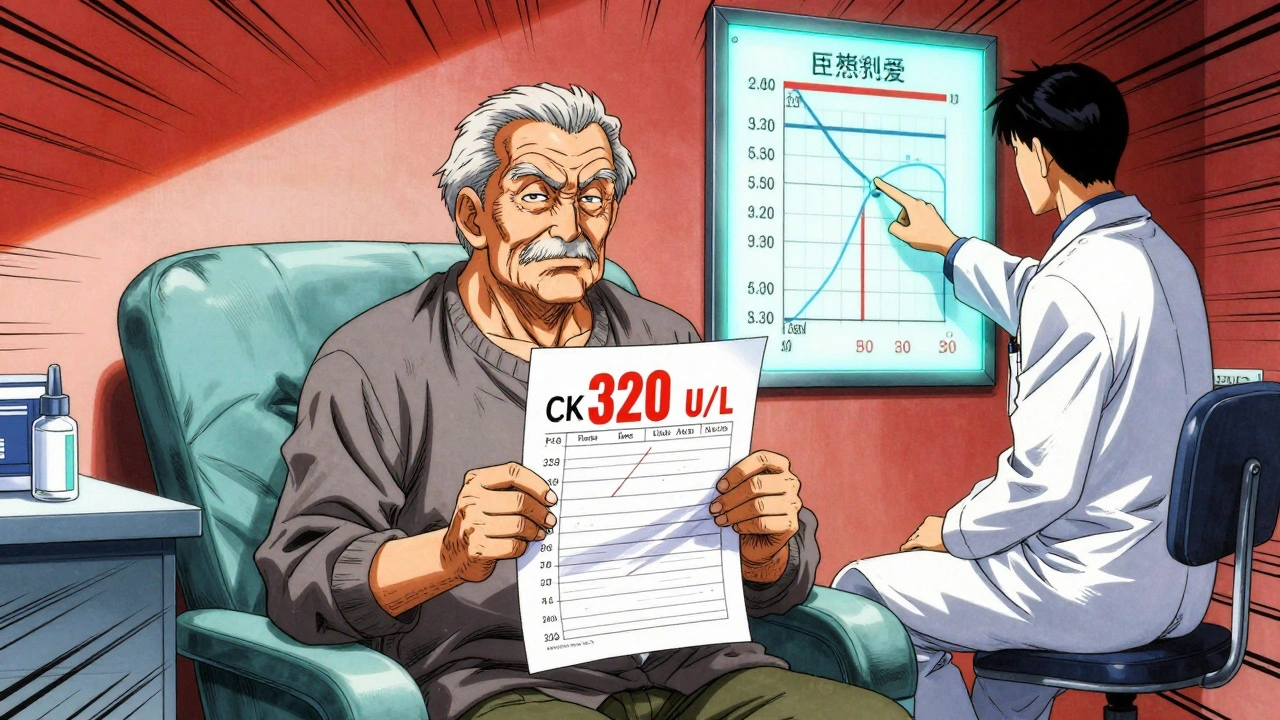
The real power of baseline CK isn’t in preventing problems-it’s in preventing the wrong decisions. When patients report muscle pain, doctors often assume it’s the statin. But studies show that 78% of the time, the pain isn’t caused by the drug at all.Take a 68-year-old woman with arthritis and mild fatigue. She starts atorvastatin. Two weeks later, her knees ache. She blames the statin. Her doctor, without a baseline, might stop the drug. But if they had her baseline CK at 320 U/L (high for her sex, but normal for her), and now it’s 340 U/L, they know it’s not the statin. It’s her arthritis flaring up. She keeps the statin-and keeps her heart protected.
A 2023 registry of over 84,000 statin users found that clinics that routinely checked baseline CK had 22% fewer unnecessary statin discontinuations. That’s huge. Stopping a statin in someone with heart disease increases their risk of heart attack or stroke. And each avoided discontinuation saves an estimated $2,850 in follow-up care and lost protection.

What to Do Before the Test
If you’re getting a baseline CK test, don’t just show up. You need to prepare:- Avoid intense exercise for 48 hours before the test. Even a long hike or heavy lifting can spike CK.
- Don’t get any intramuscular injections (like vaccines or steroids) in the week before.
- Tell your doctor about any supplements, painkillers, or other meds you’re taking.
- Make sure the lab records your exact CK number-not just ‘normal’ or ‘abnormal.’
Why? Because 68% of CK variability comes from things like recent activity, injections, or medications-not the statin. If your doctor doesn’t know you ran a 10K two days before the test, they might think the statin is the culprit. That’s a misdiagnosis waiting to happen.
The Future: Genetic Tests and Point-of-Care Tools
There’s a new player on the field: genetic testing. About 12% of Europeans have a gene variant called SLCO1B1 that makes them much more likely to get muscle problems from simvastatin. If you’re on simvastatin and have this variant, your risk goes up 4.5 times. Genetic testing could eventually replace CK monitoring for some people.But it’s not widely used yet. And it doesn’t help if you’re on atorvastatin or rosuvastatin. So for now, CK remains the most practical tool.
Even better? Point-of-care CK devices are in late-stage trials. These are like glucose meters for muscle enzymes-you get a result in minutes during your doctor’s visit. In 2023, only 63.7% of patients got baseline CK testing because labs take days. With instant results, that number could jump to nearly 100%. That means fewer mistakes, fewer unnecessary stops, and better care.
Bottom Line: Who Needs It, Who Doesn’t
You don’t need a baseline CK test if you’re:- Under 75
- Have healthy kidneys
- Take a low or moderate statin dose
- Have no history of muscle issues
- Don’t take interacting drugs like fibrates or amiodarone
But if any of those boxes are checked? Get the test. It’s not about fear. It’s about context.
Statins save lives. Muscle side effects are rare. But when they happen, knowing your starting point can mean the difference between keeping a life-saving drug-and losing it over a number that didn’t mean what you thought it did.
Stephanie Bodde
December 4, 2025 AT 20:37My dad started a statin last year and his CK was sky-high-turned out he’d been doing home workouts with dumbbells every morning 😅 Docs didn’t even ask about his routine. Baseline test would’ve saved us 3 months of panic. So glad this got shared!
Philip Kristy Wijaya
December 5, 2025 AT 05:43Let me be clear this is a classic pharmaceutical industry ploy to sell more tests and create artificial anxiety among patients who are perfectly fine the way they are
Jennifer Patrician
December 6, 2025 AT 23:27Baselines are a scam. The labs are in bed with Big Pharma. They want you to think your CK is dangerous so they can sell you more meds and more tests. My cousin’s doctor told him his CK was high but he never told him his own baseline. That’s not medicine that’s manipulation
Mellissa Landrum
December 7, 2025 AT 15:45they dont want you to know but the truth is the labs make money off every test they do and if you dont get a baseline then youll keep getting tested forever because theyll say your numbers are 'elevated' and its always your fault not theirs
Mark Curry
December 9, 2025 AT 01:34It’s funny how we treat numbers like they’re truth when they’re just snapshots. My CK was 380 last year and I didn’t even lift weights. Maybe the 'normal' range is just a social construct. We need to stop treating biology like a spreadsheet.
an mo
December 9, 2025 AT 10:48Statistical noise disguised as clinical insight. The Cochrane review explicitly states no mortality benefit from baseline CK testing. The 22% reduction in discontinuation is a statistical artifact of selection bias. You’re optimizing for administrative convenience not patient outcomes. This is algorithmic medicine at its worst.
aditya dixit
December 10, 2025 AT 20:35I’ve seen this in India too. Many elders start statins and get scared when CK is high. But they never knew their baseline. One patient had CK of 600 because he was a daily gardener. Stopped statin. Got heart attack two months later. Baseline would’ve saved him. Simple truth.
Lynette Myles
December 11, 2025 AT 15:41They’re lying about the cost. The real cost is the heart attacks they prevent by not stopping statins.
Annie Grajewski
December 12, 2025 AT 01:17Oh so now we’re doing baseline CK tests because apparently your body’s natural CK levels are a secret code only doctors can decode? I’m sure the lab techs are just dying to explain why 450 is 'fine' for me but 'dangerous' for my 70-year-old neighbor. Wake up people.
Jimmy Jude
December 13, 2025 AT 16:22My aunt had a stroke because they stopped her statin over a CK number. She cried for weeks. I cried harder. This isn’t science. This is fear. And someone’s making money off it. I’m not just mad. I’m devastated.
Mark Ziegenbein
December 15, 2025 AT 03:12It’s astonishing how the medical establishment continues to prioritize arbitrary thresholds over individualized physiology. The very notion that a single enzyme concentration can be used to dictate therapeutic continuity reveals a profound epistemological failure in contemporary clinical reasoning. We’ve reduced human biology to a binary algorithm and now we wonder why patients feel alienated
Rupa DasGupta
December 16, 2025 AT 02:54Wait so you're telling me my brother who runs marathons and has CK at 800 is 'fine' but my cousin who sits at a desk and has CK at 150 is 'at risk'? That's not science that's nonsense. And now we're gonna pay for tests so doctors can feel better about themselves? No thanks
ashlie perry
December 16, 2025 AT 02:59they dont want you to know but the real reason they dont test everyone is because then youd realize most people dont need statins at all
Juliet Morgan
December 16, 2025 AT 09:46My mom’s CK was 410 before her statin. Now it’s 425. She’s fine. No pain. No issues. But if they hadn’t tested her baseline, she’d have been told to quit the statin and she’d have had a heart attack. Thank you for this. I’m sharing it with my whole family.