

Most people think of melanoma when they hear "skin cancer." But the truth is, basal cell carcinoma and squamous cell carcinoma are far more common - and they’re both types of nonmelanoma skin cancer. Together, they make up about 95% of all nonmelanoma cases. In the U.S. alone, more than 5.4 million of these cancers are diagnosed each year. The good news? Almost all of them are curable if caught early. The bad news? Many people ignore them until it’s too late.
What Exactly Are Basal and Squamous Cell Carcinomas?
Your skin has layers. The outermost layer, called the epidermis, is made up of flat, scale-like cells called squamous cells on top, and round, basal cells at the bottom. Basal cell carcinoma starts in those bottom cells. Squamous cell carcinoma starts in the top layer. Both are caused by long-term damage from the sun’s UV rays - not just sunburns, but years of everyday exposure.
Basal cell carcinoma is the most common cancer in humans. About 8 out of 10 skin cancers are BCC. Squamous cell carcinoma is less common but more dangerous. It’s about 10 times more likely to spread than BCC if left untreated. That’s why knowing the difference matters.
How Do They Look Different?
It’s not always easy to tell them apart just by looking, but there are clear patterns.
Basal cell carcinoma often shows up as:
- A shiny, pearly bump - the most common look (70% of cases)
- An open sore that won’t heal, even after weeks
- A scar-like patch that’s flat, white, or yellow
These usually appear on the face, ears, neck, or scalp - places you get the most sun. They grow slowly, sometimes taking months or even years to get noticeably bigger. They rarely hurt. That’s part of the problem - people think, "It’s just a pimple," or "It’ll go away on its own."
Squamous cell carcinoma tends to look like:
- A firm, red bump that feels rough or scaly
- A wart-like growth that crusts or bleeds
- A flat, reddish patch that grows slowly and may itch or hurt
- An open sore that doesn’t heal and may crust over
SCC can appear on the same sun-exposed areas as BCC, but it’s also more likely to show up on the lips, ears, hands, and genitals. It grows faster - sometimes doubling in size in just 4 to 6 weeks. And unlike BCC, it can feel tender or painful.
Why Does SCC Feel More Serious?
Here’s the key difference: metastasis. That’s when cancer spreads to other parts of the body.
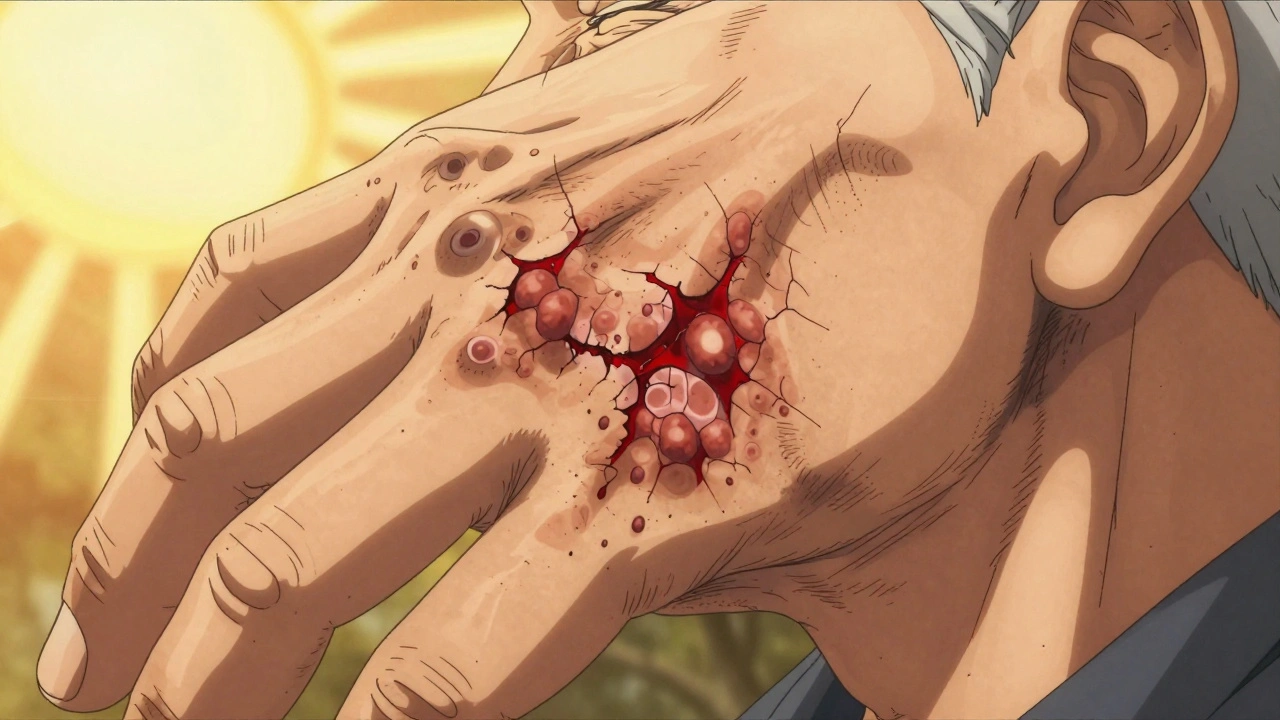
Basal cell carcinoma almost never spreads. Less than 0.1% of cases become metastatic. Even when it’s large or neglected for years, it usually just eats away at nearby skin and tissue. It can destroy your nose, ear, or eyelid if ignored - but it won’t reach your lungs or liver.
Squamous cell carcinoma is different. About 2% to 5% of cases spread, and that number jumps to 14% if it’s on the lip or ear. Once SCC spreads, the 5-year survival rate drops from 95% to just 25-45%. That’s why doctors treat it more aggressively. If you have SCC on your ear, your doctor will likely recommend wider surgical margins and possibly radiation - even if the tumor looks small.
Experts say it clearly: BCC is common. SCC is dangerous. You can’t afford to ignore either, but SCC needs faster action.
Who’s Most at Risk?
Both cancers hit people over 50 hardest. Eighty-five percent of cases are diagnosed after age 50. The average age for BCC is 67. For SCC, it’s 69.
People with fair skin, light hair, and blue or green eyes are at highest risk. But it’s not just about skin tone. It’s about sun exposure - and how you’ve had it.
Basal cell carcinoma is often linked to intense, occasional sunburns - like a weekend at the beach when you were young. Squamous cell carcinoma is tied to years of daily sun exposure - the kind you get from working outside, driving with the window down, or not wearing sunscreen every day.
Men are more likely to get SCC than women - about 65% of cases are male. That’s likely because men historically spent more time outdoors in jobs like construction, farming, or fishing. BCC affects men and women more evenly.
And if you’ve had an organ transplant? Your risk of SCC jumps 250 times higher than average. That’s because immunosuppressant drugs stop your body from fighting off early cancer cells.
Treatment: What to Expect
Both cancers are highly treatable when caught early. Cure rates are over 95% for small, localized cases.
For small BCCs, doctors often use topical creams like imiquimod or 5-fluorouracil. These work in about 60-70% of cases. For SCC, those same creams only clear about 40-50% of lesions - so they’re not the first choice.
Surgery is the gold standard. Mohs surgery - where layers of skin are removed and checked under a microscope during the procedure - has a 99% cure rate for BCC and 97% for SCC. It’s especially useful on the face because it removes the least amount of healthy tissue.
But here’s the catch: SCC often needs bigger cuts. For high-risk SCC (larger than 2 cm, deeper than 2 mm, or on the ear/lip), surgeons remove wider margins - up to 10 mm. For BCC, 3-5 mm is usually enough. That means more stitches, more scarring, and sometimes more reconstructive surgery.
SCC patients also need more follow-ups. On average, they return for 2.3 times more checkups than BCC patients. Recurrence is more common: 15% of SCC cases come back in immunocompromised people, compared to just 5% for BCC.
What’s New in Treatment?
There’s real progress. In 2018, the FDA approved cemiplimab (Libtayo), the first immunotherapy drug for advanced SCC. It works by helping your immune system recognize and kill cancer cells. In metastatic cases, it shrinks tumors in nearly half of patients - a huge leap from the 20% response rate of old chemotherapy.
For BCC, there’s vismodegib, a pill that blocks a pathway these tumors rely on. It’s used for advanced cases where surgery isn’t possible. No equivalent drug exists yet for SCC.
And AI is stepping in. New tools using machine learning can now analyze skin images with 94% accuracy in telling BCC from SCC - faster and sometimes more reliably than the human eye.
Prevention: The Only Real Shield
Here’s the hard truth: both cancers are preventable. Sunscreen isn’t optional. It’s essential.
Daily use of SPF 30+ reduces your risk of BCC by 40% and SCC by 50%. Why the difference? Because SCC is more tied to long-term, cumulative exposure. Every minute in the sun adds up.
Wear a hat. Seek shade between 10 a.m. and 4 p.m. Don’t skip your ears, neck, and lips. Use lip balm with SPF. Wear UV-blocking sunglasses.
If you’ve had one skin cancer, your risk of another goes up. That’s why high-risk patients - fair skin, history of skin cancer, organ transplant recipients - should get a full-body skin check every 3 to 6 months.
What Should You Do If You Notice Something New?
Don’t wait. Don’t hope it goes away. Don’t Google it for a week.
If you see:
- A spot that doesn’t heal in 4 weeks
- A bump that bleeds easily or crusts over
- A red, scaly patch that grows or itches
- A sore that looks like a scar but wasn’t caused by injury
See a dermatologist. No referral needed. Just book an appointment. Most clinics can do a biopsy in minutes - and you’ll know within a week if it’s cancer.
Early detection saves you from bigger surgeries, less scarring, and a lower chance of spread. It’s not about fear. It’s about smart action.
Final Thoughts
Basal cell carcinoma is the most common cancer on Earth - but it’s also the least dangerous. Squamous cell carcinoma is less common, but it’s the one that can kill you if ignored. Both are caused by the same thing: too much sun. Both are curable if caught early. The difference isn’t just in how they look - it’s in how urgently you act.
Protect your skin. Check your skin. Get suspicious spots checked out. Your future self will thank you.
Is basal cell carcinoma dangerous?
Basal cell carcinoma is rarely dangerous in the sense that it almost never spreads to other parts of the body. But if left untreated, it can grow deep into skin, bone, or cartilage - especially on the face - causing serious disfigurement. It’s not life-threatening, but it can be locally destructive.
Can squamous cell carcinoma spread?
Yes, squamous cell carcinoma can spread - and that’s what makes it more serious than basal cell carcinoma. While most cases are caught early and cured, 2-5% of SCCs metastasize, especially if located on the lips, ears, or genitals. Once it spreads, treatment becomes much harder and survival rates drop significantly.
Which is more common: BCC or SCC?
Basal cell carcinoma is far more common, making up about 80% of all nonmelanoma skin cancers. Squamous cell carcinoma accounts for roughly 20%. So while you’re 4 times more likely to get BCC, SCC is the one that requires more urgent attention due to its potential to spread.
Can you get skin cancer without sun exposure?
While UV exposure is the main cause of both BCC and SCC, a small percentage of cases occur in areas not exposed to the sun. These are often linked to radiation exposure, chemical exposure, or genetic conditions. But over 90% of nonmelanoma skin cancers are caused by sun damage.
How often should I check my skin?
Everyone should do a self-check once a month. Look for new spots, changes in existing moles, or sores that don’t heal. If you’ve had skin cancer before, are over 50, have fair skin, or spend a lot of time outdoors, you should see a dermatologist every 6 to 12 months for a professional exam.
Does sunscreen prevent both types of skin cancer?
Yes, daily sunscreen use reduces your risk of basal cell carcinoma by about 40% and squamous cell carcinoma by about 50%. SCC is more strongly tied to long-term, cumulative sun exposure, so sunscreen has a bigger impact on preventing it. But sunscreen helps protect against both.
Francine Phillips
December 3, 2025 AT 01:50Just saw a weird bump on my ear last week. Thought it was a pimple. Now I’m freaked out.
Makenzie Keely
December 4, 2025 AT 17:07Thank you for this. As a dermatology nurse, I see people ignore these spots for YEARS-then show up with a 3cm lesion on their nose. Early detection isn’t just smart-it’s life-saving. And yes, sunscreen isn’t optional. It’s your skin’s seatbelt.
Also-lip balm with SPF? Non-negotiable. I’ve seen so many SCCs on the lower lip from decades of ‘I don’t need sunscreen on my lips’ nonsense.
bobby chandra
December 5, 2025 AT 16:15Let’s be real-sunscreen is the only real superpower we’ve got. I used to think ‘I’m tan, not burnt, I’m fine.’ Then I got my first BCC at 42. Now I wear SPF 50 every. single. day. Even when it’s cloudy. Even when I’m in the car. Even when I’m just walking the dog.
And if you think you’re too dark to get skin cancer? Nope. It doesn’t care. It just wants UV exposure. You’re not immune. You’re just lucky so far.
vinoth kumar
December 6, 2025 AT 02:52My uncle had SCC on his ear. They had to remove half of it and do skin grafting. He’s fine now-but he doesn’t go outside without a hat and sunscreen. I’m copying him. No more beach days without protection.
Also, AI skin check apps? I tried one. It flagged a mole I thought was a freckle. Turned out to be early BCC. Saved me a lot of pain.
Katherine Gianelli
December 6, 2025 AT 05:06You know what’s wild? The fact that SCC is way more aggressive but way less talked about. Everyone’s scared of melanoma-but honestly? If you’re over 50 and spend any time outside, you’re way more likely to get BCC or SCC.
And if you’re a guy who works construction, drives a truck, or has a lawn? You’re basically a walking UV target. Please. Just. Wear. A. Hat.
I started giving my dad a hard time about his bald scalp and no sunscreen. He laughed-until he got a BCC on his forehead. Now he wears a baseball cap indoors. Progress!
Gene Linetsky
December 6, 2025 AT 06:52They’re lying about the 95% cure rate. It’s all about who you are. If you’re rich, you get Mohs surgery. If you’re poor, you get a biopsy and a referral that takes six months. Then it’s too late. The system doesn’t care if your cancer is ‘curable’-it only cares if you can pay for it.
And don’t get me started on how Big Pharma pushes expensive immunotherapies while ignoring prevention. Sunscreen costs $5. Cemiplimab costs $150,000. Coincidence? I think not.
Ignacio Pacheco
December 7, 2025 AT 02:48So let me get this straight: BCC is like that one friend who’s always late but never steals your stuff… and SCC is the one who shows up, smiles, then burns down your house?
Also-why does no one talk about how much SCC hurts? I had one on my knuckle. Felt like a burn that never cooled down. Took months to heal. And the biopsy? Like someone dropped a hot nail on my skin. No thanks.
Jim Schultz
December 8, 2025 AT 04:45Wow. Just… wow. You wrote a textbook. But let’s be honest-most people won’t read past the first paragraph. They’ll scroll past this like it’s a sponsored post. The real tragedy? The people who need this info the most-the 65-year-old construction worker with 40 years of sun exposure-are the ones who think ‘skin cancer’ means ‘melanoma’ and ‘I don’t have moles, so I’m fine.’
Also, why is there no public health campaign for this? No celebrities. No ads. No PSA on TV. It’s like the medical community is embarrassed to talk about ‘common’ cancer. But it’s not embarrassing-it’s preventable. And we’re failing people.
Kidar Saleh
December 8, 2025 AT 10:56I’m from the UK and we get less sun-but we still get it. And we’re terrible about protection. My mum got SCC on her nose after 50 years of gardening. She thought it was eczema. Took her three years to see a doctor. They had to reconstruct half her nose. She still won’t wear a hat.
My advice? If you’re over 40, do a monthly skin check. Use a mirror. Check your scalp. Your back. Your ears. Your feet. And if something looks off? Go. Don’t wait. Don’t rationalize. Your skin remembers every sunburn.
Chloe Madison
December 10, 2025 AT 05:28As someone who’s had two BCCs and one SCC, I can confirm: prevention is the only true cure. I used to think I was ‘too careful’-now I’m the person who walks around with a parasol and a hat and SPF 70. My dermatologist calls me ‘the gold standard.’
And yes-sunscreen on your lips matters. I had a lesion on my lower lip that looked like a cold sore. It wasn’t. It was SCC. I thought it was dehydration. I was wrong.
If you’re reading this and you’re not wearing sunscreen daily-you’re playing Russian roulette with your skin. Stop.
Vincent Soldja
December 11, 2025 AT 19:58Article is accurate. But the cure rate statistics are misleading. They assume early detection. In reality, many patients present with advanced disease due to delayed care. The 95% figure applies only to a subset of the population with access to timely dermatology. Disparities exist and are not addressed here.
Myson Jones
December 11, 2025 AT 22:40I’m a transplant recipient. My SCC risk is 250x higher. I get checked every 3 months. I wear UPF 50 clothing. I use sunscreen like it’s oxygen. I’ve had three SCCs removed already. I’m alive because I listened. If you’re immunocompromised-this isn’t a suggestion. It’s your lifeline.
And if you think it’s not your problem? It is. Your meds are making you vulnerable. You owe it to your body to protect it.
Archie singh
December 13, 2025 AT 07:01Stop glorifying sunscreen. It’s a scam. The real cause of skin cancer is depleted ozone and government radiation experiments. Sunscreen blocks vitamin D-which weakens your immune system. You’re being manipulated. Go outside. Get natural sunlight. Your body knows how to heal. Trust it.